
Blog
7 Best Free Language Apps for Speaking Success
Discover the best free language app options for learning vocabulary, practicing speaking, getting feedback, and building a consistent daily study routine.

You're standing in a cafe abroad, you understand most of the menu, and then the server asks a simple follow up question. The words are somewhere in memory, but they don't arrive fast enough, so the conversation switches to English and the moment passes. That gap between knowing a language and using it with another person is where speaking practice matters most.
Learning becomes more rewarding when knowledge turns into connection. Ordering food, asking questions, sharing an idea, or understanding how someone sees the world all depend on producing language in real time. The best free language app for one learner builds foundations, while another learner needs listening, human exchange, active recall, or guided conversation.
This roundup compares seven free or freemium options by the job each one does best. Industry estimates place the worldwide language learning app market at approximately $6.34 billion in 2024, with projections reaching $24.39 billion by 2033, according to QuantumRun's language learning app market overview. Scale doesn't prove educational quality, though. Use the summaries below to match each tool to a current gap, then combine two or three into a routine that's small enough to repeat. Learners focused specifically on German can also compare approaches in the GCA guide to German language apps.
1. ChatPal
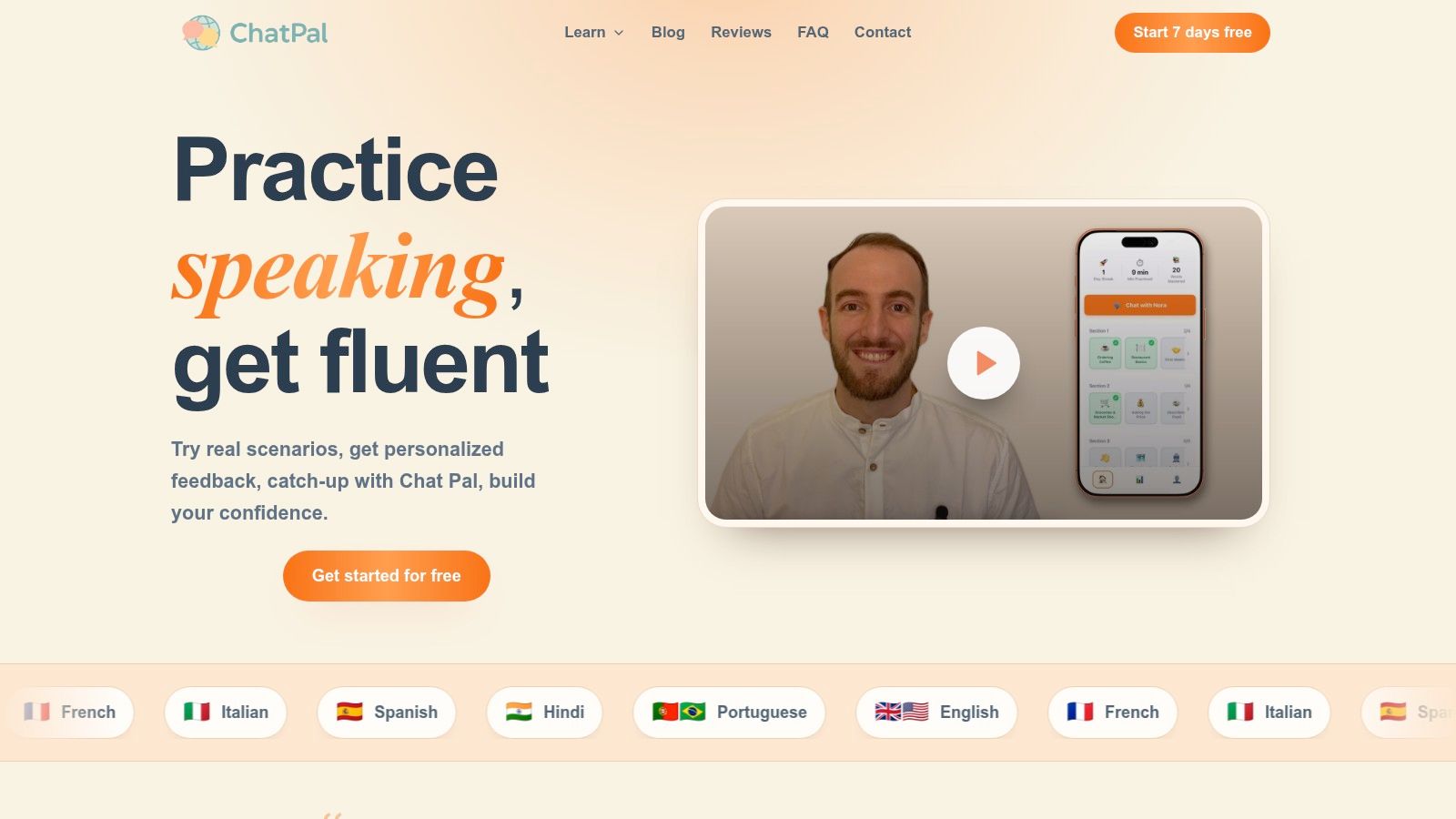
ChatPal fits learners who can read or understand more than they can say. Instead of tapping through silent drills, learners talk aloud with Nora, an AI conversation partner, in practical scenarios such as ordering food, making plans, and traveling, or in an open ended conversation. That voice first design makes it a strong candidate when the search for the best free language app really means finding regular speaking time without scheduling a tutor.
The structure is simple enough to repeat. Choose a scenario or topic, speak back and forth out loud, then review personalized feedback on grammar, pronunciation, vocabulary, and phrasing. The recap turns a casual chat into a study loop, because the next session can start by reusing a corrected sentence until it feels automatic.
Why the speaking loop matters
A meta analysis of 17 mobile assisted language learning studies found a large overall effect of d = 0.94, while the speaking effect was smaller at d = 0.46, p < .05, as reported in Cambridge's ReCALL review of mobile assisted language learning. Mobile access alone isn't enough. Short, frequent speaking sessions with immediate corrective feedback address the skill that improves more slowly through passive exposure.
- Practical scenarios: Practice ordering, planning, travel, and everyday small talk before those moments happen with a person.
- Post session feedback: Review grammar, pronunciation, and more natural phrasing while the conversation is still fresh.
- Low pressure repetition: Repeat the same situation until answers stop feeling rehearsed and start feeling usable.
- Multiple languages: Spanish, Italian, French, Portuguese, Hindi, English, German, and others are supported as the app expands.
Practical rule: Use one scenario three times across a week, and change one detail each time, such as the time, place, or person involved. Repetition builds speed, while variation builds flexibility.
Customer reviews on Trustpilot and the App Store praise the natural feeling conversations, useful corrections, and low pressure format. One reviewer reported more progress in a month than during two years of using Duolingo, a comparison explored further in the ChatPal versus Duolingo comparison. Adults returning to a language, travelers, and intermediate learners between classes will likely get the most from that format.
The trade off is clear. ChatPal offers a free 7 day trial, and continued access requires a subscription, with pricing not specified in the available information. Absolute beginners may need basic vocabulary first, and advanced learners may find the current beginner and intermediate focus less suited to their needs. Used alongside a structured course, though, it supplies the missing piece many learners never get, regular chances to speak and be corrected.
2. Duolingo
Duolingo works best as a daily starting point. Its game like, bite sized lessons cover reading, writing, listening, and some speaking, with placement options, progress tracking, and personalized review across iOS, Android, and web. For a beginner who hasn't built a study habit yet, that low friction entry is the main appeal.
The free tier includes courses in many languages, including Spanish, French, German, Italian, Portuguese, and Hindi, without a required subscription. Short lessons fit into a commute or a coffee break, and the broad catalogue makes it easy to sample a new language before committing to a longer course. Returning learners can also use placement to skip material that already feels familiar.
Where it helps and where it stops
- Habit building: Brief lessons and visible progress make daily practice easier to maintain.
- Foundations: Early vocabulary and sentence patterns give beginners something concrete to build on.
- Review: Personalized practice brings back material that needs another pass.
The limitations show up as goals become conversational. The free experience includes ads, and exercises can emphasize completing activities rather than sustaining open ended speech. Learners who want detailed explanations or extended conversation will usually need another resource alongside it.
A study of 85 university students using a mobile language app for 12 weeks found that 59% improved oral proficiency by at least one ACTFL sublevel, rising to 75% among learners who studied at least 15 hours, according to ScienceDaily's report on mobile app oral proficiency gains. Time on task matters, but recognition exercises don't automatically become spontaneous speech. Pair Duolingo foundations with a speaking tool, and review the Memrise versus Duolingo comparison when choosing between gamified lessons and vocabulary focused study.
A practical pattern is straightforward. Complete a short Duolingo session in the morning, write down three useful sentences, then say those sentences aloud in a different context later that day. That's how a strong starter app becomes part of a routine aimed at real conversation, rather than an end in itself.
3. Busuu
Busuu suits learners who want a clearer course path than a standalone chat or flashcard app provides. Expert designed, self paced lessons build practical skills in sequence, and courses include Spanish, French, Italian, Portuguese, German, and English. The progression feels closer to a structured curriculum, which helps learners who get lost when material arrives in random topics.
The community feature separates Busuu from purely self contained apps. Learners can submit writing and speaking exercises and receive corrections from other members, so personal output gets human attention. That feedback can reveal whether a sentence is merely understandable or natural, a distinction automated right or wrong marking often misses.
Free access in practice
Free membership provides essential course content and community feedback. Paid plans add offline study, more review tools, and AI speaking practice, so the free version works best as a structured foundation rather than a complete speaking program. Community feedback may also take longer for free users.
- Clear progression: Lessons follow an order that supports travel, work, and everyday communication goals.
- Community corrections: Written and spoken exercises can be checked by other learners and speakers.
- Practical focus: Course material aims at usable language instead of isolated word lists alone.
Research covering 18 experimental or quasi experimental studies and 932 foreign language learners identified instructional approach and intervention duration as significant moderators of speaking gains, as summarized in the ERIC record for the mobile speaking meta analysis. Busuu addresses the instructional sequence side of that equation. Learners still need enough duration and enough actual speaking to convert the sequence into fluency.
Use Busuu as the weekly backbone. Work through the course in order, submit one short written or spoken exercise for correction, then reuse the corrected version in conversation practice elsewhere. That combination gives structured input a spoken outlet, which keeps grammar study connected to communication with real people and real cultures.
4. Memrise
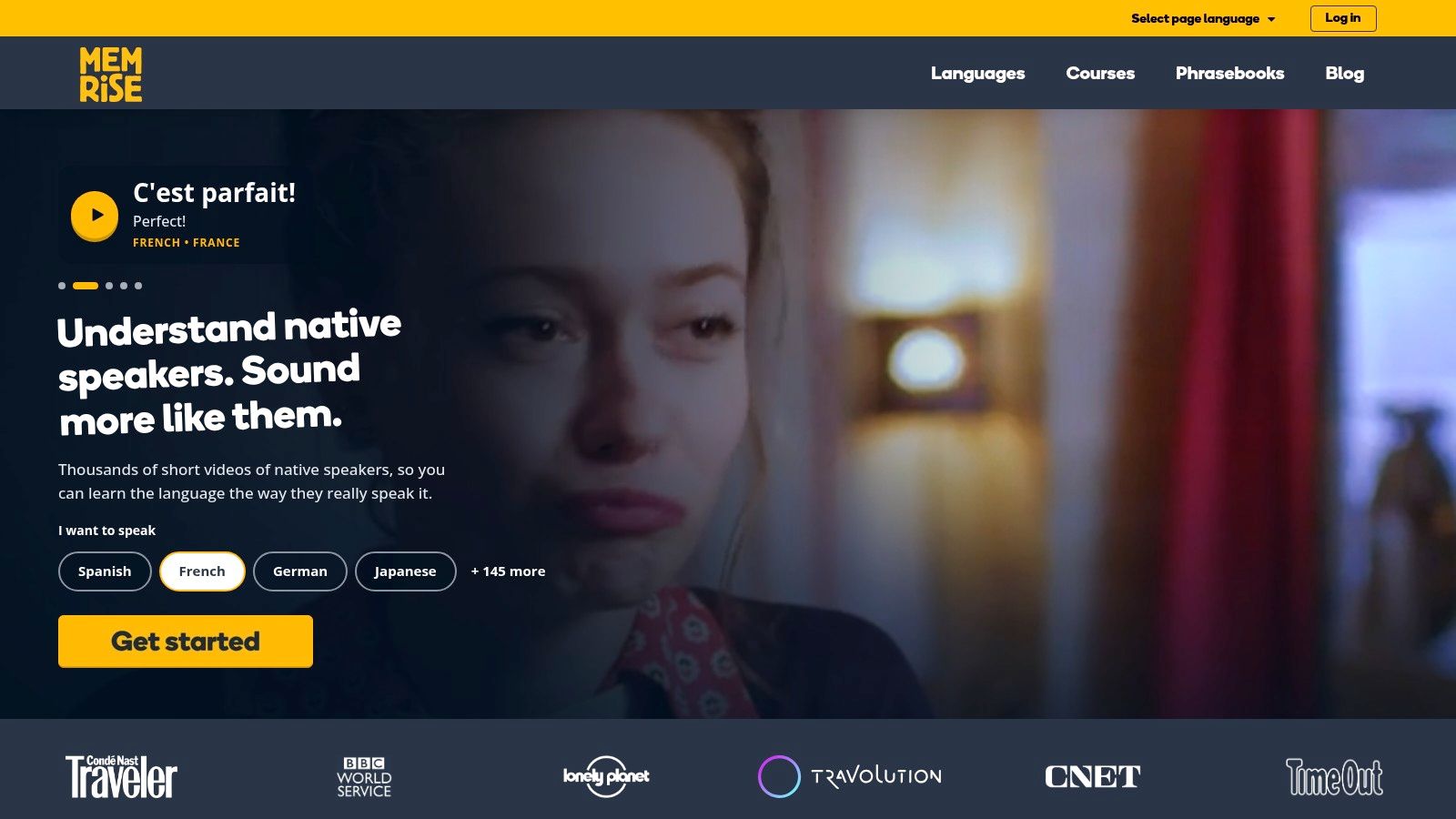
Memrise is the vocabulary and listening specialist in this group. Its continuing free plan includes official courses, video clips of phrases in everyday use, gamified tests, and personalized review that syncs across devices. Rather than a short trial, the free plan is ongoing, which makes it easy to keep as a long term companion app.
The video clips do important work. Hearing real speakers with different voices and accents trains the ear for how phrases sound outside a textbook recording. Topic based vocabulary, such as food, directions, or introductions, also maps neatly onto travel and everyday situations learners can picture themselves in.
Best way to use the free plan
- Learn phrases, not single words: Choose expressions tied to a situation coming up soon, such as a trip or a first meeting.
- Listen before reading: Play a clip, guess the meaning, then check the text to sharpen sound recognition.
- Review briefly and often: Let the personalized review plan resurface fading items in short sessions.
The limits are equally clear. Memrise focuses more on vocabulary and listening than on full conversational ability, and some features plus ad free use require Pro. Sustained grammar study and human conversation need support from another resource.
Language choice also deserves a closer look than most rankings give it. Recent global usage reporting noted that Japanese became the fourth most popular language studied worldwide in Duolingo's 2025 report, while Chinese, Korean, and Portuguese were among the fastest growing, a shift discussed in research on mobile assisted speaking pressure and performance. Depth and speech quality can vary by language, so test the specific course rather than trusting a general ranking.
Treat Memrise as the phrase bank. Learn five travel phrases there, then use them the same day in a spoken scenario or exchange. Vocabulary remembered in isolation fades, while vocabulary used to greet, ask, and respond starts to belong to the learner.
5. HelloTalk
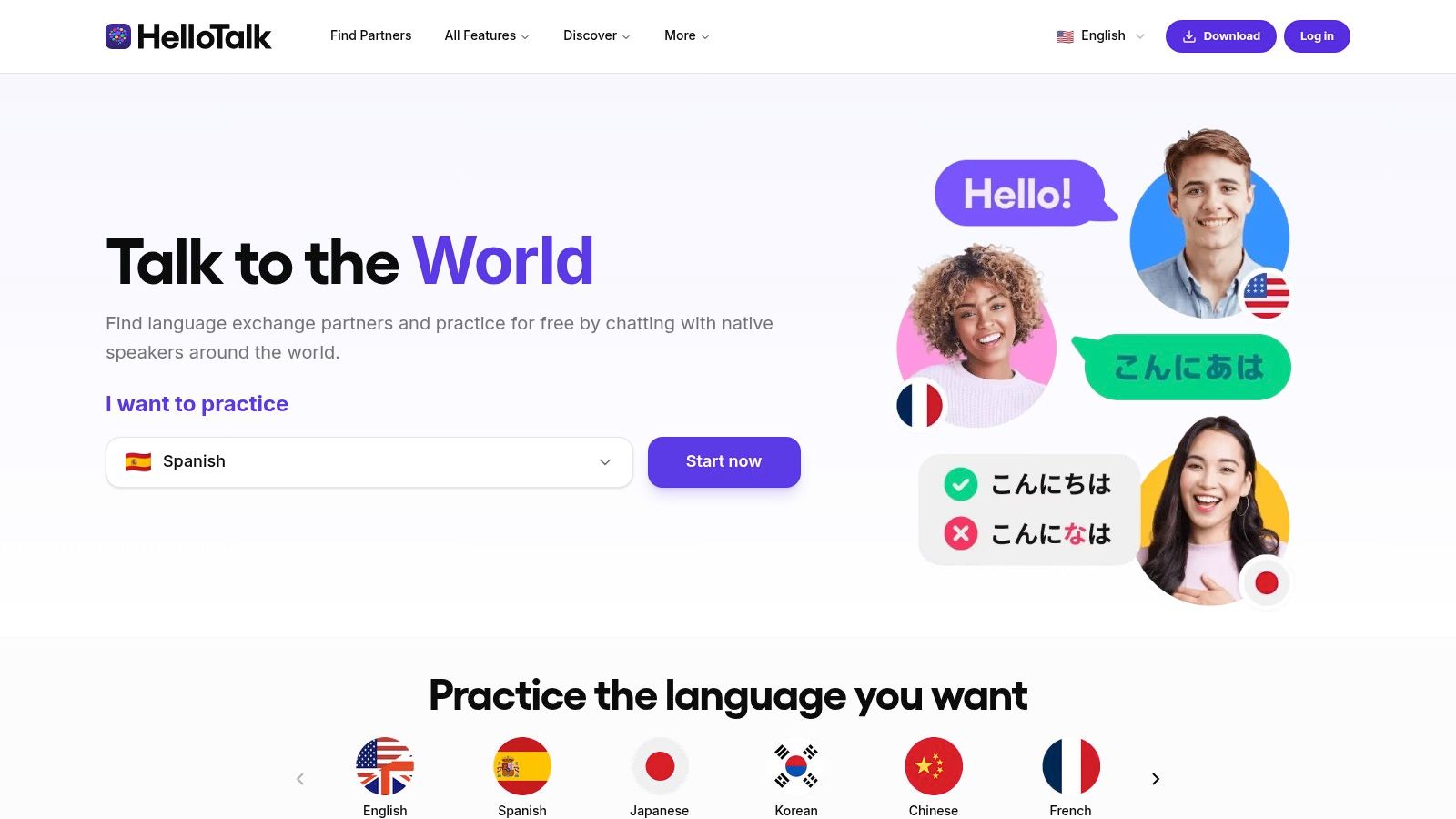
HelloTalk replaces lessons with people. Learners connect with speakers of their target language who want to practice the learner's language in return, using text, voice, and video messaging, voice rooms, and community posts. Translation and correction tools sit inside the chat, so help is available mid conversation.
That human contact is the point. A voice message from a partner in another country carries informal expressions, humor, and cultural context that scripted dialogues rarely match. For many learners, that first friendly exchange is also the moment the language stops feeling like a school subject and starts feeling like a bridge to another culture.
Making exchanges actually work
Partner availability, quality, and consistency can vary, and there's no sequential course or dependable grammar progression. Exchanges also work best when both participants contribute time and feedback, so learners need to guide the process rather than wait for it to happen.
- Bring a topic: Arrive with three questions about daily life, food, or work so conversation doesn't stall at greetings.
- Send voice first: Short voice notes build speaking and listening without the pressure of a live call.
- Ask for corrections: Request one or two fixes per message, then repeat the corrected sentence aloud.
A mixed method study found a moderate positive relationship between social learning strategies and speaking self efficacy at r = 0.585, p = 0.000, reported in IDEAS journal research on learning strategies and speaking confidence. Practicing with people, asking questions, and receiving feedback supported confidence in that research. HelloTalk supplies those ingredients, provided the learner stays active.
Pair it with structured study so gaps get filled systematically. Learners building Spanish conversation habits can follow the guidance in this overview of apps for practicing spoken Spanish, then bring the resulting phrases into a HelloTalk voice room. Real partners reward preparation.
6. Tandem
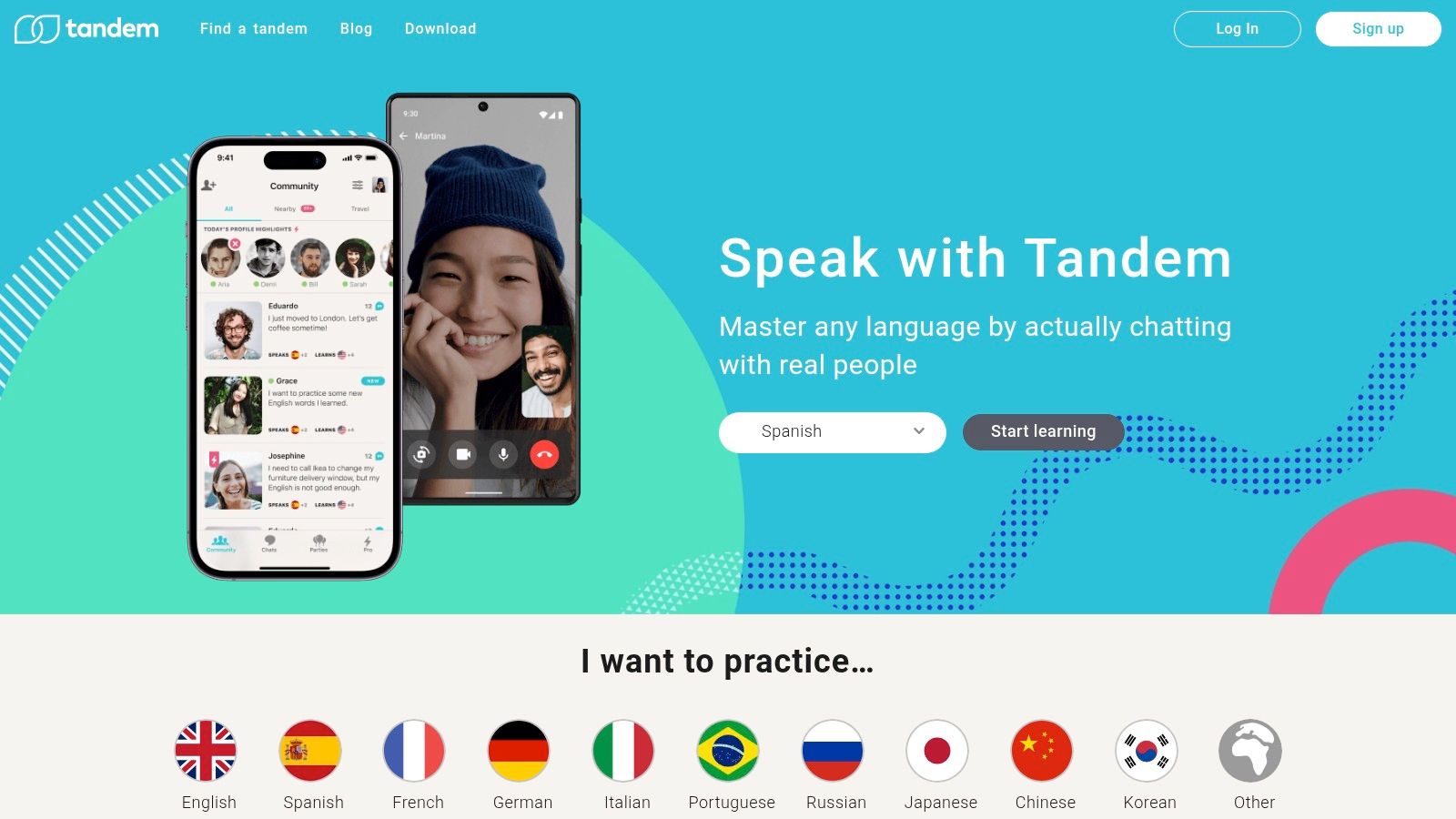
Tandem focuses on one to one language exchange. Users search by language, location, interests, and other preferences, then practice through text, voice notes, audio calls, or video calls, with in chat correction and translation tools. A community application review before entry adds a basic filter that open platforms don't always provide.
The format flexibility helps nervous speakers progress gradually. A learner can start with text, move to voice notes once phrasing feels safer, and attempt a short audio call when ready. Interest and location filters also make it easier to find a partner whose life and topics invite real conversation.
What learners need to bring
Tandem is a conversation tool, not a complete course. Sessions aren't automatically structured around a level or curriculum, and practice depends on finding a responsive, compatible partner. Reviewing the privacy policy before sharing personal information is a sensible step with any exchange community.
Set a small goal for every exchange, such as describing yesterday's routine or planning an imaginary weekend trip. A shared task gives both partners something to correct, repeat, and remember.
The wider context shows why that spoken step matters. The European Commission's 2024 Eurobarometer found that three out of five Europeans could hold a conversation in a language other than their mother tongue, while only 28% could converse in more than one foreign language, according to the Eurobarometer survey on Europeans and their languages. Conversation ability, not recognition alone, is the threshold that opens everyday interaction.
Use Tandem after some structured preparation. Rehearse a scenario privately during the week, then try the same topic with a partner on the weekend. Learners working on French can prepare with the approaches in this guide to French speaking practice apps, so the live call becomes a second performance rather than a cold start.
7. Language Transfer
Language Transfer takes an audio first route. Free courses play on the website and in the app, with downloads and progress saving, and donations are accepted rather than required. A teacher works through material with a student while learners pause, think, and answer aloud before hearing the response.
That pause is the method. Instead of listening passively, learners actively recall patterns and construct sentences themselves, which builds an understanding of how the language fits together. Screen free lessons also fit commutes, walks, and household tasks, turning otherwise unused time into structured thinking in the target language.
Languages and limits
Courses include Spanish, French, Italian, German, Greek, Turkish, Arabic, Japanese, Swahili, and English for Spanish speakers. Coverage and completeness vary by language, though, and the format is primarily audio based with fewer interactive exercise types. There's no live conversation partner and no individualized speaking feedback.
- Active recall: Answering aloud before the recording continues forces real sentence building.
- Pattern awareness: Guided thinking helps learners notice how forms connect across sentences.
- Free access: Audio courses remain available without a subscription wall.
The access question behind free learning is significant. UNESCO estimates that 40% of the world's population lacks access to education in a language they speak or understand, as noted in UNESCO's overview of multilingual education and inclusion. Free audio that reaches learners anywhere supports participation in education, travel, work, and community life.
Use Language Transfer to understand the mechanics, then test those mechanics with a person or a voice based practice tool. Listen to one track during a commute, note two sentence patterns, and use both in conversation the same evening. Understanding a pattern is the first step, and speaking it to someone is where it becomes part of a shared culture.
Best Free Language Apps: 7-Item Comparison
| App | Learning Approach and Complexity | Cost and Resources | Expected Outcomes | Ideal Use Cases | Key Advantages |
|---|---|---|---|---|---|
| ChatPal | AI voice conversations with personalized feedback; simple to start, best for learners with some foundation | Free 7-day trial; subscription required afterward, price unspecified | Builds speaking confidence and improves grammar, pronunciation, vocabulary, and phrasing | Practicing spoken language through realistic scenarios or open conversation | Natural-feeling conversations and targeted feedback |
| Duolingo | Short, structured, game-like lessons; low effort per session | Courses available free with ads; iOS, Android, and web | Develops regular study habits and foundational reading, writing, listening, and some speaking skills | Beginners and returning learners seeking daily practice | Bite-sized lessons and broad language selection |
| Busuu | Structured courses plus community corrections; moderate learner involvement | Free essential content; some features require Premium | Builds practical skills with a clearer course progression and feedback on learner output | Self-paced study for everyday, travel, or work communication | Combines guided lessons with community feedback |
| Memrise | Vocabulary, listening, videos, and review; straightforward self-study | Ongoing free plan; some features and ad-free use require Pro | Expands useful vocabulary and listening familiarity | Learning everyday phrases and hearing real speakers and accents | Real-world video clips and personalized review |
| HelloTalk | Informal text, voice, and video exchanges; requires active partner engagement | Large language-exchange community; partner availability varies | Provides real-person practice and exposure to informal language and culture | Learners seeking flexible conversation with native speakers | Multiple communication formats and correction tools |
| Tandem | One-to-one language exchange; learners arrange partners and topics | Partner access; practice depends on finding a compatible, responsive user | Develops conversational skills through personalized exchanges | Learners who want targeted one-to-one practice by interest or location | Partner filters and text, voice, and video options |
| Language Transfer | Audio lessons with active listening and spoken responses; self-paced | Free courses; audio and app access, with downloads available | Builds language understanding, pattern recognition, and sentence formation | Screen-free study and learners who prefer guided audio lessons | Free access and active recall through listen-and-answer lessons |
Build a Free Routine That Keeps You Speaking
The strongest choice depends on the learner's current gap, not on a universal ranking. Structured lessons from Busuu or Duolingo establish foundations, Memrise expands vocabulary and listening, HelloTalk and Tandem provide human exchange, Language Transfer trains active thinking, and a voice first tool such as ChatPal targets spoken conversation directly. Most learners need two or three of those roles covered, not seven apps competing for attention.
Start by naming the obstacle. A traveler who freezes at restaurant questions needs speaking minutes more than another vocabulary list. A returning learner who can't form past tense sentences needs structure first, while a heritage speaker may need low pressure conversation to reactivate what's already there. Matching the tool to the gap is what makes any best free language app useful.
Formal education alone rarely closes that gap. Eurostat reported that 89% of EU upper secondary students were learning English as a foreign language in 2024, yet only 28% of adults who knew at least one foreign language described themselves as proficient in their best known one, according to Eurostat's foreign language learning statistics. Years of study can still leave speaking confidence behind, which is why a post classroom speaking habit matters.
A small weekly pattern
- One primary course: Follow a single structured path so grammar and vocabulary build in order.
- Five minutes of review: Recycle phrases with a vocabulary app on days between lessons.
- Spoken output several times a week: Record a short response, join a voice room, or run a scenario conversation.
- One human moment: Use the week's material with a partner, classmate, or speaker encountered in daily life.
Progress check: Once a month, record a one minute answer to the same question, such as describing a typical day. Comparing recordings shows fluency gains that lesson streaks can't measure.
Keep the routine small enough to survive busy weeks. Ten focused minutes repeated daily will usually beat an ambitious plan abandoned by Friday, and speaking several times each week keeps retrieval speed improving. When a free tier runs out, rotate to another tool that fills the same role rather than letting the habit stop.
The deeper reward sits beyond test scores and travel convenience. Every conversation held in another language is a small act of connection across cultures, a chance to hear how other people describe their families, work, humor, and home. Speaking is the piece that opens that exchange, because understanding words privately never quite becomes meeting someone. Build the routine, keep it modest, and let consistent spoken practice turn stored knowledge into real relationships with people and places that were previously out of reach.
Ready to turn stored vocabulary into actual conversation? ChatPal offers voice first practice with Nora across everyday scenarios, plus personalized feedback on grammar, pronunciation, and phrasing after each session. Start the free 7 day trial, run one scenario today, and hear how quickly regular speaking builds confidence.