
Blog
Oral Fluency Practice That Actually Works in 2026
Transform your speaking with proven oral fluency practice methods. Daily routines, drills, AI partners, and progress tracking for real conversations.
A learner can read a restaurant menu, understand a podcast, and recognize the grammar in a textbook, then freeze when a waiter asks a simple question. The words are somewhere in memory, but retrieving them quickly, choosing the right tone, and responding without a script still feels impossible.
That gap isn't a lack of intelligence or effort. It usually means passive knowledge hasn't yet become an interactive skill. Effective oral fluency practice closes that gap through repeated dialogue, realistic situations, focused feedback, and progress measures that reveal more than confidence alone.
Speaking Is the Bridge to the Rest of the World
Speaking turns language from a private collection of vocabulary into a channel for human exchange. UNESCO's World Atlas of Languages documents 8,324 spoken or signed languages, with approximately 7,000 still in use, and estimates that between half and two-thirds of the world's population use two or more languages in daily life. Those figures place language learning in its proper context. It isn't merely an academic exercise. It's one of the ways people cross cultural, social, and professional boundaries.

A grammar rule can explain how to form a question, but speaking lets you ask someone about their family, clarify a misunderstanding, or share an opinion. The exchange may be imperfect. It may include pauses, substitutions, and gestures. Those imperfections are part of the bridge because communication grows through participation, not observation.
The fastest route forward isn't another endless vocabulary list. Learners need deliberate repeated dialogue that makes retrieval easier while preserving the uncertainty of real conversation. A useful routine combines four elements:
- Repeated production: Say similar content several times so the brain spends less effort searching for basic structures.
- Scenario objectives: Practice opening a conversation, asking a follow-up question, repairing a misunderstanding, or changing register.
- Selective feedback: Correct the errors that affect meaning or recur often, rather than interrupting every sentence.
- Personal tracking: Compare today's pauses and repairs with your own earlier recordings, not with a polished native-speaker video.
A low-pressure resource such as language learning motivation can help learners protect the habit when excitement fades, but motivation alone won't create automaticity. The practice has to give the learner enough opportunities to retrieve language aloud.
Practical rule: If a study activity never requires you to respond in real time, it can support speaking, but it isn't speaking practice by itself.
The journey from frozen to fluent begins with manageable exchanges. Order the coffee, explain a preference, ask one question, and stay in the conversation when the first word fails. Each attempt adds another piece to the bridge.
What Oral Fluency Really Means
Oral fluency isn't the same as speaking quickly. It describes how effectively a person produces and manages language while another person is listening and responding.
The Council of Europe's CEFR describes spoken ability through observable performance. At B2, a learner should interact with enough fluency and spontaneity for regular interaction with native speakers to be possible without strain for either party. At C2, extended speech can flow effortlessly, with pauses used mainly to select precise wording or examples. These descriptors focus on sustained interaction, natural expression, and control of pauses, rather than a raw vocabulary count. Read more about practical progress in becoming fluent in a language.
Four related abilities often get mixed together:
- Accuracy means forming language correctly. A speaker may use accurate grammar but still respond slowly.
- Complexity means expressing relationships, conditions, causes, and qualifications. Complex language isn't automatically fluent.
- Lexical range means having access to enough words and phrases for a topic. Recognizing a word doesn't guarantee being able to retrieve it under pressure.
- Interactional competence means managing the exchange itself. It includes taking a turn, responding to what someone said, asking for clarification, repairing a message, and keeping the topic alive.
A conversation exposes the difference. Someone might know the word for “appointment” but fail to respond when a receptionist offers an unfamiliar time. A fluent interactional response could be, “Sorry, did you say Thursday morning?” That sentence may be grammatically simple, but it keeps the channel open and negotiates meaning.
A 2024 study comparing TOEFL iBT Speaking performance with a separate measure of interactional competence found a strong relationship, with Pearson's r = 0.76 and p < 0.001 (Applied Linguistics study). The study also found that some interactional behaviors appeared comparatively independent of general speaking proficiency. A test score can therefore offer useful evidence, but it doesn't capture every behavior that makes a conversational partner effective.
Fluency is what happens when a speaker can keep meaning moving, even when the original sentence doesn't arrive perfectly.
That definition changes the drills worth doing. Silent flashcards can build recognition. Grammar exercises can improve accuracy. Oral fluency practice must add retrieval, turn-taking, repair, and sustained speech.
A Daily Practice Routine Built on Repetition
A learner can finish one speaking attempt feeling fluent, then freeze when the same idea comes up in a real conversation. The first attempt consumes attention for planning, word retrieval, and sentence building. Immediate repetition frees some of that attention for smoother delivery, clearer organization, and phrasing that sounds less assembled.
A practical protocol is 4/3/2 repetition. Choose one realistic topic, such as describing a recent trip or explaining a work project. Speak about it for four minutes, repeat the same content for three minutes, then repeat it again for two minutes. The shorter limits require prioritization while keeping the meaning and topic stable.
Research on this structure found that time pressure improved oral fluency. Repeating the same task again later also produced stronger fluency and complexity than completing it only once (De Jong research PDF). Repetition research with Japanese English learners found that speech-rate gains were largest during the early performances but continued across later attempts. Pauses and self-repairs changed at different points in the sequence. One successful retelling, therefore, is only part of a useful practice cycle.
The five-part sequence
A voice-first AI partner such as ChatPal can support this routine alongside live conversation, tutoring, self-recording, and peer work. Voice sessions can provide open conversation and scenarios such as ordering food, asking for directions, making plans, or handling everyday small talk. For a worked example, see learn Spanish through conversation.
Use a defined sequence instead of opening a conversation without a task:
- Warm-up: Speak freely about the day for five minutes. The goal is retrieval, not polished performance.
- Model and shadow: Listen to a natural sentence, then repeat it while matching its rhythm and phrasing. Learners who want more detailed voice practice can also use this guide to improve your voice with Isolate Audio.
- Scaffolded monologue: Describe one topic with prompts, then remove the prompts and try again.
- Interactive role-play: Respond to a partner who changes the situation, asks follow-up questions, or introduces a small problem.
- Debrief: Review a small number of pauses, repairs, pronunciation issues, or useful phrases, then use them in a fresh sentence.
A same-day routine can be completed in 40 minutes. Spend 5 minutes warming up, 10 minutes shadowing, 10 minutes on 4/3/2, 10 minutes in role-play, and 5 minutes reviewing a checklist. These timings form a workable baseline, not a rule that every learner must follow exactly.
| Step | Duration | Activity | Goal |
|---|---|---|---|
| Warm-up | 5 minutes | Open conversation about the day | Retrieve familiar language without overplanning |
| Model and shadow | 10 minutes | Repeat short natural phrases aloud | Notice rhythm, linking, and pronunciation |
| 4/3/2 retell | 10 minutes | Repeat one topic with decreasing limits | Reduce hesitation and improve organization |
| Interactive role-play | 10 minutes | Handle a realistic scenario and follow-up questions | Manage turns, meaning, and unexpected responses |
| Debrief | 5 minutes | Review the recording and select high-value feedback | Turn one session into the next practice target |
Keep the topic stable during repetition, while changing the conversational partner or prompt. This prevents memorization from becoming the only skill. A learner might first describe a holiday to an AI partner, then explain it to a friend, and finally answer a colleague's questions about the same trip.
The routine works because it makes speaking effortful within clear limits. Learners do not need to improvise a completely new subject every minute. They get several chances to express the same meaning more easily, then revisit it later to check whether the improvement remained.
Beyond Speed How to Sound Natural in Real Conversations
Fast speech can hide weak interactional control. A learner may increase articulation rate while ignoring the listener's reaction, failing to ask follow-up questions, or using the same formal tone with a friend and a hiring manager.
A natural conversation requires turn-taking, topic maintenance, clarification, repair, and register control. The speaker must notice when the other person looks confused, decide whether to continue or explain, and choose language appropriate to the relationship. That is why “speak faster” is an incomplete fluency target.
Three scenarios worth drilling
| Scenario | Interactional Skill | Sample Opening Prompt |
|---|---|---|
| Meeting a stranger | Open and sustain small talk | “Give a 90-second self-introduction that ends with a question about the other person.” |
| Losing a word | Clarify and negotiate meaning | “Explain the problem without using the missing word, then ask the listener for help under time pressure.” |
| Changing social context | Shift register and tone | “Answer the same request first in a job interview, then at a casual dinner.” |
The first exercise trains more than a prepared introduction. Ending with a question hands the turn to the other person and creates a reason to listen. The second teaches circumlocution, a vital recovery skill. The third makes learners feel how vocabulary, politeness, directness, and sentence length change with the social frame.
Load prompts like these into a voice-first AI partner, or use them with a tutor or language exchange partner. Ask the partner to interrupt only when meaning breaks down, then introduce a follow-up question that wasn't in the script. Rehearse the social objective, not just the sentence.
A useful test: Could the listener tell what you want from the conversation, and could you respond when the conversation changes direction?
Speech analysis can help with filler awareness, but removing every “um” isn't the same as becoming a better conversational partner. For practical guidance on reducing distracting fillers, consult this AIDictation speech polishing guide, then preserve natural planning pauses where they help you think.
Pronunciation also belongs inside the interaction. A sound matters most when it blocks comprehension, changes a word, or forces the listener to work unnecessarily hard. Learners can build a focused practice loop with resources on ways to improve pronunciation, then test the target sound inside a role-play rather than only repeating isolated words.
Research on generative-AI-supported second-language speaking reports more practice opportunities, reduced anxiety, and personalized feedback, but overall oral-proficiency findings remain inconsistent. One reviewed study found no significant overall proficiency gain after six weeks, and the review identifies continuing limitations in pragmatic competence and discourse management (International Journal of Applied Linguistics review). AI can provide access and repetition. It can't remove the need to practice appropriateness with real people and varied situations.
Feedback That Builds Confidence Instead of Killing It
Mid-sentence correction often solves the wrong problem. During a sustained exchange, the speaker's immediate job is to keep meaning moving. An interruption for a minor article error can redirect attention from the message to self-monitoring, especially for a returning learner who already expects to make mistakes.
Feedback should match the activity. A fluency task needs protection from unnecessary interruption. An accuracy task can tolerate more direct correction because correctness is the stated objective.
Two correction windows
Use a deferred pass after the speaker finishes. Select one pronunciation issue that affected comprehension, one recurring grammar pattern, and one phrase that could sound more natural. Give a short alternative and ask the learner to reuse it in a new sentence.
Add a written recap at the end. Written notes suit smaller issues such as article choice, word forms, prepositions, and minor agreement errors. The learner can review them without losing the emotional momentum of the conversation.
Before accepting or requesting a correction, apply four questions:
- Did the error block or seriously distort meaning?
- Is it recurring, rather than a one-off slip?
- Will fixing it help in many future conversations?
- Can the learner immediately reuse the correction?
If the answer is “no” to most of these questions, keep the conversation moving. An AI partner can be configured to flag only high-impact moments during the exchange and save the rest for the recap. That configuration matters more than the sheer volume of corrections.
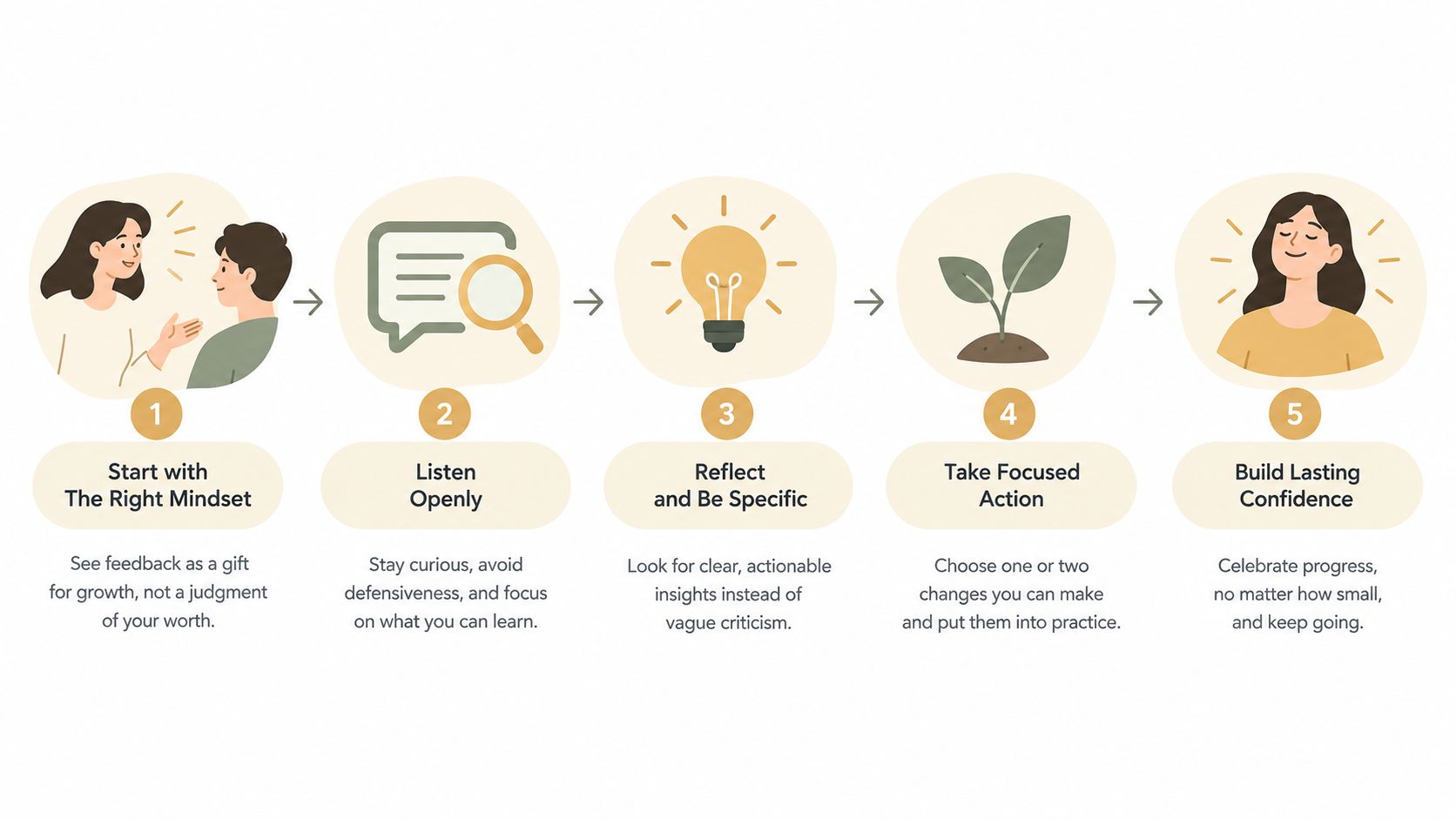
Fluency-oriented feedback includes long hesitations, abandoned clauses, and pronunciation that prevents comprehension. Accuracy-oriented feedback includes grammar slips that don't interrupt the exchange, article choice, and small word-form errors. Treating both categories identically creates either too much interruption or too little instruction.
The research-backed principle is selective intervention. Recent evidence on AI-supported language practice also reports that learners may avoid speaking because they fear errors, peer judgment, or damage to their self-image, while AI can reduce anxiety and increase access to practice. The same evidence reports mixed proficiency effects, so a comfortable practice environment still needs deliberate design (Springer study on corrective feedback).
Feedback should leave the learner with a sentence to use, not a pile of reasons to stay silent.
This principle applies beyond language lessons. Someone learning how to prepare for coding interviews also needs feedback that preserves problem-solving flow while identifying the highest-impact improvements. In speaking practice, the learner should control whether feedback arrives during the role-play, immediately afterward, or in a written review.
Measuring Progress With Real Numbers Not Vibes
Confidence matters, but it fluctuates with sleep, topic familiarity, and the perceived status of the listener. A useful dashboard needs observable speech features. The strongest practical measures are articulation rate, pause frequency, and self-initiated repairs, with intelligibility reviewed alongside them.
A synthesis of 263 effect sizes from 22 studies found that perceived fluency is strongly associated with speaking speed, composite fluency measures, and pause frequency. Pause duration has a moderate association, while repair measures are weaker predictors (Assessment of second-language fluency). That doesn't make repairs irrelevant. A speaker who notices and resolves a misunderstanding may be more effective than one who speaks quickly but leaves the listener confused.
Build a personal baseline
Record the same one-minute monologue on Day 1, Day 15, and Day 30. Use a topic that remains comparable, such as describing a typical workday, a recent trip, or a personal goal. Keep the prompt stable, but don't memorize the answer.
Log these observations:
- Articulation rate: Count syllables and divide by speaking time. Research on highly intelligible second-language speech reports a common range of 3 to 3.5 syllables per second, although scripted and unconstrained speech differ. Use that range as context, not as a native-speaker target.
- Silent pauses: Count pauses using a consistent threshold. Research comparing thresholds found that 250 to 300 milliseconds produced the strongest relationship between silent-pause frequency and L2 proficiency, with the traditional 250-millisecond cutoff recommended for research measurement.
- Filled pauses: Mark “um,” “uh,” and similar planning sounds. Track the trend rather than trying to eliminate every natural hesitation.
- Self-repairs: Count moments when you restart, replace, or reformulate an expression.
- Intelligibility: Ask whether the message was easy to follow, especially at the points where you paused or repaired.
Use a simple 1 to 5 personal rubric for each metric. A 1 can represent frequent breakdowns that obscure meaning, while a 5 can represent steady delivery with rare disruptive pauses and repairs. Don't assign universal cutoffs to the rubric. The value comes from applying the same judgment to each recording.
Create columns for date, topic, articulation rate, silent pauses, filled pauses, repairs, intelligibility, and one observation. Compare transcripts line by line. A slower recording may still show meaningful progress if the speaker pauses less, completes more clauses, or repairs messages more efficiently.
Massed repetition can reduce breakdown pauses while also producing slower articulation and more verbatim repetition, and it may reduce motivation. A good dashboard therefore shows several trends together. Progress belongs to the learner's own timeline, not to a fluent stranger's edited video.
Your 30 Day Plan to Make Speaking a Daily Habit
A sustainable month doesn't require heroic sessions. It needs a repeatable pattern that fits work, study, travel, or family responsibilities. Keep the daily speaking slot between 15 and 25 minutes, then add one 45-minute live conversation each week with a tutor, friend, colleague, or exchange partner.
Week 1 focuses on listening and the baseline
- Monday: Morning, shadow a short dialogue. Midday, record the one-minute baseline. Evening, note pauses and difficult phrases.
- Tuesday: Morning, repeat useful sentence patterns. Midday, complete a short voice session about your routine. Evening, write three phrases worth reusing.
- Wednesday: Morning, shadow questions and answers. Midday, practice a restaurant or travel scenario. Evening, repeat the hardest response.
- Thursday: Morning, listen for linking and stress. Midday, describe a familiar place without reading notes. Evening, mark one pronunciation target.
- Friday: Morning, shadow the week's phrases. Midday, answer follow-up questions on the same topic. Evening, review the recording.
- Saturday: Hold the weekly 45-minute live conversation. Focus on staying engaged rather than correcting every error.
- Sunday: Record a 90-second weekly summary and compare its flow with Monday's baseline.
Week 2 uses timed retells
Choose one topic each day and apply 4/3/2. On Monday, describe a recent event. Tuesday, explain a process. Wednesday, give an opinion. Thursday, retell a story. Friday, describe a problem and solution. Use the midday voice session to add follow-up questions, and spend the evening reviewing one recurring hesitation.
The weekend live conversation should include one repeated topic. On Sunday, record the 90-second summary again and compare pause frequency and repairs with the prior week's sample.
Week 3 trains interactional objectives
Monday's objective is small talk. End a 90-second introduction with a question. Tuesday's objective is clarification. Explain a missing word and ask the partner for help. Wednesday's objective is turn-taking. Practice acknowledging an answer before adding your own point.
Thursday's objective is register. Answer the same prompt as if speaking to a hiring manager and then to a friend. Friday combines all four skills in a role-play. The weekend conversation should include a deliberate repair when something is misunderstood, followed by a short Sunday review.
Week 4 makes feedback and measurement routine
Monday, request only feedback on meaning-blocking errors. Tuesday, use a deferred correction pass. Wednesday, apply one pronunciation correction in three fresh sentences. Thursday, review grammar patterns in writing. Friday, complete a full role-play and compare your data with the earlier recordings.
Use the final weekend for the 45-minute live conversation, the Day 30 one-minute monologue, and a 90-second summary of the month. Compare the recordings line by line. Keep the next month's target narrow, such as fewer abandoned clauses, better follow-up questions, or more appropriate register shifts.
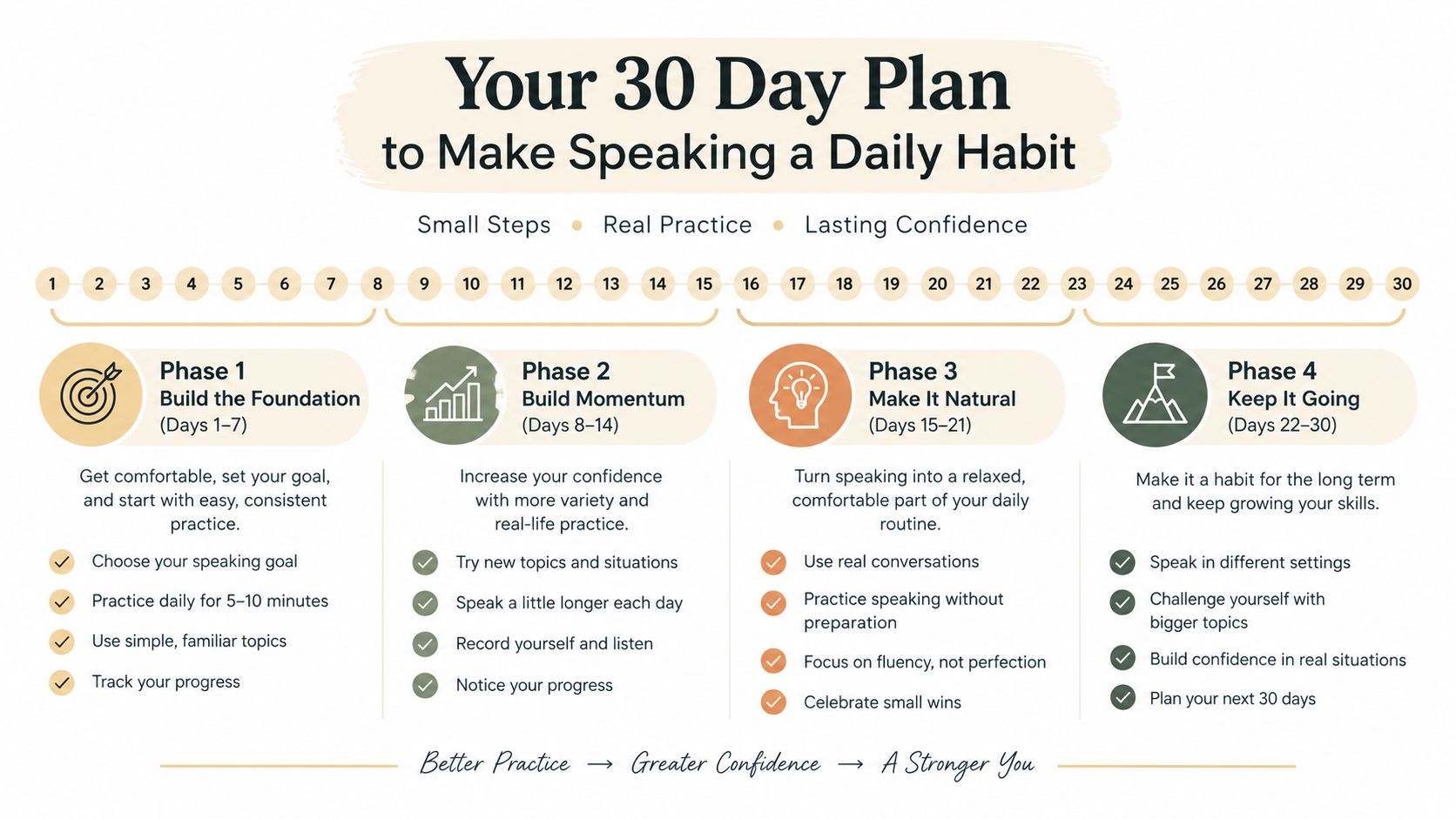
Language learning creates a practical bridge between communities, families, workplaces, and travelers. Across 8,324 spoken or signed languages, consistency matters more than perfection because every respectful exchange gives the learner another way to meet someone on their own linguistic terms.
ChatPal offers voice-first practice with Nora through realistic conversations, role-plays, open-ended exchanges, and session recaps covering grammar, pronunciation, vocabulary, and phrasing. Use it as one part of a broader oral fluency routine, then visit ChatPal to turn your next 30 days of speaking into a consistent daily habit.