
Blog
8 Sentences with Ser in Spanish: Examples and Grammar
Explore 8 sentences with ser in spanish covering identity, origin, time, and materials, with translations, grammar tips, and mistakes to avoid.
You're standing in a kitchen or a living room, meeting a Spanish-speaking family for the first time. Someone asks who you are, where you're from, or what you do, and suddenly a tiny sentence with ser becomes the key that opens the conversation. That's why language learning matters so much, it helps bridge cultures, and speaking is the step that turns study into a real human connection. The eight patterns below give you a practical path from recognition to confident use, and a voice-first practice tool like translation or ChatPal can speed up the speaking side alongside your other study methods.
1. Mi madre es enfermera. Identity and Profession
This is one of the first sentences with ser in Spanish that learners should make automatic. Ser is the natural verb for a profession or identity, so you say Mi madre es enfermera, Soy profesor de historia, or Mi hermano es arquitecto en Barcelona. Spanish usually drops the article in this pattern, so es enfermera sounds right, while es una enfermera changes the feel and is not the default way to state occupation.
A simple speaking model helps here. Say the sentence in one breath, then swap only the job word, then swap the person.
Speak it aloud: “Mi madre es enfermera. Mi padre es médico. Yo soy profesor de historia.”
The reason ser fits is that occupation is treated as a defining characteristic, not a temporary condition. That matches the broader Spanish pattern where ser links a subject to an attribute that identifies or classifies it, which is why the verb works so well in introductions and workplace talk. The present forms are soy, eres, es, somos, sois, son, so you can move from family to self-introduction without changing the whole structure.
The mistake that shows a gap is adding an article or using estar because you think all descriptions need the same verb. If you say Mi madre está enfermera, the learner problem is clear. The fix is repetition in spoken context, especially for introductions and networking conversations.
- Drop the article: Say es ingeniero, not es un ingeniero, unless you're adding extra description.
- Swap the subject: Practice Mi madre, Mi hermano, Yo, then your own real example.
- Use a live role-play: A short networking exchange forces the pattern into memory faster than reading alone.
If you want a deeper refresher on verb patterns, the conjugation guide is a useful companion.

2. Somos de Colombia. Origin
Origin is one of the most useful ways to introduce yourself, and ser is the verb that makes it work. In Somos de Colombia, ser + de tells where someone comes from, which is why you also get sentences like Soy de Madrid, pero vivo en Sevilla and Ellos son de Puerto Rico. That little de turns the sentence into a clear statement of identity and background.
Say the whole exchange, not just the answer
The strongest practice is the question and answer together.
Practice pair: “¿De dónde eres?” “Soy de Italia.”
“¿De dónde son?” “Son de Colombia.”
This pattern matters because origin is often part of first meetings, travel conversations, and workplace introductions. It also connects directly to the social side of language learning, since saying where you're from is one of the fastest ways to start a real exchange. In Spanish, that exchange feels natural because ser frames origin as a stable piece of information, not a temporary state.
A common learner mistake is reaching for estar because location is involved. But origin is not the same as physical location. Soy de Madrid says where you come from, while Vivo en Sevilla says where you live now.
Practical rule: Learn the sentence as a chunk, Soy de + place, then add a second chunk like Vivo en + place.
You can also use short voice practice to make this stick. Introduce yourself, ask the other person where they're from, and answer back without stopping to translate every word. That back-and-forth is what turns grammar into conversation.

3. Hoy es martes, 14 de octubre. Time and Date
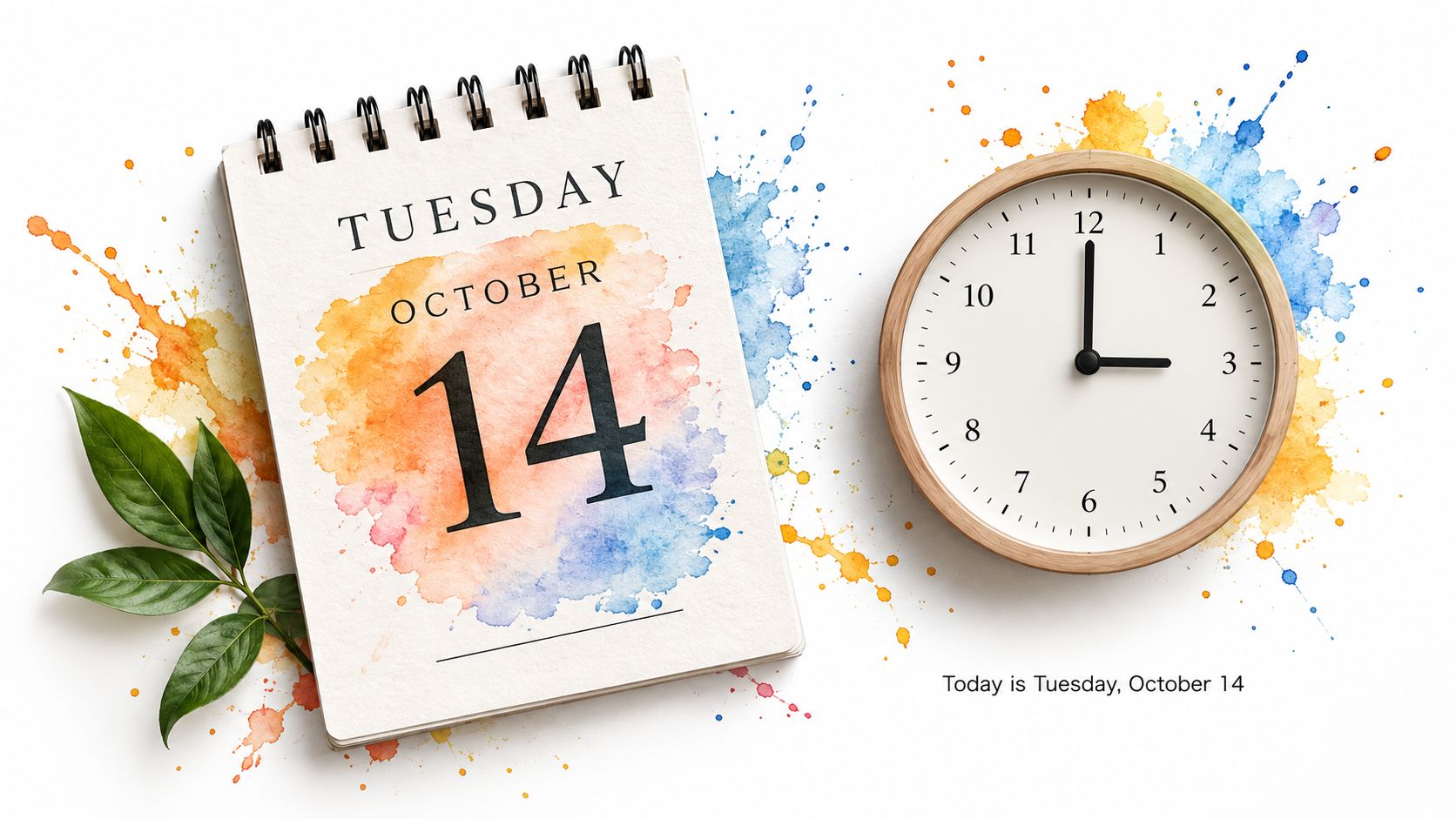
Time is one of the clearest places where ser is required. You say Hoy es martes, 14 de octubre for a date, La reunión es el lunes a las nueve for a scheduled event, and Son las siete y cuarto de la mañana for the hour. The verb doesn't describe a state here, it anchors a point in time.
The easiest way to remember it is to pair the day and the hour with two anchor phrases.
- Hoy es... for days and dates.
- Son las... for hours.
- Es la una for the single-hour exception.
That last form matters because one o'clock is singular, while the other hours are plural. Once you hear it aloud a few times, the structure starts to feel obvious. This is exactly the kind of speaking pattern that helps learners move beyond recognition, because time expressions come up constantly in travel, school, and work.
A useful drill is to say the date and time every morning. You don't need a long study session. A 20-second spoken habit can train your mouth to reach for es and son quickly, without pausing to build the sentence in your head.
If you're planning real-life interactions, try a mini booking scenario. Say the day, say the hour, then confirm the place.
Speak it aloud: “La cita es el miércoles. Son las ocho. La reunión es en la sala cinco.”
If you want a parallel guide for this structure, the time-in-Spanish lesson can reinforce the pattern with more examples.
4. Este libro es mío. Possession
Possession is one of those areas where ser helps you sound clear fast. In Este libro es mío, the verb links the object to ownership, and the possessive pronoun does the rest. You'll hear the same structure in Las llaves son tuyas, no mías and La bicicleta es de mi hermana.
Ownership in real conversations
This pattern shows up when you're sorting items, sharing a desk, or checking what belongs to whom. That makes it extremely practical in shared homes, classrooms, and workplaces. If someone asks ¿De quién es este paraguas?, the answer Es mío is short, natural, and immediately useful.
The mistake to watch for is hesitating because you're trying to translate word by word. Learners often know the possessive words, but they freeze when ownership appears in conversation. The best fix is to practice the question and answer as one exchange.
Spoken drill: “¿De quién es este paraguas?” “Es mío.” “¿De quién son las llaves?” “Son tuyas.”
You can also practice while handling objects around you. Pick up three items in your room and say who they belong to. Then switch to a family setting or office setting and repeat the same pattern with new nouns. That makes the grammar feel less like a rule and more like a tool you can use instantly.
Voice practice helps here because ownership questions often happen quickly in real life. If you can answer without searching for the verb, the exchange stays smooth and polite.
5. La mesa es de madera. Material
Material is another place where ser gives you precision. La mesa es de madera tells what something is made of, and that same shape works in La camisa es de algodón, El suelo es de mármol, and ¿De qué es la bolsa? Es de cuero. The pattern is simple, but it opens up much richer descriptions of the physical world.
This matters in shopping, travel, home life, and design conversations. You may need to explain furniture, clothes, or building materials, and ser is the verb that links the object to its substance. That makes the sentence feel complete without extra explanation.
Build the material habit
Start with a small set of common materials and keep them active in speech.
- madera for wood
- vidrio for glass
- plástico for plastic
- lana for wool
Then use them with visible objects around you. Say what your desk, bottle, shirt, or bag is made of. The point is not to memorize a list, it's to train your mouth to describe real things on sight.
A common learner gap shows up when the sentence becomes too vague. If you can name the object but not the material, the pattern still needs work. If you can answer ¿De qué es...? with confidence, you've moved from recognition to usable speech.
Try this aloud: “La mesa es de madera. La ventana es de vidrio. La chaqueta es de lana.”
That kind of spoken repetition turns passive vocabulary into active description, which is exactly what you need in everyday conversation.
6. El puente fue construido en 1920. Passive Construction
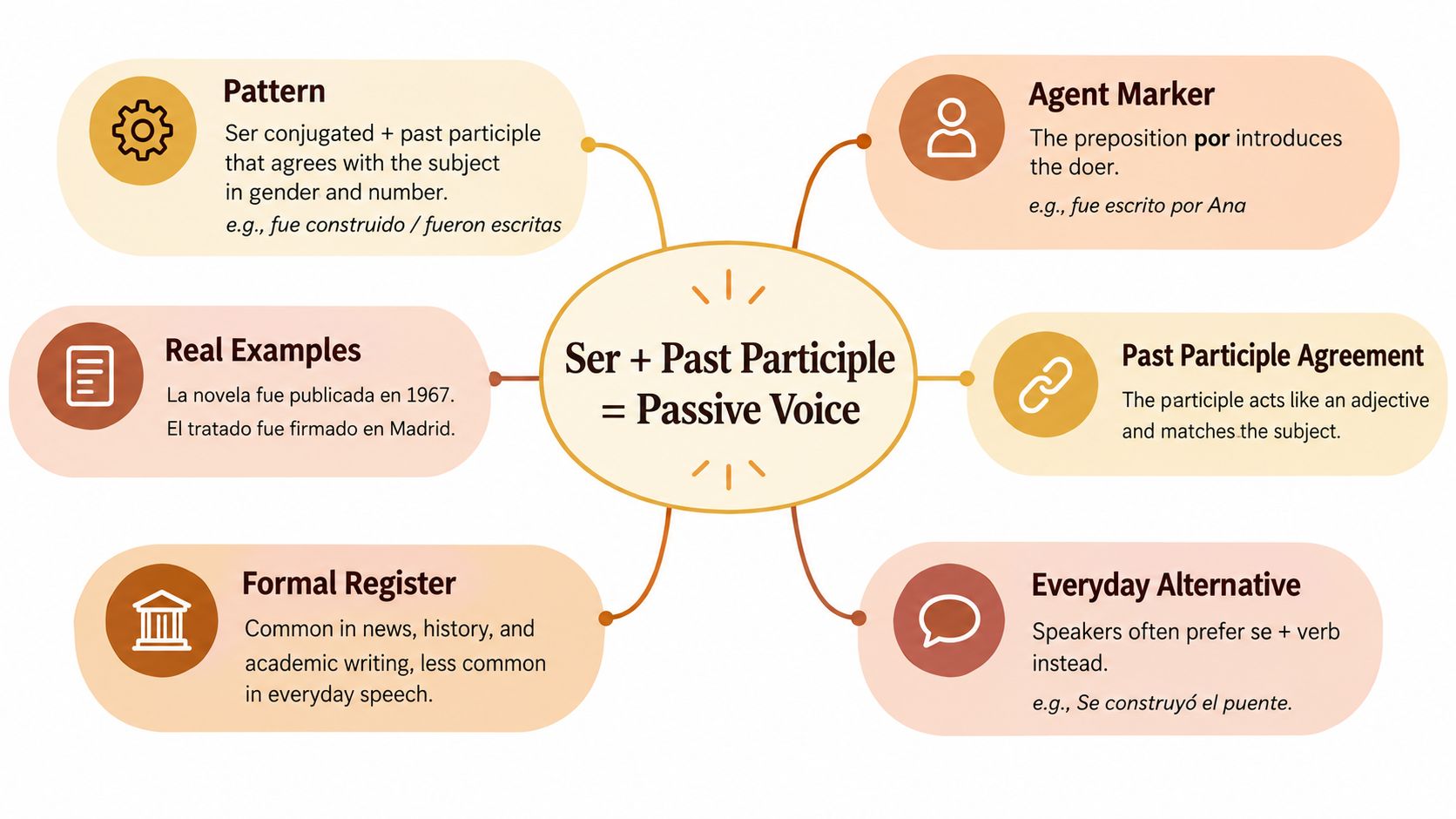
The passive with ser is more formal, but it's still a valuable part of sentences with ser in Spanish. In El puente fue construido en 1920, the sentence focuses on the bridge and the action done to it, not on who did it. The same pattern appears in La novela fue publicada en 1967, Las obras fueron restauradas por el museo, and El tratado fue firmado en Madrid.
This structure is common in news, history, museum text, and formal speech. It helps you understand writing where the doer is hidden or less important. It also gives you a strong option when you want to describe events without centering the person who acted.
Say the passive out loud
The form is ser + past participle, so the structure matters as much as the vocabulary. If you know a few common verbs, you can start producing passive sentences quickly.
- escribir becomes escrito
- construir becomes construido
- firmar becomes firmado
- publicar becomes publicado
- pintar becomes pintado
The mistake that exposes a gap is trying to force the active voice into every sentence. Sometimes you need the passive because that's how the information is organized. Speaking the passive aloud helps you hear the difference and makes the structure less intimidating.
If you're preparing for an oral exam or reading formal Spanish, this pattern is especially useful. A short retelling of a news item in your own words can make it stick better than isolated drills.
For a related grammar walkthrough, the ser imperfect guide can support your review.
7. El cielo es azul. Inherent Characteristic
This is the classic place where ser expresses a quality that feels inherent or generally true. In El cielo es azul, the sentence describes a typical characteristic, not a temporary condition. The same logic gives you Mi abuela es muy generosa for personality and El agua es fría en invierno for a general quality.
The contrast with estar matters a lot here. La sopa está fría points to a temporary state, while El agua es fría en invierno can describe a broader, more general truth. Learners often overuse the temporary verb because they've heard the shortcut “ser is permanent, estar is temporary,” but that rule is too narrow. The better question is whether you're describing what something is like in general or what it's like right now.
Use paired adjectives
Create simple contrasts with the same adjective.
Pair it: “Es aburrido.” “Está aburrido.”
Pair it: “Es fría.” “Está fría.”
That contrast trains your ear and your mouth at the same time. It also helps you catch the learner mistake where the adjective is correct, but the verb choice is not. In speaking, that gap often shows up when you're describing people, food, weather, or moods.
A practical way to rehearse is to describe someone you know and then describe the same thing in a temporary way. You'll start hearing the difference between a stable description and a current state. That's exactly why voice practice works so well for this grammar point.
If you want a matching reference on the other half of the contrast, the estar conjugation guide is a helpful next step.
8. La reunión es en la sala cinco. Location of an Event
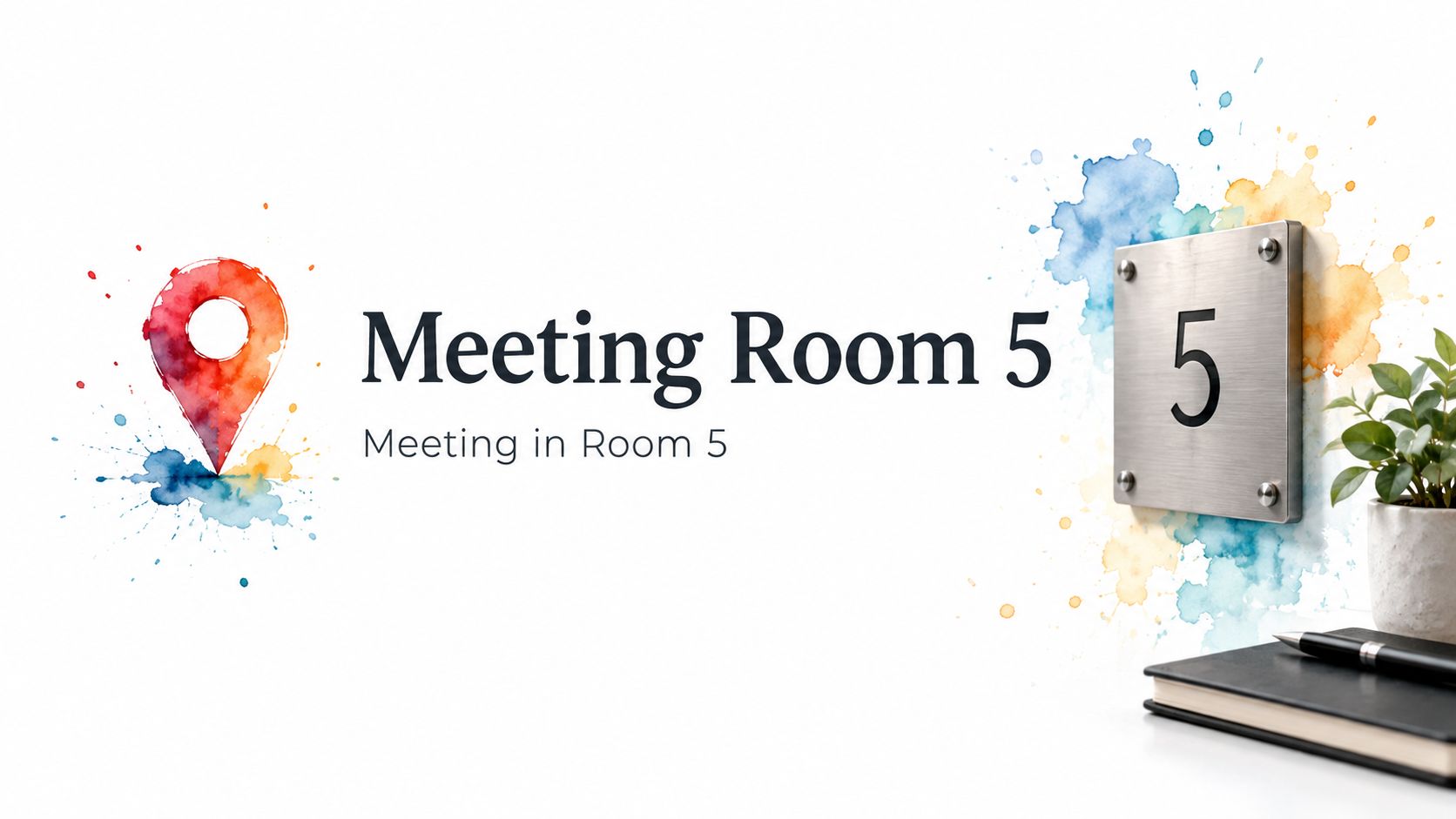
Events use ser in Spanish when you're saying where they take place. La reunión es en la sala cinco is correct because the sentence points to the location of an event, not the location of a person or object. You'll hear the same pattern in La cena es en un restaurante cerca del hotel, El concierto es en el teatro principal, and ¿Dónde es la fiesta? Es en la casa de Marta.
This is one of those patterns that saves time in school, work, and social planning. Invitations, schedules, and meeting details all rely on it. A learner who can say event locations clearly sounds much more confident in everyday coordination.
The question choice is important too. Use ¿Dónde es... for events, and keep ¿Dónde está...? for people or objects. That small distinction helps you avoid one of the most common ser/estar mistakes in live conversation.
Practice the whole invitation
Say the date, time, and place in one short breath.
Speak it aloud: “La reunión es el martes. Son las nueve. Es en la sala cinco.”
Then change the noun. Make it a dinner, a concert, or a class. That flexibility matters because you're not memorizing one fixed sentence, you're learning a pattern that applies across real situations.
A common gap appears when learners overgeneralize location and reach for estar everywhere. Events are different. Once you've said enough invitations aloud, the pattern starts to feel natural, and planning conversations become much easier.
8-Point Comparison: Uses of Ser in Spanish
| Example (Topic) | Complexity | Resources / Practice | Expected Outcome | Ideal Use Cases | Key Advantages |
|---|---|---|---|---|---|
| Mi madre es enfermera. (Identity and Profession) | Low, ser + profession, gender agreement | Basic profession vocabulary, gender forms, role-play introductions | State professions and identities accurately | Introductions, networking, family descriptions | High-frequency, immediate communicative value; reinforces no-article rule |
| Somos de Colombia. (Origin) | Low, ser + de + place, nationality agreement | Place names, nationality adjectives, Q&A drills | Express origin/nationality and prompt follow-ups | Icebreakers, travel, cultural exchanges | Natural conversation starter; culturally informative |
| Hoy es martes, 14 de octubre. (Time and Date) | Low–Medium, es/son distinction, la una exception | Time/date vocabulary, drills on es vs. son, calendar practice | Give days, dates, and times; schedule plans | Scheduling, travel, meetings | Essential for planning; consistent and widely used pattern |
| Este libro es mío. (Possession) | Low–Medium, stressed possessives vs. unstressed, agreement | Possessive pronouns, ¿De quién es...? exchanges, sorting exercises | Clarify ownership and respond to possession questions | Shared spaces, travel, offices | Practical for everyday interaction; enforces gender/number agreement |
| La mesa es de madera. (Material) | Low, ser + de + material, vocabulary needed | Materials vocabulary, shopping and description role-plays | Describe what objects are made of | Shopping, home décor, describing objects | Simple reusable pattern; increases descriptive precision |
| El puente fue construido en 1920. (Passive Construction) | Medium–High, ser conjugation + past participle agreement | Past participles, agreement practice, active↔passive conversion | Read/produce passive voice in formal contexts | News, history, academic writing, exams | Enables formal descriptions; useful for reading comprehension |
| El cielo es azul. (Inherent Characteristic) | Medium, ser vs. estar distinction, adjective agreement | Adjective usage drills, contrast pairs with estar, speaking practice | Describe inherent traits accurately; master ser/estar contrast | Describing people, places, personality, appearance | Clarifies a core grammatical distinction; supports precise descriptions |
| La reunión es en la sala cinco. (Location of an Event) | Low–Medium, ser + en for events, distinction from estar | Location vocabulary, practice ¿Dónde es...? vs ¿Dónde está...? | State event locations and combine with time | Invitations, schedules, work/school logistics | Practical for planning; clear rule for event locations |
Turn Eight Patterns Into Daily Speaking Habits
These eight patterns cover a lot of daily Spanish: identity, origin, time, possession, material, passive structures, characteristics, and event locations. Together, they show why ser is more than a conjugation chart. It's a tool for introductions, planning, describing the world, and participating in conversations that matter.
A simple routine makes the grammar stick. Say one new sentence aloud each day, then use it in a short role-play or voice session. One day you can say Mi madre es enfermera, the next Soy de Italia, then La reunión es en la sala cinco. That progression moves you from controlled practice to real speaking decisions, which is where the learning starts to feel alive.
Language learning is a positive force because every clear sentence gives you another way to connect with someone else. Speaking is the step that makes that connection possible. It lets you describe your life, ask better questions, and move across cultural boundaries with more ease and confidence. The broader value of language ability is clear in public surveys of communication and multilingual use, and your own practice becomes meaningful the moment you start using it with another person.
A voice-first tool like 10 lesson planning templates is not required, but it can accelerate the habit if you want structured feedback after speaking. ChatPal, for example, gives learners a place to practice out loud and review grammar and pronunciation after a session. Regular conversation with real people is still the goal, and a tool like that can help you build toward it one spoken sentence at a time.
If you want a low-pressure way to practice ser in real conversation, visit ChatPal and try speaking the patterns out loud with feedback after each session. It's a practical way to work on identity, time, origin, and event-location sentences without staying stuck in silent drills. Use it to turn today's grammar into tomorrow's conversation.