
Blog
33 in Spanish: How to Say It and Use It Naturally
Learn how to say 33 in Spanish with clear pronunciation, ordinal forms, regional variations, and real example sentences for confident everyday speaking.
33 in Spanish is treinta y tres. Use this cardinal form for an age, quantity, room number, or price, but use trigésimo tercero for “33rd,” with pronunciation and rhythm changing slightly in natural conversation.
You may meet the number while reading a hotel door, checking a jersey, giving your age, or listening to a phone number. At first, treinta y tres can feel like one phrase to memorize. In practice, it opens a larger pattern, and speaking it aloud helps turn a small vocabulary item into a genuine connection with Spanish-speaking people and cultures.
Language learning creates bridges because conversation lets people exchange more than information. It carries humor, courtesy, family history, and everyday ways of seeing the world. A number such as 33 is a small puzzle piece, but saying it clearly helps reveal the larger picture.
Why a Single Number Matters More Than It Looks
Suppose a hotel clerk tells you your room is number 33. You recognize the digits, but you still need to produce the answer naturally: la habitación treinta y tres. The same phrase appears when you say your age, describe a quantity, or identify a player's number.
Treinta y tres isn't an isolated vocabulary chore. It shows how Spanish combines a tens word with a unit, a structure that continues through the higher two-digit numbers. Once the rhythm feels familiar, you can move from treinta y tres to nearby forms such as treinta y cuatro and then apply the same logic to other tens.
That's why pronunciation matters as much as spelling. Learners need to hear the light connection between treinta and y, keep the final sound in tres clear, and recognize that regional accents may shape the phrase differently. They also need to know when 33 is a cardinal number and when “33rd” requires trigésimo tercero instead.
For extra listening and language-learning motivation, browsing customer reviews can be a useful way to notice how people describe communication tools and everyday conversations.
Practical rule: Learn the number as a phrase, a pattern, and a spoken rhythm. Memorizing only the spelling leaves out the part you need most in conversation.
How 33 Fits the Spanish Counting Pattern
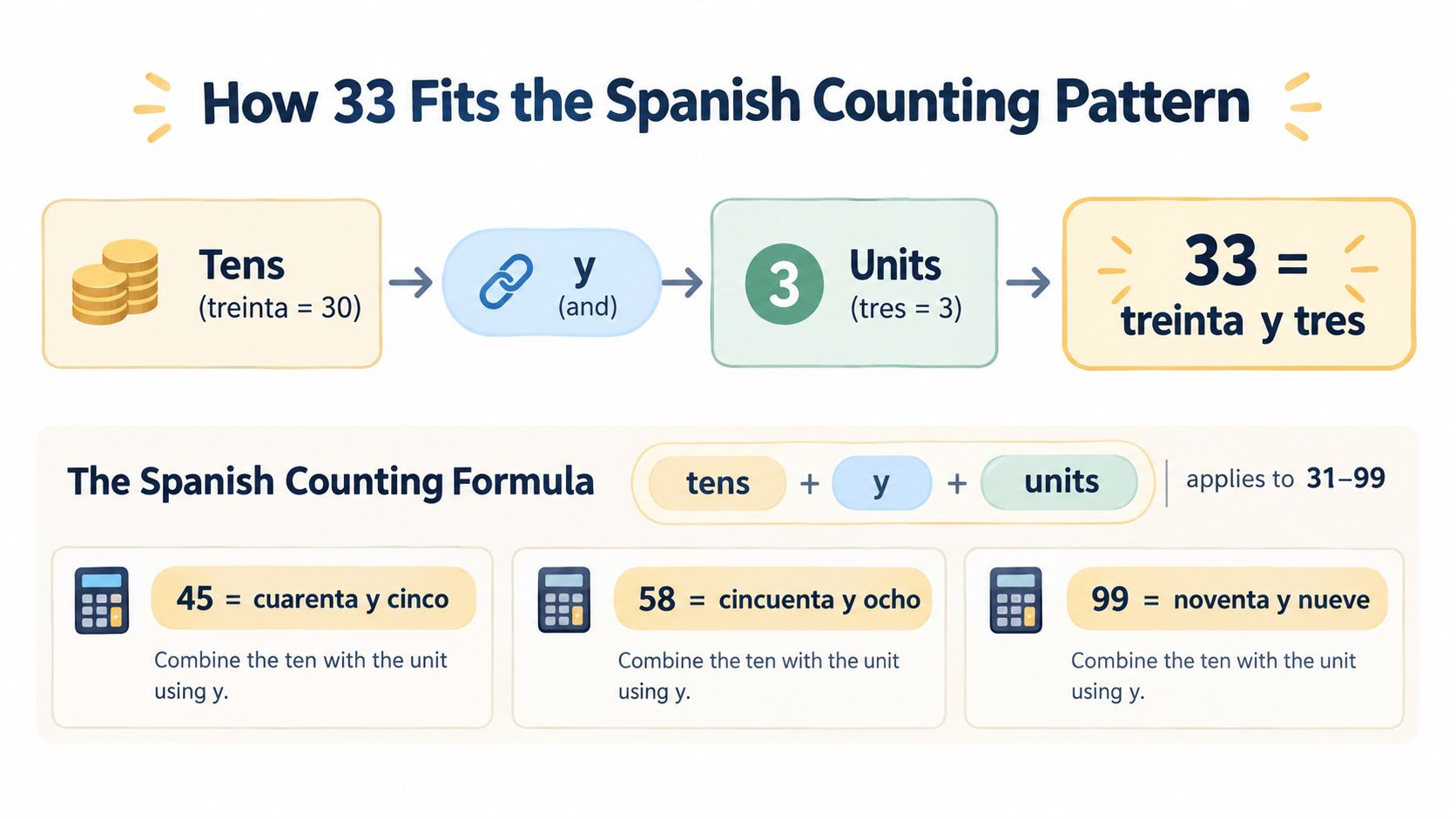
Spanish forms numbers above 30 by joining the tens and the units with y, meaning “and.” The formula is:
tens + y + units
For 33, treinta represents 30 and tres represents 3, producing treinta y tres. The conjunction is essential. English learners sometimes carry over “thirty-three” too rigidly, but Spanish keeps y between the two parts.
Build the pattern around 33
- 31: treinta y uno
- 32: treinta y dos
- 33: treinta y tres
- 34: treinta y cuatro
- 35: treinta y cinco
The pattern continues through treinta y nueve. It also works with other tens, such as cuarenta y cuatro, where cuarenta supplies the tens and cuatro supplies the unit. Educational explanations of Spanish numbers describe this tens-and-units construction with y, making 33 a useful example for generalizing beyond memorized forms. This guide to counting in Spanish can provide another practice route for building number confidence.
The teens behave differently. Forms such as dieciséis and diecisiete are fused words, not a tens word followed by y and a unit. Learning that contrast prevents you from applying the 30s pattern where it doesn't belong.
Say the neighbors aloud: treinta y uno, treinta y dos, treinta y tres, treinta y cuatro, treinta y cinco. Your aim is to recognize the reusable structure, not merely recall one answer.
Saying Treinta y Tres Out Loud
A helpful first approximation is TRAYN-tah ee TRESS. Another learner-friendly breakdown is:
trein-ta-y-tres
The strongest beat generally falls on the first syllable of treinta and on the final syllable of tres. Keep the Spanish vowels relatively open and steady. English speakers often turn them into more shifting English-style vowel sounds, which can make the phrase less clear.
A simple pronunciation drill
- Say treinta slowly, keeping the opening tr together.
- Add a light y, pronounced like ee.
- Say tres, giving attention to the final s.
- Join the phrase, first slowly and then at a comfortable conversational pace.
The tr cluster can cause trouble. English speakers may soften it into something closer to a d or ch sound. Spanish t is made with the tongue closer to the teeth than English t, and it often sounds crisp without a strong release of air. The r in tres is normally a single tap, not the long trill associated with rr.
Record yourself saying the phrase, then compare it with native audio from a reliable Spanish-learning source. Listen for the three parts, trein, ta, and tres, while allowing the middle y to remain light rather than heavily stressed.
How 33 Sounds in Real Conversation
Careful classroom speech separates the words clearly. Natural conversation often compresses them into one rhythmic group. Speakers may make treinta y sound closer to treintai, with the conjunction flowing into the next syllable instead of receiving its own strong beat.
The final s in tres can also change depending on the following sound and the speaker's region. Before a following vowel, some speakers may weaken it toward an h-like sound, so tres años can sound less sharply separated than a learner's dictionary pronunciation. This doesn't change the meaning, but it can affect listening.
Compare these rhythm groups:
- treinta y tres
- treinta y tres años
- el treinta y tres por ciento
In isolation, the phrase may sound carefully segmented. Inside a longer expression, the surrounding words guide the rhythm, and the number may pass more quickly.
Nervous learners often confuse nearby forms in the 30s because treinta, treinta y uno, treinta y dos, and treinta y tres share the same opening. A chained drill helps:
Treinta, treinta y uno, treinta y dos, treinta y tres.
Repeat the sequence until your ear waits for the distinctive tres rather than trying to retrieve the entire phrase at once. That small shift makes real-time comprehension easier.
Regional Pronunciation Differences to Know
The spelling treinta y tres stays the same across Spanish, but the sounds around it can vary. In Spain, many speakers produce consonants with a crisp dental quality, while speakers in Mexico and other parts of Latin America may soften certain consonants between vowels in fast speech. The result can sound more clipped or relaxed without representing a different number.
Voseo regions, including Argentina, Uruguay, and parts of Central America, also preserve the same number. What may change is the surrounding verb or possessive phrasing, not the form of 33 itself. A learner should therefore focus on hearing the number independently from the regional grammar around it.
Listen for trece and treinta
A particularly useful contrast is trece, meaning 13, versus treinta, meaning 30. The distinction involving c before e or i varies by region. In much of the Americas, that sound is close to s, while in Spain it's often pronounced like the “th” in English think. This difference can influence how learners hear trece and compare it with nearby number words. Busuu's Spanish numbers resource offers a useful reference for this pronunciation distinction.
Choose one target accent for focused practice, then expose yourself to other varieties once the phrase feels stable. Resources on improving Spanish pronunciation can help you build a listening routine that includes both careful speech and faster conversational examples.
The Ordinal Form and When to Use It
Treinta y tres is a cardinal number. It answers “how many?” or identifies a quantity. For “33rd,” Spanish uses the ordinal trigésimo tercero, not the cardinal phrase.
Use the ordinal for an ordered position, edition, floor, anniversary, or formal rank. Use the cardinal for an age, quantity, price, or ordinary identification number. The distinction is important because the two forms perform different grammatical jobs.
The forms to recognize
- Masculine full form: trigésimo tercero
- Masculine before a singular masculine noun: trigésimo tercer
- Feminine form: trigésima tercera
- Masculine abbreviation: 33.º
- Feminine abbreviation: 33.ª
The shortened trigésimo tercer appears before a masculine singular noun. For example, el trigésimo tercer presidente means “the thirty-third president,” while la trigésima tercera edición means “the thirty-third edition.” Gender agreement changes the ordinal ending, and the abbreviation reflects that distinction with a raised o or a.
Pronunciation also shifts from the cardinal. A useful guide is tri-GÉ-si-mo ter-CER-o, with the main stress in trigésimo and tercero following standard Spanish stress patterns.
Here are three practical examples:
- El trigésimo tercer presidente ganó la elección.
- La trigésima tercera edición incluye material nuevo.
- La habitación trigésima tercera está en el mismo pasillo.
Reference material on the written ordinal form confirms trigésimo tercero, 33.º, and 33.ª, as well as the shortened masculine form before a masculine noun. Wiktionary's entry for 33.º and Omniglot's Spanish number reference are useful places to check the written conventions.
Real Situations Where You Will Use 33
Age is one of the easiest contexts:
Tengo treinta y tres años.
Here, 33 is a quantity describing age, so the cardinal form is correct. You'll use the same form for an amount, a room, or an object count.
A price might be treinta y tres euros con cincuenta céntimos. A room number can be la habitación treinta y tres, and an apartment address may include el número treinta y tres. These are identification or quantity contexts, not ordered positions.
Dates need care. If someone is referring to a numbered day in an abstract exercise, the number can be read as a cardinal, but a real calendar month may not contain that day. Don't turn an impossible date into a routine expression just because the digits are available.
Sports provide another familiar setting. A jersey can be described as el número treinta y tres, especially when reading the number as a complete number rather than reciting separate digits.
Phone numbers depend on local convention and the purpose of the call. When clarity matters, speakers may read digits individually, while a grouped sequence can include forms such as treinta y tres, cuarenta y dos, and cincuenta y ocho. If you're dictating a number, pause between groups and confirm what the listener heard.
The key question is simple: are you naming a quantity or identifying an item, or are you placing something in an order? Choose treinta y tres for the first situations and trigésimo tercero for the second.
Quick Reference for the Thirties in Spanish
Use this table as a practice card. The pronunciation hints are approximations for English-speaking learners, not replacements for native audio.
| Number | Spanish | Pronunciation Hint | Pattern Note |
|---|---|---|---|
| 30 | treinta | TRAYN-tah | Tens word alone |
| 31 | treinta y uno | TRAYN-tah ee OO-no | Tens + y + unit |
| 32 | treinta y dos | TRAYN-tah ee DOHS | Tens + y + unit |
| 33 | treinta y tres | TRAYN-tah ee TRESS | Tens + y + unit |
| 34 | treinta y cuatro | TRAYN-tah ee KWAH-tro | Tens + y + unit |
| 35 | treinta y cinco | TRAYN-tah ee SEEN-ko | Tens + y + unit |
| 36 | treinta y seis | TRAYN-tah ee SAYS | Tens + y + unit |
| 37 | treinta y siete | TRAYN-tah ee SYEH-teh | Tens + y + unit |
| 38 | treinta y ocho | TRAYN-tah ee OH-cho | Tens + y + unit |
| 39 | treinta y nueve | TRAYN-tah ee NOO-eh-beh | Tens + y + unit |
The conjunction y remains part of the construction, including before a unit beginning with an a or o sound. Spanish doesn't insert a hyphen, and the number doesn't fuse into a single word in the way some teen forms do.
For an enjoyable way to practice rhythm and pronunciation, singing along with best karaoke songs in Spanish can help you hear connected speech. You can also reinforce everyday number vocabulary with ChatPal's Spanish vocabulary resources.
Common Mistakes English Speakers Make With 33
Three slips appear often when English speakers first say treinta y tres.
- Confusing trece and treinta y tres. Trece means 13. Treinta y tres means 33. The shorter form can sound tempting when a speaker is moving quickly, so practice the contrast deliberately.
- Dropping y. Saying treinta tres removes the connector and produces an incorrect form. Keep the middle y, even when it becomes light in connected speech.
- Using an English-style tr. Spanish places the tongue for a brief tap in the r of tres. Don't turn it into a strongly English-sounding cluster or a long trill.
Learners sometimes also stress the wrong syllable or search for an h in treinta. There is no written h, and the phrase works best with a clear first beat in treinta and a firm final syllable in tres. A pronunciation guide gives a useful approximate IPA form as /ˈtɾejn.θa/ for treinta, with regional differences possible.
Use this short contrast drill:
treinta, trece, treinta y tres
Say each one slowly, then alternate them at natural speed. The aim is not theatrical perfection. It's reliable distinction when someone asks for a number unexpectedly.
From One Number to Real Speaking Confidence
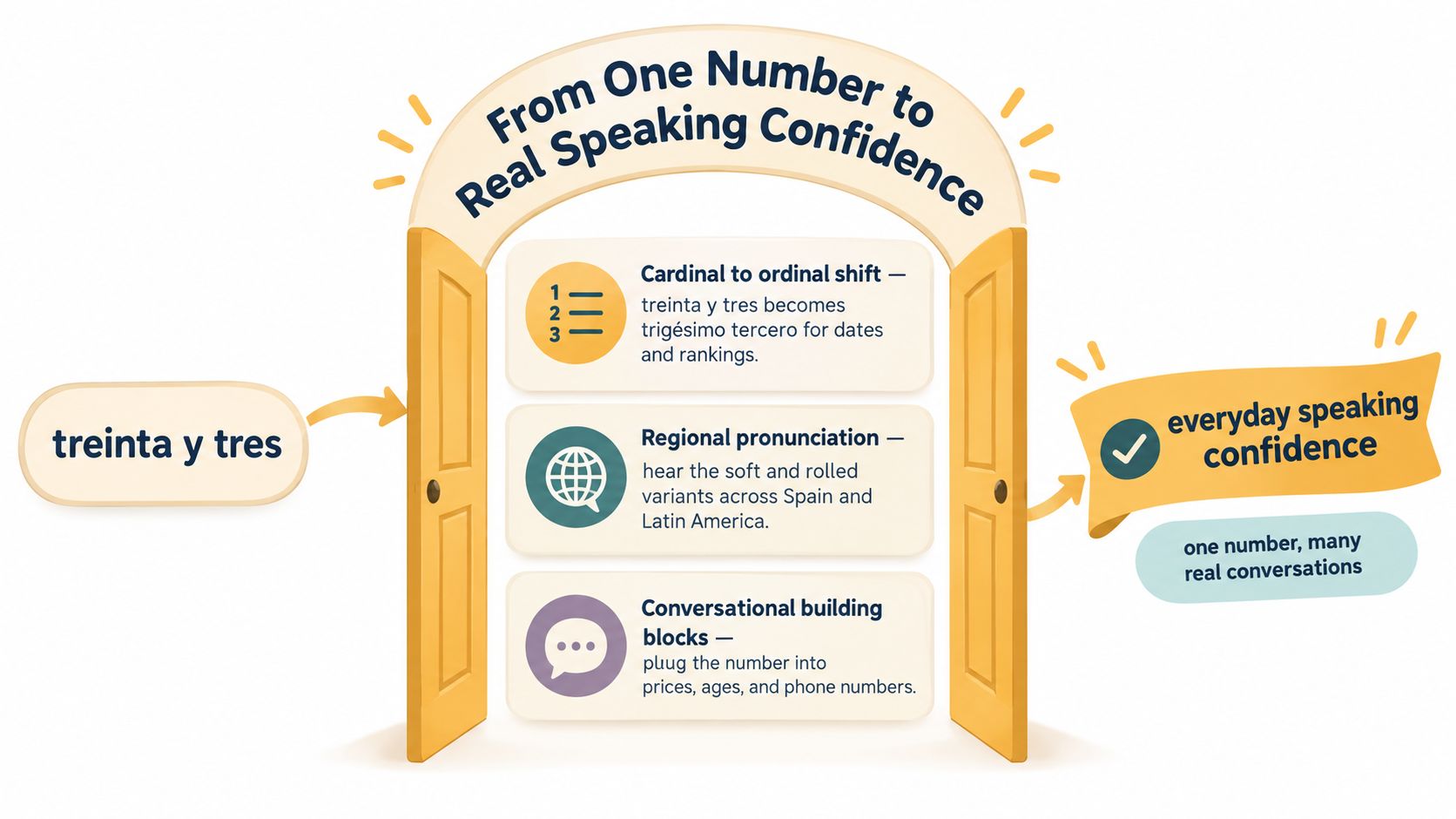
Saying treinta y tres confidently gives you more than one memorized answer. It trains you to combine a tens word, a connector, and a unit, then place that phrase inside a complete sentence. The same habit supports ages, prices, room numbers, and other everyday exchanges.
The cardinal-to-ordinal shift adds another useful layer. You learn that “33” and “33rd” aren't interchangeable, while regional listening practice teaches you to recognize the phrase even when its consonants soften or its rhythm compresses.
Practice with short scenarios rather than isolated repetition:
- Announce a room number.
- State an age.
- Quote a price.
- Read a phone-number group.
- Name an ordered position with trigésimo tercero.
Speaking a language helps people meet across cultural differences because it turns passive knowledge into shared action. A small number can become a confidence win when you use it aloud, recover from a mistake, and keep the conversation moving.
Frequently Asked Questions About Saying 33 in Spanish
What is 33rd in Spanish?
The ordinal is trigésimo tercero. Before a singular masculine noun, it shortens to trigésimo tercer, as in el trigésimo tercer presidente. The feminine form is trigésima tercera, as in la trigésima tercera edición.
How do you write the ordinal abbreviation?
Write 33.º for masculine singular and 33.ª for feminine singular. The raised letter marks the grammatical gender. If a Spanish speaker writes one of these forms, use the noun's gender and the surrounding sentence to understand which ordinal is intended.
How do you say the thirty-third day of a month?
Use an ordinal when you're describing an ordered day, but remember that an ordinary calendar month doesn't have a day 33. In a hypothetical sequence or formal numbering system, “the thirty-third day” would be el trigésimo tercer día.
How should you dictate 33 over the phone?
For a standalone number, say treinta y tres and pause. If the listener could confuse the digits, you can clarify by saying tres, tres, especially when reading a sequence digit by digit. Confirm the grouping rather than relying on speed.
How do you use 33 in a math expression?
Say treinta y tres más doce for “33 plus 12.” Here, 33 is a cardinal quantity, so treinta y tres is the correct form. The same logic applies to subtraction, multiplication, and division expressions.
Does the number change with a plural noun?
The cardinal number itself doesn't become plural. The noun does: treinta y tres libros means “33 books,” while treinta y tres casas means “33 houses.” The number names the quantity, and the noun carries the plural ending.
Does 33 agree with gender?
For ordinary cardinal use, treinta y tres stays the same with masculine and feminine nouns. You can say treinta y tres libros and treinta y tres casas. Gender becomes visible in the ordinal forms, such as trigésimo tercero and trigésima tercera.
Return to the thirties table whenever the pattern feels slow. Repeating the sequence aloud, then placing it into a sentence, will make the form easier to retrieve during real conversation.
ChatPal offers voice-first Spanish practice with realistic conversations, pronunciation feedback, grammar corrections, and session recaps. Use it to rehearse situations such as giving your age, naming a room, or clarifying a phone number, then visit ChatPal to practice saying treinta y tres in a natural exchange.