
Blog
How to Improve Speaking Confidence Fast
Discover how to improve speaking confidence with a practical step-by-step program. Master daily routines, targeted drills, and graded exposure for real fluency.
You know the answer, but the moment someone asks you a simple question, the words disappear. You recognize the vocabulary on a page, understand much of what you hear, and may even rehearse perfect sentences in your head. Then a real conversation begins, and you pause too long, switch languages, or settle for a short reply.
That experience doesn't mean you're bad at languages. Speaking confidence is a trainable habit, built through manageable repetitions, useful feedback, and conversations that feel safe enough to continue. The aim isn't to eliminate every nervous feeling. It's to become capable of speaking while some anxiety is still present, recovering quickly when a sentence goes wrong, and returning to the conversation instead of avoiding it.
Why Learners Freeze in Conversations
You are ordering coffee in a language you have studied for months. The server asks a follow-up question that never appeared in your textbook. You know the words separately, yet retrieval slows down. While searching for the right verb, you begin judging your accent, the people waiting behind you, and the mistake you might make. The pause grows, confidence falls, and a simple exchange starts to feel like an exam.
The difficulty is that recognizing language isn't the same as retrieving it under pressure. Reading gives you time to identify a word. Listening lets you process another person's sentence. Conversation asks you to choose an idea, find vocabulary, arrange grammar, pronounce the result, monitor the listener, and respond to new information, often within moments.
Traditional study still has a place, but it can leave a gap between knowledge and performance. Flashcards strengthen recognition. Grammar exercises improve accuracy when the sentence is already provided. Speaking practice trains the physical and mental sequence that dialogue requires: starting, pausing, repairing, and continuing.
Confidence is a mechanical skill
Quiet learners can become effective speakers, while outgoing learners can freeze in an unfamiliar language. Personality may influence preferences, but it does not decide whether speech becomes automatic. Confidence grows when your brain receives repeated evidence that it can complete a speaking task and survive an imperfect result. Each manageable exchange functions like a short practice circuit: attempt, feedback, adjustment, and another attempt.
Public-speaking anxiety is widespread and often begins early. A large community survey found that one-third of respondents reported excessive anxiety when speaking to a large audience, while onset occurred by age 13 for 50% of affected people, by age 17 for 75%, and by age 20 for 90%. The same study found that 10% reported marked interference with work, social life, or education (research on public-speaking anxiety and its functional impact).
These findings clarify why passive knowledge rarely solves freezing. Avoidance lowers discomfort briefly, but it also removes the repetitions that make speaking familiar. A practical introduction to challenging anxious thoughts and behaviors appears in this CBT in anxiety guide. Learners working on perfectionism can also use this resource about fear of making mistakes.
Use a small task to create an immediate feedback loop. Ask one follow-up question, describe one object, or answer in two sentences. Notice where retrieval stalls, adjust one phrase, and repeat the same task later. The goal is functional confidence: completing the exchange while nervous, then making the next attempt easier.
Practical rule: Don't wait to feel confident before speaking. Choose a speaking task small enough to complete while nervous, then repeat it until the task feels ordinary.
Rewiring the Brain for Spontaneous Speech
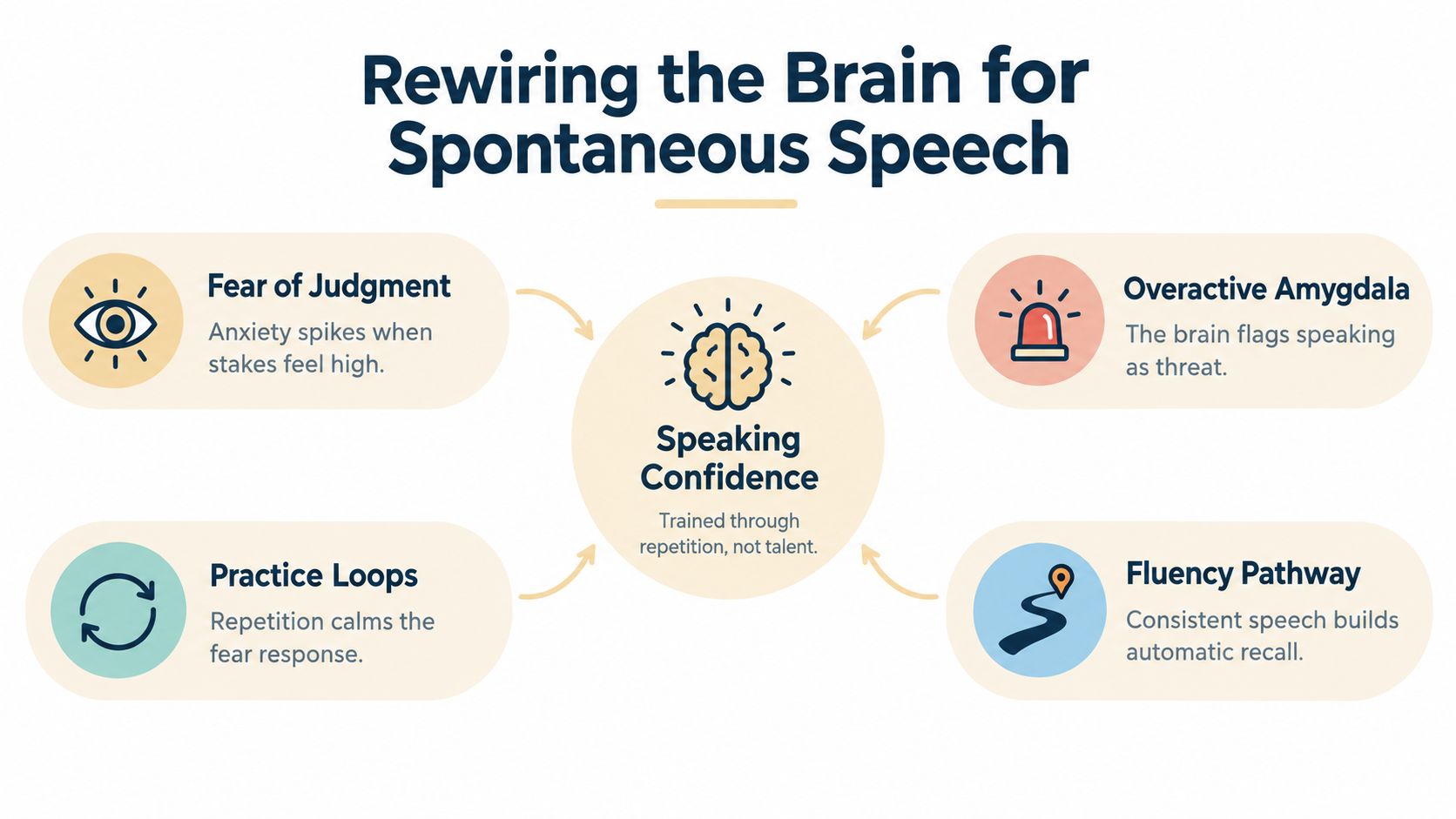
The most useful shift is from fear reduction to functional execution. If you make “feeling no anxiety” the entry requirement, you may postpone speaking indefinitely. If you define success as communicating one clear idea, asking for clarification, or repairing a sentence, you can practice the behavior that confidence depends on.
Confidence and anxiety can coexist. A 2026 university EFL study found that students could report high speaking confidence while still experiencing moderate classroom anxiety. It also found a strong negative correlation between confidence and anxiety, with r = -0.657, suggesting that confidence helps learners manage anxiety rather than erase it (study of confidence and classroom speaking anxiety).
Use three thinking loops
Before a conversation, use metacognitive preparation. Predict likely topics, list a few useful phrases, and retrieve vocabulary connected to the situation. For a doctor's appointment, that might include describing symptoms, asking how long something will take, and checking instructions. You aren't writing a script. You're reducing the number of decisions your brain must make in real time.
During speech, use monitoring, but keep it narrow. Track one feature, such as whether your main verb is clear or whether you're speaking too quickly. Trying to inspect every sound and grammar choice at once creates more pressure and can interrupt communication.
Afterward, use evaluation. Write down one sentence that worked, one moment that became difficult, and one replacement phrase to try next time. This turns a vague impression of failure into a specific training target. A 2025 multi-country study identified self-perceived speaking competence as the only significant predictor of language anxiety for speakers in both Malaysia and China, and it highlighted preparation, monitoring, feedback, and reflection as useful intervention strategies (research on speaking competence and language anxiety).
Add coping strategies to the language task
Preparation works better when paired with self-regulation. Students in a 2026 study faced high speaking anxiety linked to fear of negative evaluation and oral recitation pressure, yet maintained good oral communication performance when they used preparation, relaxation, positive thinking, and other coping strategies (study of coping strategies and speaking anxiety).
Try a short routine before speaking:
- Set one communication goal. Decide whether you'll ask a question, explain a preference, or tell a short story.
- Relax your body. Drop your shoulders, place both feet on the floor, and take a slow breath.
- Allow repair. Keep phrases such as “Let me say that another way” or “I'm looking for the word” ready.
- Review the process. Judge whether you stayed engaged, not whether every sentence was flawless.
Personalized practice can make this preparation more relevant by matching topics and difficulty to your current level. A structured approach to personalized learning paths can help turn broad goals into repeatable speaking situations.
Designing a Graded Exposure Roadmap
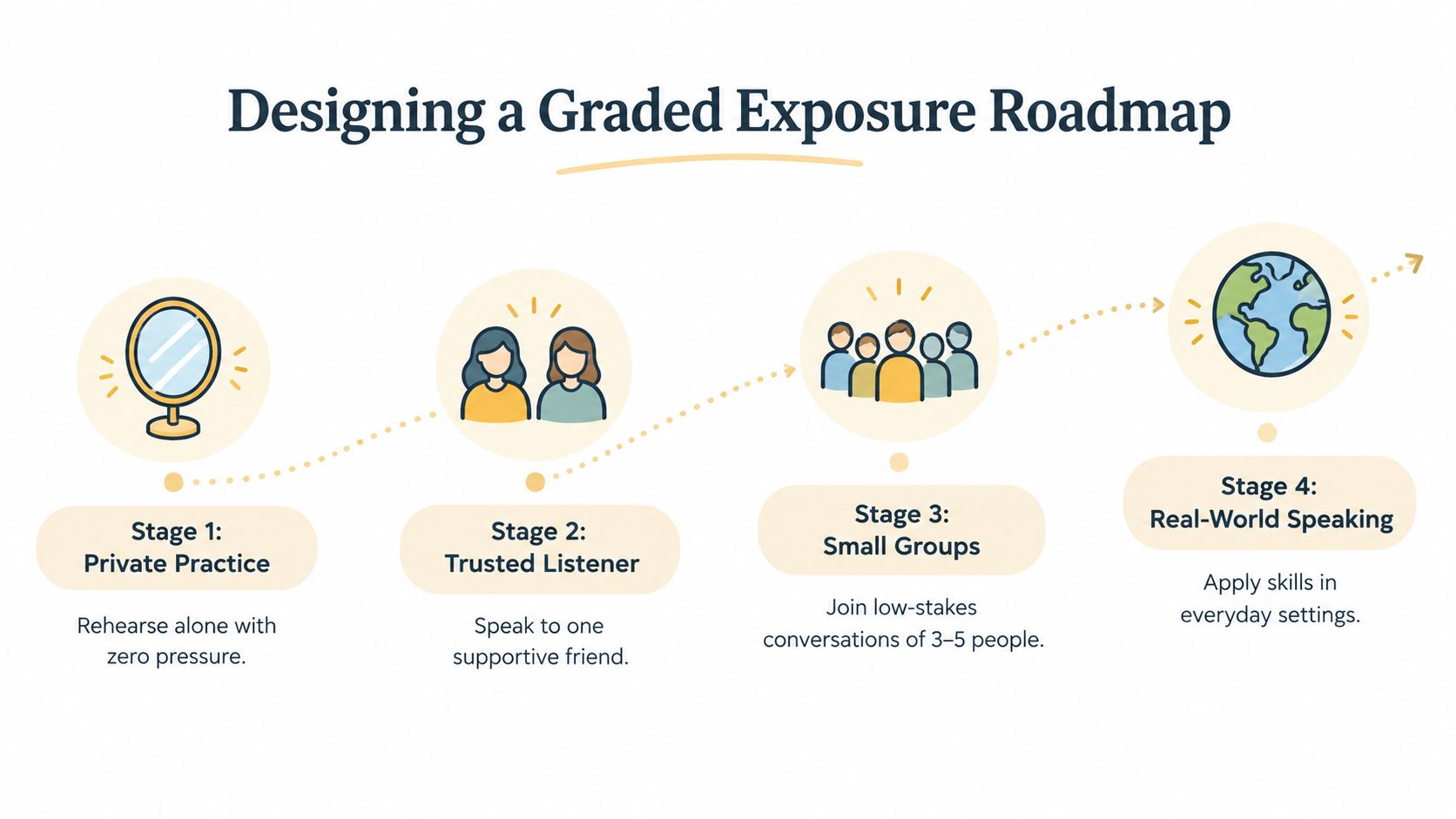
Jumping from silent study to a fast conversation with strangers is a poor test of ability. The task may combine unfamiliar vocabulary, social judgment, noise, speed, and the pressure to respond immediately. A graded exposure roadmap separates those demands so you can strengthen one layer before adding the next.
Stage 1, private practice
Start where no one else needs to hear you. Read a dialogue aloud, shadow a short recording, describe what's in your room, or answer a predictable question into your phone. The point isn't to perform. It's to make your mouth produce the language without waiting for perfect internal planning.
Stay at this stage until you can complete a short prompt without abandoning it after a mistake. You don't need smooth speech. You need the ability to continue.
Stage 2, one trusted listener
Choose a patient friend, tutor, or classmate. Agree on the purpose before starting, such as speaking for a few minutes without interruption and saving corrections for the end. A supportive listener lowers the social stakes while preserving the unpredictability of another person's response.
Graduate when you can ask for clarification and respond to a follow-up question. If you can only deliver memorized lines, keep practicing interactive turns before increasing the audience.
Stage 3, small groups
Move into low-stakes conversations with a few participants. Choose a language exchange, study group, or role-play built around familiar situations, such as making weekend plans or discussing a recent meal. Prepare two ideas and two questions, then aim to contribute rather than dominate.
Small groups teach an important skill that solo practice can't provide: entering a conversation already in progress. Your target is not constant fluency. It's taking a turn, listening for the next opening, and returning after someone speaks.
Stage 4, real-world speaking
Use the language for practical tasks, beginning with situations where the outcome matters but the consequences are manageable. Ask for directions, order food, greet a neighbor, or make a simple appointment. Keep a fallback phrase ready, but don't use it as an excuse to end the interaction immediately.
Graduation test: Move forward when the current task feels repeatable, not when it feels perfect. Mild nervousness is acceptable. Overwhelm means the step is too large.
A 14-week process combining mini-speeches, presentations, and scaffolded feedback reduced EFL speaking anxiety by about 30%, with participants identifying more speaking opportunities, greater self-confidence, and learning from mistakes as important mechanisms (study of scaffolded speaking practice and EFL anxiety). The lesson is practical. Exposure becomes more useful when each attempt produces information you can apply to the next attempt.
Daily Micro Drills for Fluency and Pronunciation
Speaking confidence grows from regular output, not occasional heroic sessions. A short daily routine works because it gives you frequent contact with the physical actions of speaking, including breath control, sound placement, rhythm, retrieval, and self-correction.
A compact practice circuit
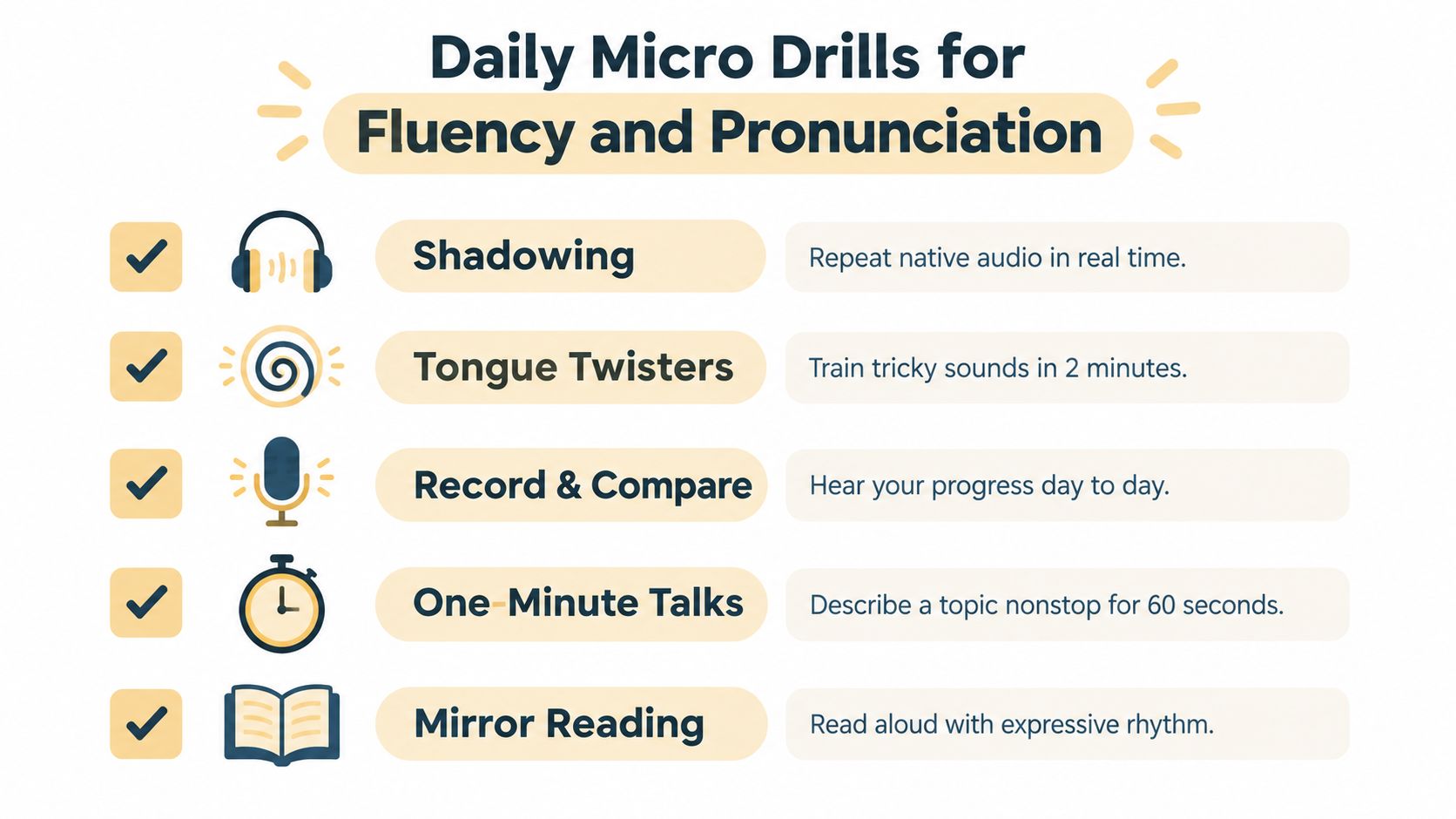
Shadowing trains timing. Play a short sentence from a reliable audio source and repeat along with it, matching pauses, stress, and connected sounds rather than translating each word. Start with a manageable clip and replay it until your voice can follow the speaker without constant hesitation.
Sound targeting isolates a pronunciation problem. Select one difficult sound from a word you regularly use, say it slowly, then place it in a short phrase. Contrast helps: record the target word beside a familiar word with a similar sound and listen for the difference.
Record and compare gives you evidence that memory can't provide. Record a short answer to the same prompt on different days, then listen for one feature only, such as final consonants, vowel length, or sentence stress. Don't turn the review into a search for every flaw.
One-minute talks build retrieval stamina. Choose a simple topic, such as your breakfast, your route to work, or a film you watched, and speak continuously. If a word disappears, describe it, use a simpler term, or say that you don't know the word yet.
Mirror reading connects pronunciation to expression. Read a short passage aloud while watching your mouth and posture. Add natural pauses and emphasis instead of giving every word the same weight. Guidance on targeted ways to improve pronunciation can help you choose more focused sound practice.
Remove fillers without creating silence
Native-language fillers often appear when your brain needs planning time. Rather than demanding silence immediately, replace repeated fillers with a deliberate pause or a useful bridge phrase, such as “The main point is…” or “Let me think about that.”
Keep a simple log after recording. Note the filler you use most, mark one place where a pause would work, and repeat the sentence. Your goal is not to sound artificially formal. It's to make pauses feel intentional instead of apologetic.
Practice can fit into ordinary routines. Shadow audio while preparing breakfast, describe objects during a walk, or record a one-minute answer before starting work. The setting matters less than producing speech often enough for the process to become familiar.
Accelerating Progress with AI Conversation Partners
A conversation partner is valuable because live speaking creates decisions that worksheets can't reproduce. You need to choose words, respond to meaning, notice whether the listener understands, and keep going after an imperfect sentence. When a human partner isn't available, a voice-first AI tool can provide a repeatable practice environment without making every attempt feel like a public performance.
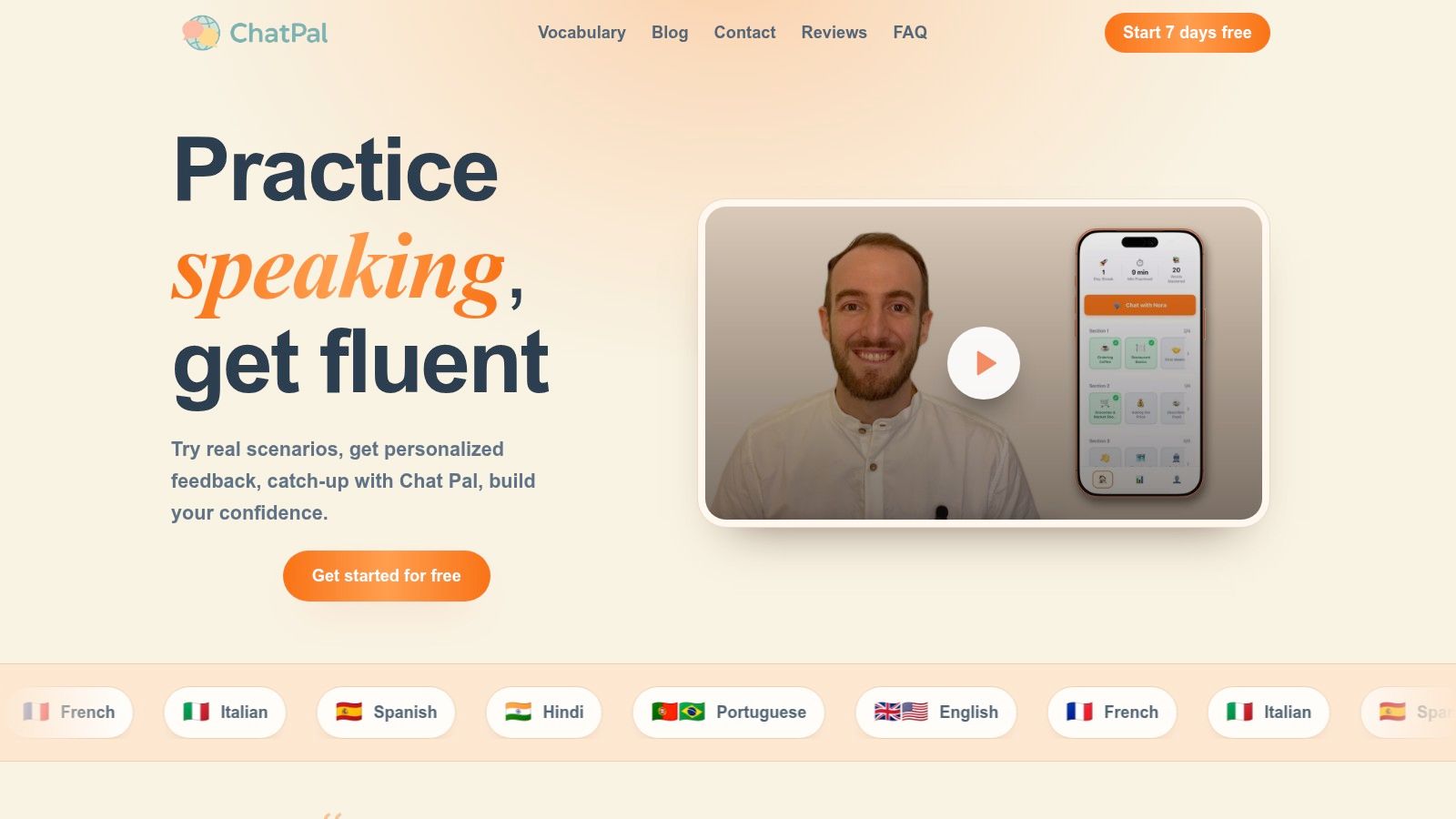
ChatPal lets learners speak aloud with an AI partner, Nora, in realistic scenarios such as ordering food, making plans, navigating travel, and handling everyday small talk. It also supports open conversation, which is useful when a learner wants to practice spontaneous answers rather than follow a fixed dialogue. After a session, the app provides a recap of grammar mistakes, pronunciation issues, and clearer ways to phrase what was said.
Turn feedback into a loop
Use AI conversation practice with a specific purpose. Before starting, choose one target, such as past-tense verbs or asking follow-up questions. During the conversation, prioritize meaning over perfect form. Afterward, review only a small group of corrections, say the improved versions aloud, and use them in a fresh response.
That sequence matters because feedback without reuse stays passive. A correction becomes useful when you retrieve it, pronounce it, and place it into another meaningful sentence. This is how a speaking session supports both confidence and accuracy.
A tool like ChatPal shouldn't replace teachers, friends, or real-world interaction. It can accelerate the practice loop by making spoken repetition available when native speakers aren't nearby. Learners can use a voice-based AI language learning app for rehearsal, then carry the phrases and coping strategies into human conversations.
The best scenario is one that is slightly challenging but still familiar. Try a hotel check-in before traveling, a workplace introduction before a meeting, or a casual conversation about weekend plans. If the exchange overwhelms you, reduce the topic, slow the pace, and repeat the same scenario with a narrower goal.
A short product demonstration can make the practice format easier to understand:
Use the recap as a training record, not a verdict on your ability. Save phrases that you want to reuse, notice recurring pronunciation patterns, and return to the same type of conversation until your response becomes less effortful.
Building Cultural Connections Through Speech
A language becomes useful when it lets you take part in another person's world. Grammar provides the structure, while speech puts that structure into a relationship. A greeting to a neighbor, a question in a market, or a conversation with relatives turns stored knowledge into participation.

Speaking also connects cultural understanding to ordinary routines. It can deepen relationships and broaden awareness of different backgrounds, as described in this overview of why studying a foreign language matters. Each short exchange gives you a chance to notice how people greet, explain, soften requests, and show interest.
Confidence creates participation
You do not need native-like speech to communicate respect or curiosity. You need enough functional confidence to ask, listen, clarify, and try again. Cross-cultural communication relies on two-way conversation, empathy, mutual understanding, and cooperation across different backgrounds (why cross-cultural communication supports intercultural success).
Treat mistakes as adjustments in a working system. A correction shows which sound, phrase, or response needs another repetition. Record that correction, use it in a new sentence, and bring it into your next low-pressure exchange. Confidence grows through this loop, much like a physical skill improves through controlled practice.
Schools and language programs can strengthen the process by creating regular opportunities to speak, reflect, and connect language with culture. Tools for organizing instruction, including Tutorbase for language schools, can support that environment while learners develop a daily speaking routine.
Speech forms a practical cultural bridge. Travelers can ask for directions, professionals can collaborate across borders, families can reconnect with heritage languages, and communities can include more voices. A brief rehearsal prepares you for a human exchange in a way that a vocabulary score alone cannot.
Start with one spoken task today. Describe your surroundings, answer a familiar question, or rehearse a conversation you expect to have. Record one sentence, then improve its wording or pronunciation tomorrow.
ChatPal offers voice-first practice with Nora, everyday scenarios, and post-session feedback on grammar, pronunciation, and phrasing for beginner and intermediate learners. Visit ChatPal to build a consistent speaking habit with a free 7-day trial.