
Blog
Overcoming the Fear of Making Mistakes in Speech
Conquer your fear of making mistakes in language learning. Discover the psychology behind speaking anxiety and practical strategies to build real fluency.
You know the grammar. You recognize the words when someone else says them. You may even rehearse the sentence in your head before opening your mouth. Then a native speaker asks a simple question, and the answer disappears. Your mind searches for the correct tense, your pronunciation feels suddenly uncertain, and the conversation moves on while you remain quiet.
That experience can feel like a personal failure, but it usually reflects a specific barrier rather than a lack of intelligence or ability. Fear of making mistakes turns speaking into a public performance, even though language exists for something much more valuable: human connection.
Language learning gives people a way to cross cultural distance. A greeting, a shared joke, a question about someone's home, or an imperfect attempt to order a meal can open a door that translation alone can't open. Speaking is the puzzle piece that turns knowledge into participation. The aim isn't flawless performance. It's the willingness to use what you know, listen closely, repair misunderstandings, and keep the conversation moving.
The Silent Barrier to Real Conversations
A learner arrives at a café abroad with a sentence prepared. They know how to ask for a coffee, understand the relevant vocabulary, and have practiced the grammar in writing. The server responds with a quick follow-up question, perhaps about size or milk, and the learner freezes. A nod replaces a sentence. The exchange ends politely, but the learner leaves with the painful impression that all the studying failed.
It didn't fail. The learner encountered the gap between recognizing language and producing language under social pressure. Reading and listening allow time to process. Conversation demands several actions at once: retrieve words, form a sentence, pronounce it, interpret the response, and decide what to say next. Fear adds another task, monitoring how the speaker might be judged.
This is why capable learners often remain silent. They may understand a great deal but treat every spoken sentence as evidence of competence. A small error then feels larger than it is, because the speaker isn't only communicating an idea. They're also trying to protect their reputation.
Speaking practice isn't a final exam for the language you know. It's how passive knowledge becomes usable knowledge.
That distinction matters beyond travel. A professional may need to contribute in a meeting. A student may need to answer an oral question. A heritage learner may understand family conversations but struggle to respond quickly. In each case, the person needs repeated chances to speak before the situation feels ordinary.
The wider purpose makes that effort worthwhile. Every language carries humor, customs, histories, and ways of seeing the world. Speaking lets learners meet people as participants rather than observers. An imperfect sentence can create warmth because it shows curiosity, respect, and a willingness to cross the distance between cultures.
The Psychology Behind Speaking Anxiety
A learner may know the right phrase, rehearse it to themselves, and still stop when another person is listening. The hesitation often reflects a calculation of social cost: if the sentence is wrong, will someone laugh, correct them publicly, misunderstand them, or judge their ability? A low-risk exchange can then feel like a public test.
Research on perfectionism helps explain this reaction. A psychology paper identified concern over mistakes and perceived pressure to be perfect as important links between perfectionism and fear of failure. Improvement is not the problem. The difficulty begins when one error becomes evidence that the entire performance, or the person speaking, is unacceptable.
A review of language-learning anxiety also connects fear of mistakes with fear of negative evaluation and perfectionistic self-presentation. Public errors can feel more threatening than private ones, so a learner may speak comfortably alone but lose access to familiar language in front of another person. Public speaking anxiety self-help tips offer further techniques for understanding and managing this evaluation response.
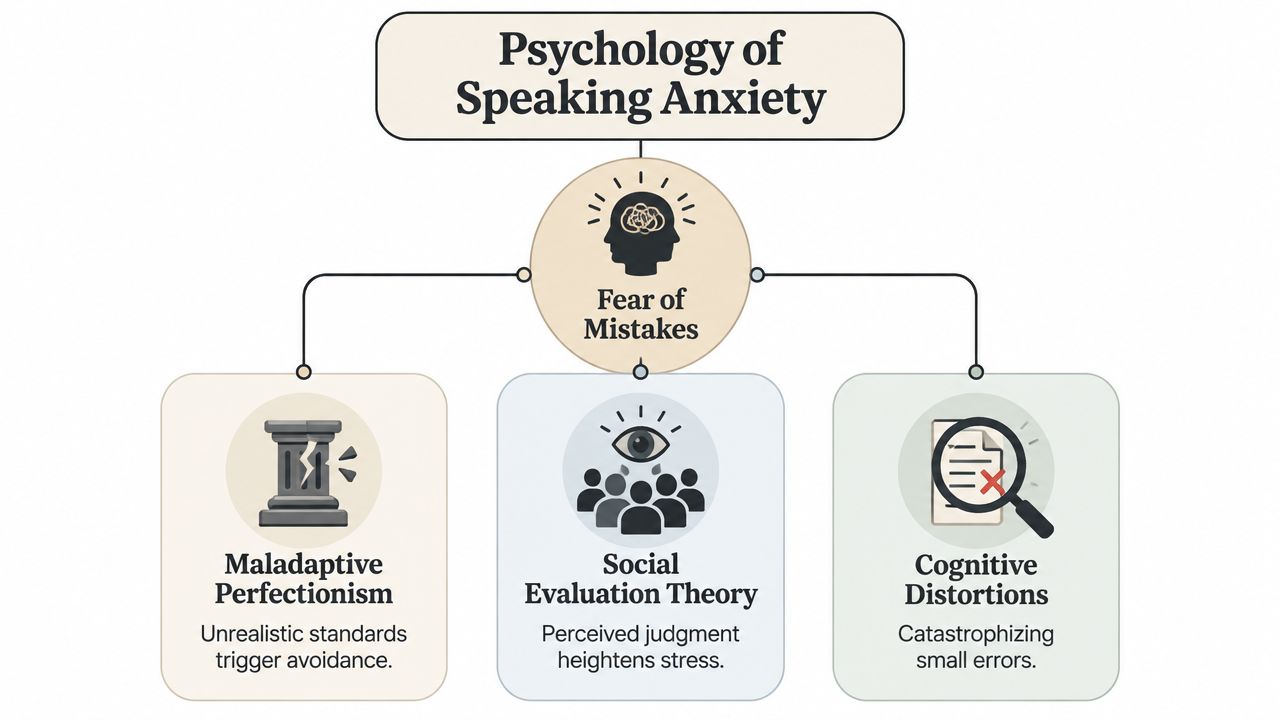
Skill gaps and social threat
Ask: What exactly feels dangerous about speaking?
A vocabulary problem calls for retrieval practice. A pronunciation problem may improve through targeted feedback. If the learner knows the phrase but avoids saying it because another person might notice an error, evaluation, rather than knowledge, is driving the silence.
These factors can overlap. Uncertain pronunciation may lead a learner to predict embarrassment, avoid speaking, receive less practice, and remain uncertain. The silence then acts like a protective wall that also keeps the fear intact.
A large study of children found that fear of making mistakes was common but not universal. 61% reported never or almost never fearing mistakes in the previous seven days, while 14% reported fearing mistakes always or often (the study). The researchers also found a significant link between higher global self-worth and lower fear of mistakes. For language learners, this suggests that self-perception can affect the willingness to risk a sentence, even when the necessary knowledge is available.
Why preparation alone may not work
Planning can create order without removing the fear of evaluation. The same child-focused study found that action planning was positively associated with increased fear of mistakes. Preparation may sharpen attention to every possible failure.
Practice must therefore provide evidence that an imperfect sentence has a limited social cost. Low-pressure AI or trusted peer conversations can function as reputation-safe rehearsal: the learner tests a phrase, receives manageable feedback, and discovers that an error does not define their ability. Resources on language-learning motivation can support this process, while repeated practice keeps motivation connected to an activity the learner can sustain.
Why Passive Knowledge Increases Hesitation
More grammar study doesn't always produce more speaking confidence. For an intermediate learner, returning student, heritage speaker, or lapsed learner, additional silent study can widen the gap between what they understand and what they can produce quickly.
Passive knowledge gives the internal editor more material to criticize. A learner may know that a verb should take a particular ending, recognize several natural alternatives, and hear a subtle pronunciation difference. During conversation, that awareness can slow production. Instead of selecting a workable phrase, the learner searches for the perfect one.
The result is a silence loop:
- The learner studies and understands more.
- Their standards for accuracy become more demanding.
- Speaking reveals gaps between knowledge and speed.
- Fear encourages avoidance.
- Avoidance limits the practice needed for faster production.
The loop doesn't mean grammar is unimportant. Grammar gives speech structure, and vocabulary gives it substance. The mistake is expecting silent knowledge to perform automatically in a live exchange.
Understanding more than you can say
Consider a learner who can follow a podcast about familiar topics but can't describe their own weekend without long pauses. Listening provides contextual support. The speaker supplies the words, the rhythm, and much of the grammatical structure. Speaking removes those supports and requires active retrieval.
That learner doesn't need to start from the beginning. They need to convert known language into rapid, imperfect output. Short spoken responses, paraphrasing, repetition, and role-play create that conversion. The focus should be on getting an understandable message across, then improving one feature at a time.
A 2026 study reported that 44.1% of students said fear of grammatical errors frequently or strongly inhibited oral participation (the study report%20The%20Fear%20of%20Making%20Mistakes%20and%20Its%20Relationship%20with%20the%20Low%20Production%20of%20Speaking%20Skill%20(2).pdf)). It identified limited vocabulary, pronunciation uncertainty, and grammar accuracy as major triggers. Those findings point toward a combined solution: practice that elicits speech, feedback that identifies the actual issue, and repetition that makes production less effortful.
Replace silent review with vocal rehearsal
Take a familiar topic such as ordering food. Rather than rereading a dialogue, say the request aloud, change one detail, answer a likely follow-up, and recover when a word is missing. “I'd like the vegetable soup” can become “Could I have the soup without cheese?” or “What do you recommend?”
This kind of rehearsal creates useful imperfection. Learners discover which words disappear under pressure, which sounds feel difficult, and which sentence patterns need more automaticity. A practical guide to learning to speak a foreign language can help turn that insight into regular speaking behavior.
Reframing Errors as Cultural Bridges
An error in conversation isn't automatically a social failure. Often, it's evidence that the learner has taken the risk required to participate. Someone who stays silent can protect a perfect image, but they also lose the chance to ask, respond, joke, clarify, and build familiarity.
Native speakers usually care more about shared meaning than grammatical perfection. They may correct a phrase, ask a follow-up, or offer a word. Those responses can become part of the interaction rather than a verdict on the learner's ability. A mispronounced word may lead to a smile and clarification. A strange phrase may prompt the listener to explain a more natural expression. The conversation becomes collaborative.

The value of visible effort
A carefully memorized phrase can be useful, but an imperfect attempt often communicates something extra: “This relationship matters enough to make an effort.” That message can cross cultural boundaries even when the sentence isn't polished.
The same principle appears in communication beyond spoken languages. Learning about understanding deaf culture as a culture shows why communication should be approached with respect for community, identity, and shared norms rather than reduced to technical correctness. Language is connected to people and culture, not just a collection of forms to reproduce accurately.
A learner ordering food might use the wrong article but still receive a friendly explanation. A traveler might confuse two words and create a brief moment of humor. A professional might phrase an idea awkwardly and invite a colleague to clarify. These moments can feel uncomfortable, yet they often produce more authentic contact than staying quiet.
A better question after an error
Perfectionism asks, “How bad did that sound?” A connection-focused learner asks:
- Did the other person understand the main message?
- What did the exchange teach about natural usage?
- Which correction is worth practicing next?
- Did speaking create an opportunity that silence would have removed?
That change doesn't require pretending errors feel pleasant. It places them inside a larger purpose. The objective is not to perform a flawless identity. It's to remain present while communicating with another human being.
The mistake is temporary. The relationship made possible by speaking can continue.
Evidence-Based Strategies for Building Tolerance
Confidence grows more reliably when practice produces clear information. “Speak more” is incomplete advice if every attempt leaves the learner wondering what went wrong. A useful routine separates attempt, feedback, interpretation, and retry.
Pronunciation research supports this structure. A Cambridge Handbook chapter reports that quasi-experimental studies generally found corrective feedback supports both segmental and suprasegmental pronunciation development, especially when learners have enough phonetic knowledge, conversational experience, and awareness of target sounds. Feedback works better when it includes a model form rather than only a prompt (the Cambridge Handbook chapter).
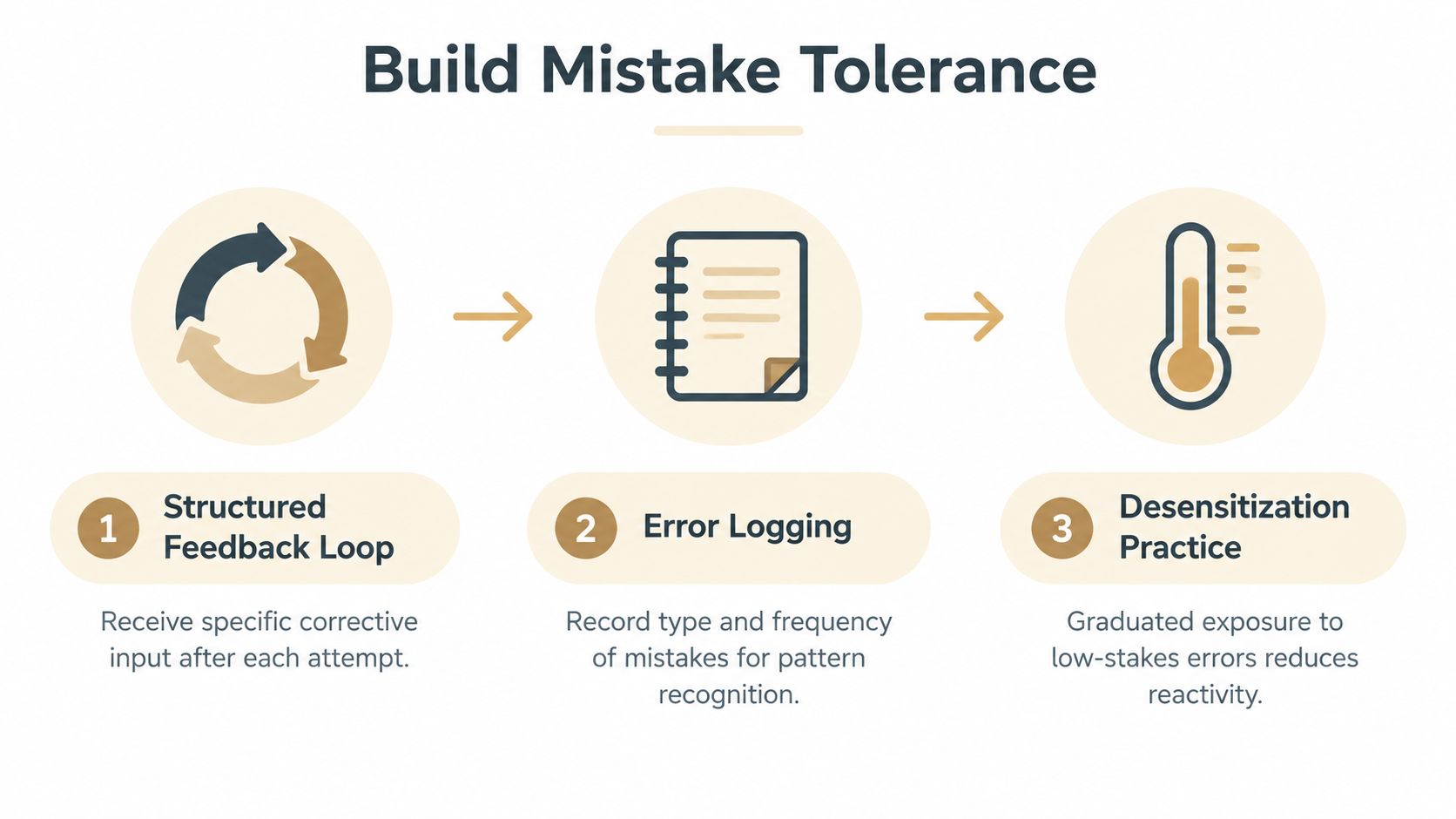
Build a feedback loop
Use this sequence after each short speaking attempt:
- Speak without interruption. Finish the idea, even if you need to paraphrase.
- Select one target. Choose pronunciation, grammar, vocabulary, or phrasing. Don't correct everything at once.
- Compare with a model. Listen to or read a natural version, then repeat it.
- Use it again. Put the corrected form into a new sentence.
Mobile pronunciation research with 84 Chinese EFL university students found that all three groups improved, while groups using peer feedback outperformed the autonomous ASR-only group. The paper reported gains in comprehensibility, segmental accuracy, and word-stress accuracy (the mobile-assisted pronunciation study). The practical lesson isn't that every learner needs a peer for every session. It's that feedback should be interactive and usable, not merely a score.
Another study found that trainees receiving corrective feedback with 100% accuracy or 66% accuracy improved more than those receiving feedback with 33% accuracy, but the authors also concluded that more accurate feedback doesn't necessarily produce greater pronunciation gains (the feedback study). Consistency and clarity matter more than chasing an impossible standard.
Log patterns, not shame
After practice, record the error neutrally:
- “Dropped past-tense ending”
- “Paused when describing time”
- “Unclear vowel in a familiar word”
- “Used a direct translation”
A log turns a global judgment, “I'm bad at speaking,” into a specific training target. Automatic speech recognition can help, but an independent review found that ASR worked better for segmental sounds than suprasegmental features, longer treatments were more effective, and peer practice improved results. The review also found explicit feedback outperformed implicit feedback, while both supported improvement (the ASR review).
ChatPal offers one example of a voice-first environment where learners can rehearse realistic conversations with an AI partner, receive recaps about grammar, pronunciation, vocabulary, and phrasing, and retry without a human audience. It can accelerate learning, but peer conversation and real-world interaction still matter because learners eventually need to transfer practice into relationships.
A supportive learning environment should make correction specific, respectful, and limited enough to use. The aim isn't to remove every error before conversation. It's to teach the learner that an error can lead directly to adjustment and another attempt.
Designing a Low-Pressure Speaking Routine
A speaking routine should reduce the size of the risk before increasing the difficulty. Start privately, move toward simulated interaction, and then bring the same language into real conversations. This progression treats speaking as a physical habit, not an intellectual test.
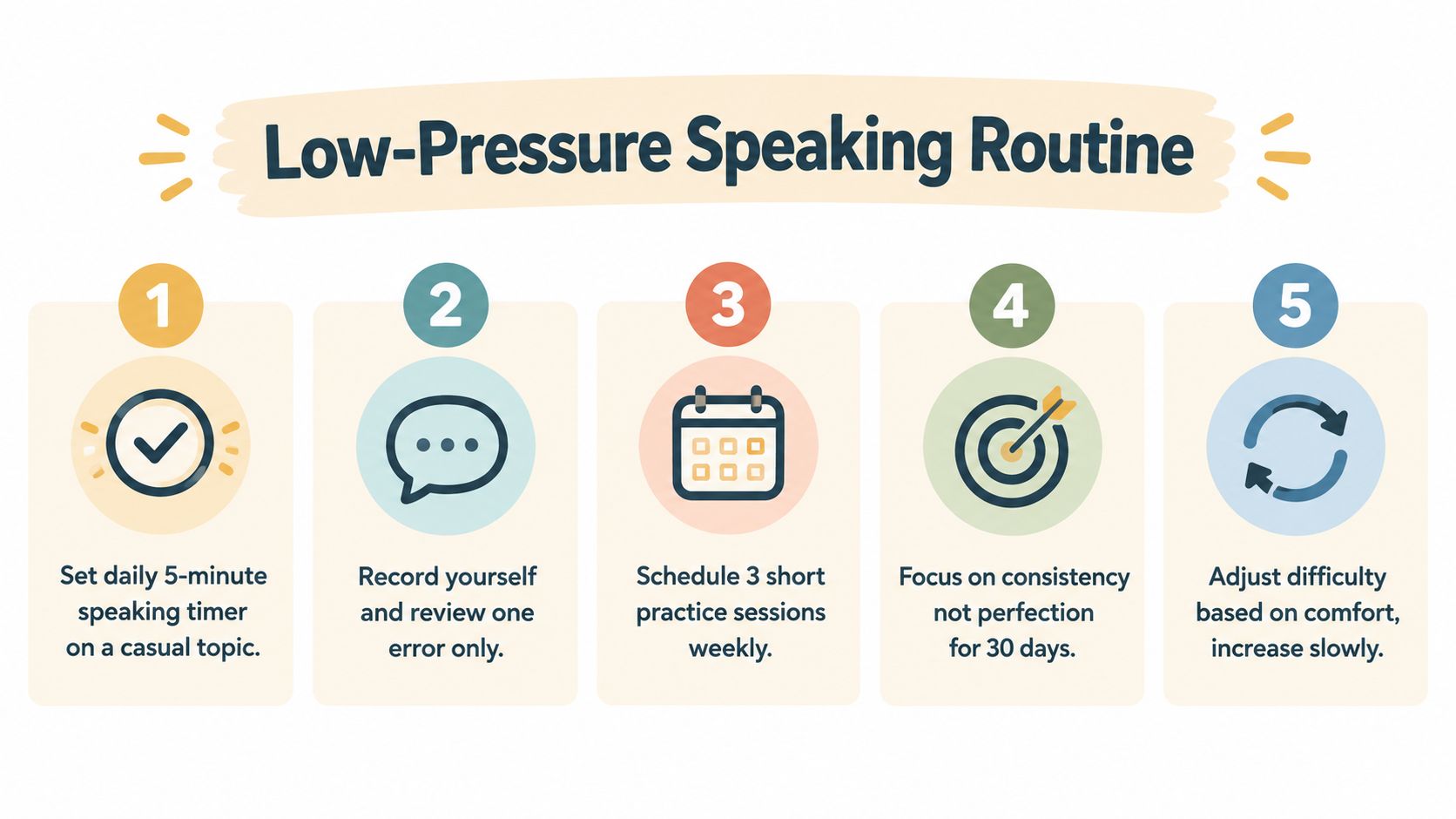
Use a simple five-part structure:
- Choose one everyday situation. Pick ordering food, introducing yourself, making small talk, asking for directions, or discussing a work task.
- Speak on a short timer. Describe the situation aloud without stopping to search for perfect wording.
- Review one error. Record yourself or use a feedback tool, then select a single correction.
- Repeat with a small change. Keep the same topic but alter the person, place, time, or request.
- Increase difficulty slowly. Add follow-up questions, less familiar vocabulary, or a more spontaneous response only when the current level feels manageable.
A practical weekly rhythm
Keep the routine predictable. Use private voice rehearsal for familiar topics, conversation simulation for unpredictable questions, and peer or tutor practice for genuine social exchange. Each setting serves a different purpose.
A traveler preparing for a trip might rehearse checking into a hotel, then practice answering an unexpected question about payment or luggage. A professional might explain a project update, review one unclear phrase, and repeat the explanation with a colleague. A heritage learner might describe a family tradition, note missing vocabulary, and ask a relative for the natural expression.
Schedule three short practice sessions weekly and keep daily speaking brief enough to repeat. The routine described in personalized learning paths can help learners adjust topics and difficulty to their level instead of forcing every speaker through the same sequence.
Measure behavior, not perfection
Track whether you spoke, whether you completed the attempt, and whether you used one correction. Don't make confidence the entry requirement. Confidence often arrives after repeated evidence that speaking is survivable.
If a topic causes intense hesitation, reduce the challenge. Use sentence frames, familiar vocabulary, or a private rehearsal first. If a topic feels easy, add a follow-up question or remove preparation time. Gradual exposure works because it increases contact with uncertainty without overwhelming the learner.
Taking the First Step Toward Fluency
You know the answer, but a colleague looks your way and the sentence disappears. The barrier may involve vocabulary or grammar, yet it may also involve a social calculation: What will an observer conclude if I speak imperfectly? A mistake can feel like a risk to competence, belonging, or reputation. Fluency grows when learners gather evidence that imperfect speech does not erase their ability.
The evidence supports a practical approach. In children, fear differs among individuals, and higher global self-worth is linked with lower fear of mistakes (the child study). Workplace research covering 1,000 people found that more than 40% feared failure and mistakes 20% to 40% of the time or more. One out of two believed they could perform better without that worry (the workplace research). Fear is common, but repeated, safer practice can change how costly speaking feels.
A conversation turns stored knowledge into social experience. Each exchange shows how people respond, which expressions create warmth, and how speakers repair confusion. A mistake may become a question, correction, laugh, or story. Silence offers none of that feedback.
Start with a reputation-safe rehearsal today. Use a low-pressure AI conversation or a trusted peer before speaking in a higher-stakes setting. Choose a familiar topic, complete one exchange, review one error without self-judgment, and repeat the corrected phrase aloud. The first goal is continued participation, not polished fluency.
ChatPal provides beginner and intermediate learners with voice-first practice through Nora, an AI conversation partner, everyday scenarios, and recaps of grammar, pronunciation, vocabulary, and phrasing. Use the ChatPal free 7-day trial to practise privately, then carry one repaired sentence into a real conversation.