
Blog
You Want Something? Real Phrases for Real Talks
Learn natural English phrases for when you want something. Get real, everyday expressions to speak confidently in any conversation.

You're standing at a café counter with a coffee that needs more milk. You know the words, but the barista is busy, someone's waiting behind you, and suddenly asking feels harder than reading an entire page in English. Then the barista looks up: “You want something?” Is that a friendly offer, an impatient question, or ordinary conversation?
"The Moment When Words Get Stuck"
The difficult part of that café moment isn't necessarily milk. It's deciding how to enter the conversation without sounding demanding. You might rehearse "More milk, please," then wonder whether it's too direct, whether you should apologize, or whether the opportunity has already passed.
That hesitation deserves a kinder explanation than “Your English isn't good enough.” In a study of university students in Malaysia and China, self-perceived speaking competence, rather than measured proficiency or frequency of language use, significantly predicted language anxiety, according to research on speaking competence and anxiety. Knowing language and feeling able to use it aren't identical experiences.
A manageable conversational goal
At the counter, your task isn't to produce an impressive sentence. It's to help another person understand a small need. “Could you add a little milk, please?” does that without requiring a complicated explanation.
Practical rule: Choose a sentence that completes the interaction, not a sentence that proves how much English you know.
The same approach applies when you need a document before a meeting or want to join a conversation at someone's home. Notice the situation, choose a clear opening, and leave room for the other person to respond.
- At a counter: Wait until the staff member looks toward you, then make your request.
- During a meeting: Use a brief opening such as “Before we start…” rather than waiting for a perfect silence.
- With friends: Let the shared situation do some work. You don't need to explain everything from the beginning.
The phrase “You want something?” is useful because it invites that next turn. Understanding the invitation makes it easier to answer instead of getting trapped in silent rehearsal.
"What "You Want Something" Actually Means"
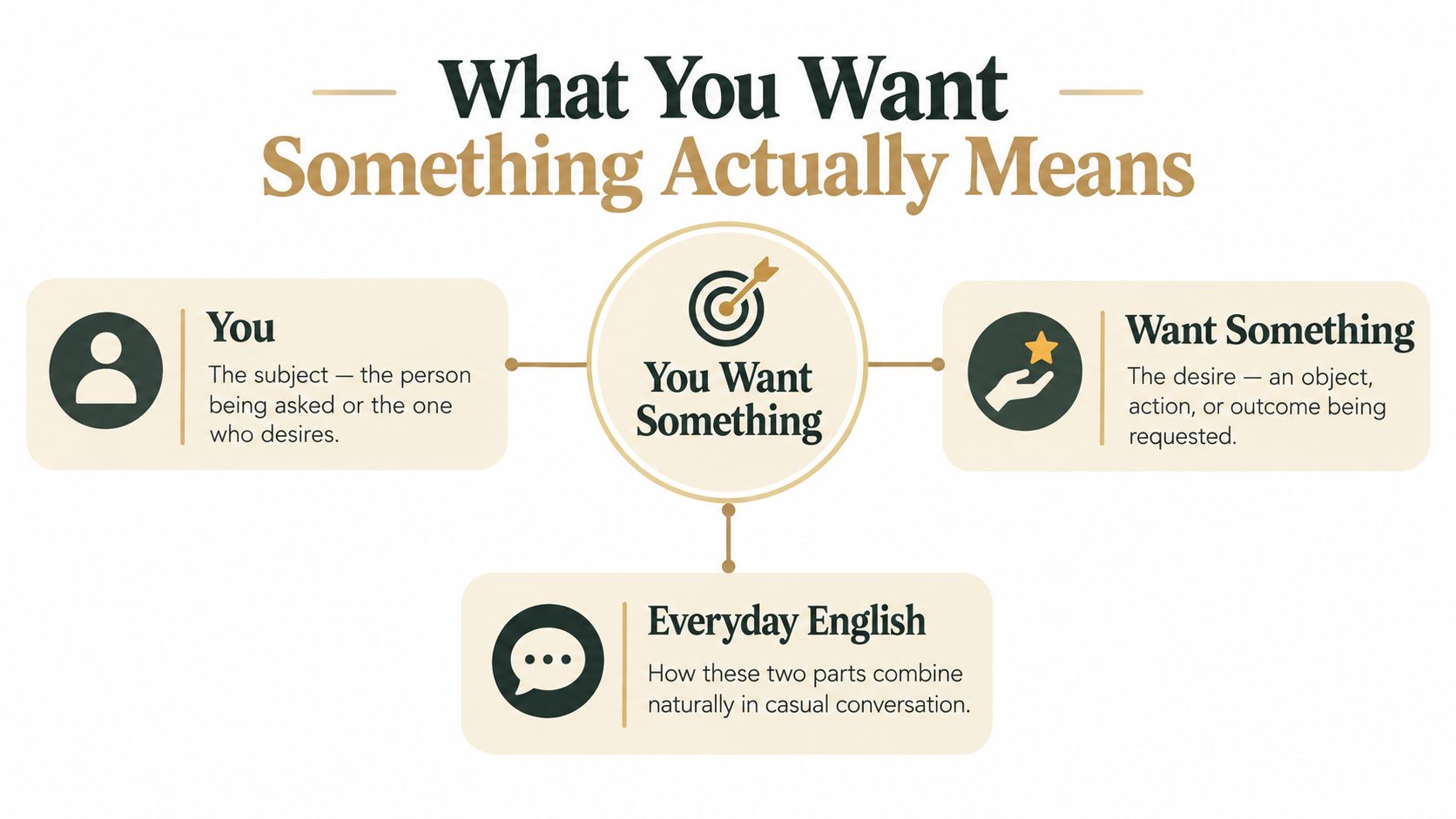
“You want something” has a straightforward foundation: you identifies the person, while want something describes a desire for an unspecified thing. Without a question mark or questioning delivery, it's a statement: “You want something, but you haven't said what.”
As a conversational question, “You want something?” usually means “Do you want something?” The speaker leaves out do, which makes the wording informal. It isn't automatically polite or gentle; the situation and delivery determine whether it sounds welcoming, curious, or suspicious.
The concept map separates the person from the desire being discussed.
An offer depends on context
A host standing beside a tray of snacks may use the question as an offer. A colleague noticing that you're waiting by their desk may use it to ask whether you need help. The grammar is similar, but the speaker's purpose differs.
| Phrase | Likely meaning in context |
|---|---|
| “You want something to drink?” | An offer of a drink |
| “Do you want something else?” | A question about an additional or different choice |
| “You want something from the shop?” | An offer to bring back an item |
| “You want something?” | An open question whose meaning needs context |
Something leaves the object unnamed. Adding to eat, to drink, or from the shop narrows the possibilities and makes answering easier.
Don't assume that a question must always use anything. “Would you like something to eat?” is a natural offer because the speaker presents food as an available possibility. For a refresher on how want works in statements and questions, review verbs in the present tense.
"Hearing the Phrase in Real Situations"
Listen for what happens around the question, not just the question itself. In these illustrative exchanges, a greeting, an explanation, or a follow-up gives the short phrase its purpose.
The settings below show how people's surroundings help listeners interpret an offer.

At the café
Barista: “Here's your coffee. Do you want anything else?”
Customer: “A little more milk, please.”
Barista: “Of course. Just say when.”
The barista signals that the main order is ready before checking for another need. The customer can answer with a short phrase because the context is already clear.
Before a meeting
Coworker: “There's time before everyone arrives. You want something from the kitchen?”
Colleague: “Some water would be great, thanks.”
Coworker: “Sure. Still or sparkling?”
The kitchen reference explains what kind of offer is being made. The follow-up shows why conversation practice needs more than a memorized opening: someone may ask you to make another choice.
At a friend's home
Host: “The snacks are on the table. You want something to eat?”
Guest: “Not right now, thanks. Maybe later.”
Host: “Help yourself whenever you're ready.”
Declining is a complete, successful response. You can acknowledge an offer warmly without accepting it or inventing a lengthy excuse.
For a listening break, use the video to notice pauses and delivery rather than concentrating only on individual words.
For travelers, preparing the surrounding social language matters too. Jasumo's basic Japanese sayings for first-timers is a relevant companion resource when preparing for Japan. In English, practicing how to make small talk can help you continue after the practical exchange ends.
"Softer, Stronger, and More Polite Ways to Say It"
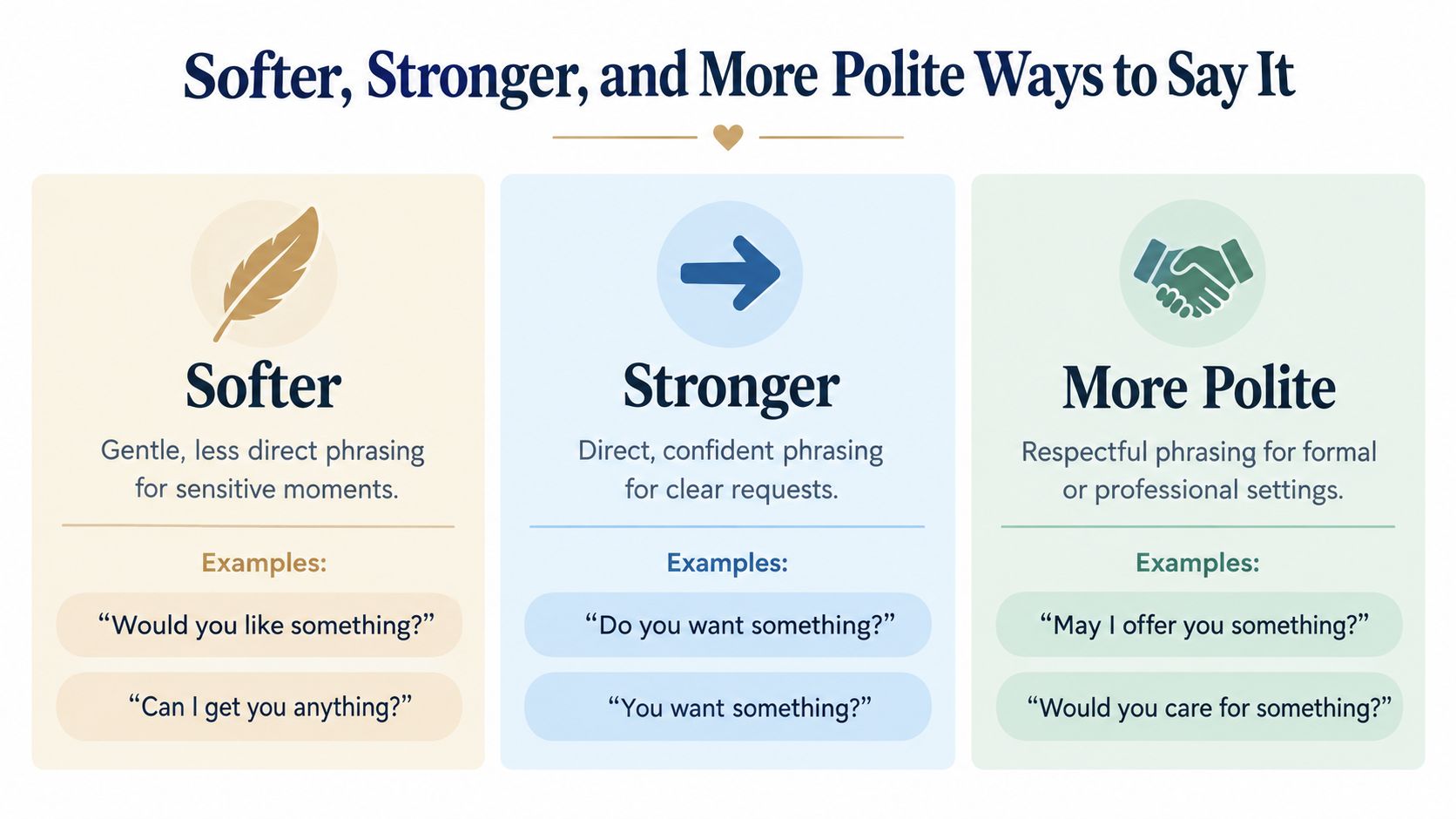
Choose an expression according to your relationship, your purpose, and the setting. A friend reaching for a snack doesn't need the same wording as a visitor arriving for a business appointment. More formal language isn't always warmer, and direct language isn't automatically rude.
The comparison below groups useful alternatives, but treat the labels as starting points rather than fixed rules.
| Expression | A suitable situation | What to notice |
|---|---|---|
| “Would you like something?” | Welcoming a visitor | A courteous offer, especially with a specific option |
| “Do you want anything?” | Checking with a friend | An ordinary, open question |
| “Can I get you something?” | Offering practical help | The speaker offers to take action |
| “Anything else?” | Finishing a service exchange | A brief check for additional needs |
| “May I offer you something?” | Formal hosting | Respectful, but potentially stiff among friends |
| “Would you care for something?” | A deliberately formal offer | Often more natural with an item named |
Be clear about who wants what
These expressions mostly ask about another person's wishes. They aren't interchangeable with making your own request. If you need water, “Would you like some water?” offers water to someone else; “Could you bring some water, please?” asks someone to bring it.
That distinction matters more than choosing the fanciest modal verb. Before speaking, decide whether you're offering, requesting, or checking a preference.
- For a sensitive offer: Give the person an easy way to decline. “Would you like some help, or would you prefer some space?”
- For a clear choice: Name the options. “Do you want tea or coffee?”
- For written hospitality: Make the proposed next step explicit rather than relying on a friendly voice.
Written replies deserve particular care because the reader can't hear your tone. For a travel-industry example of drafting assistance, Explola explains how to draft professional safari replies with AI. When reviewing any draft, check whether the wording offers something, asks for information, or makes a commitment.
Courtesy means making the other person's options clear, not adding formal words until the message becomes difficult to follow.
"Small Choices That Change How You Sound"
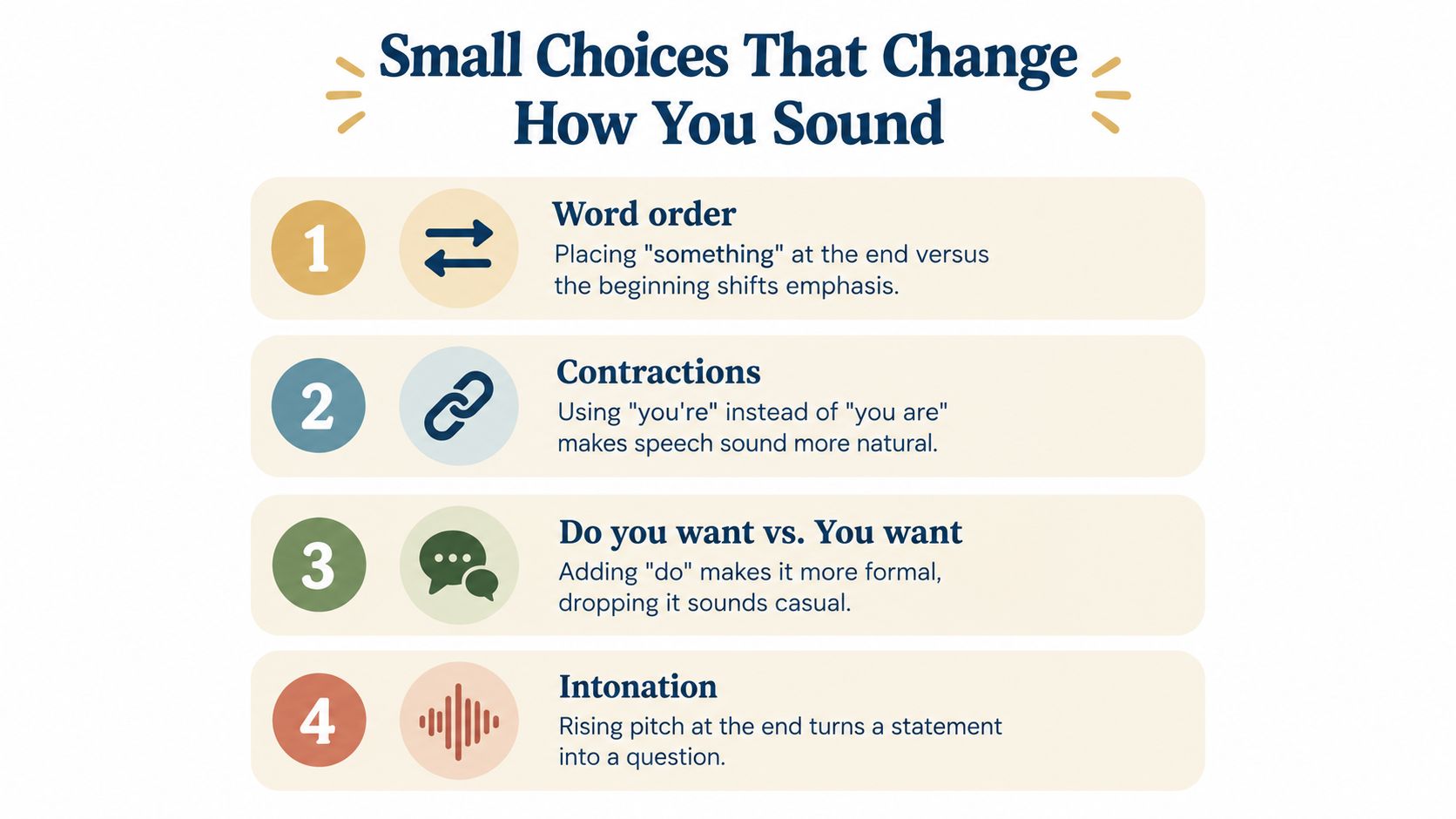
Compare saying “You want something?” while smiling beside a drinks tray with saying it sharply to someone standing in a doorway. The words are identical, but the listener has different reasons to interpret them as hospitality or confrontation. Intonation supports meaning; it doesn't work alone.
A rising pitch can help signal a question, especially with statement word order. But not every English question rises, and a rising ending doesn't guarantee friendliness. Give yourself a reliable starting point: an unhurried pace, a clear object when possible, and enough silence for an answer.
Use the visual as a checklist, with the grammatical distinctions below in mind.
Keep the grammar separate from the tone
“Do you want…?” is the standard question form, not a specifically formal one. “You want…?” is a conversational alternative. Using do is a dependable choice when you're unsure whether the shorter version suits the relationship.
Contractions also need care. You're means you are, so it can't replace you in “You want something.” “You're want something” is incorrect; natural contractions belong where the underlying grammar allows them, as in “You're welcome” or “There's some water.”
| Avoid | Prefer | Reason |
|---|---|---|
| “Do you wants something?” | “Do you want something?” | Use the base verb after do |
| “Something else you want?” | “Do you want something else?” | Standard question order is easier to interpret |
| “You're want a drink?” | “Do you want a drink?” | You're adds an unwanted form of be |
Moving something to the front doesn't create a neutral alternative. “Something you want?” is an elliptical expression that needs a suitable conversational context.
Don't copy casual speech by removing words at random. Start with a complete, dependable sentence, then learn which shorter forms fit the situation.
If someone hesitates after your offer, wait. Repeating the question immediately, especially more loudly, may create pressure rather than clarity.
"Practicing the Phrase Until It Feels Natural"
Practice the exchange, not just the opening line. Choose a familiar situation, such as welcoming a guest, and speak both the offer and a possible response aloud. Then continue until the practical need is resolved.
The CEFR's description of language activity distinguishes interaction from reception and production. That distinction is useful here: recognizing a question or saying a prepared sentence isn't the whole task. You also need to respond to what another person says.
Rehearse with a small surprise
- Begin with a stable setting: Put a cup on the table and rehearse offering a drink. Physical context gives the words a purpose.
- Change the answer: Accept, decline, or ask what's available. Don't always practice the easiest response.
- Add a complication: The requested drink has run out, or the guest wants a different option.
- Review selectively: Listen to a recording and choose a specific change, such as a clearer question ending or correct word order.
Don't make every attempt harder in every way. Keep the situation familiar while changing the response, then try a different setting once you can manage the exchange comfortably.
A useful practice target: Finish the conversation even when the reply isn't the one you expected.
A study partner can introduce those unexpected replies, while solo recordings let you hear whether you rush. For additional rehearsal ideas, use this guide to English speaking practice. Judge progress by what you can handle: accepting an offer, clarifying a choice, or repairing a misunderstanding without abandoning the conversation.
"Why Small Phrases Build Bigger Confidence"
A short offer can do more than organize a drink or a snack. It gives another person permission to express a preference, ask for help, or join an activity. When you learn to make that space in another language, you're practicing hospitality as well as grammar.
That connection matters beyond English. In the European survey described in Europeans and their languages, 45% identified understanding people from other cultures as a main benefit of language learning. Speaking gives learners a practical way to pursue that understanding through questions, invitations, and everyday exchanges.
Measure connection, not performance
You don't need to imitate someone else's personality to sound natural. You can be quiet, thoughtful, direct, or playful while still making your meaning clear.
- Notice participation: Did you ask instead of remaining silent?
- Notice understanding: Did the other person know what you meant?
- Notice recovery: Could you clarify when something went wrong?
For a broader approach to improving speaking confidence, keep those observable actions in view. A successful conversation doesn't require flawless delivery. It requires people willing to listen, respond, and make room for each other.
ChatPal offers voice-first conversations with Nora, an AI practice partner, plus session recaps covering grammar, pronunciation, and clearer phrasing. Visit ChatPal to rehearse an everyday offer, respond to a follow-up, and use that low-pressure practice alongside conversations with people.