
Blog
Hotel Check in Dialogue: 8 Scripts for Travelers in 2026
Learn the perfect hotel check in dialogue with 8 practical scripts for travelers. Confidently check in anywhere in 2026.

Speaking opens the door to confident travel because language learning does more than build vocabulary. It helps bridge cultures, and speaking enables the practical connection between knowing a phrase and using it with another person. Hotel reception is an ideal low-stakes setting: the exchange follows familiar patterns, yet it gives travelers a real chance to listen, respond, clarify, and ask for what they need.
Hotel check-in conversations are usually highly ordered service encounters. Research based on naturally occurring front-desk interactions in four hotels across England, Germany, and Spain found a consistent movement from arrival to stay to departure, with miscommunication occurring infrequently (doctoral study of hotel interaction). That predictability makes practice easier, but real confidence comes from handling the unexpected turns.
The eight hotel check in dialogue scripts below progress from a standard arrival to room requests, late procedures, language barriers, group arrangements, complaints, remote check-in, and concierge conversations. Use them aloud, change the details, and rehearse both sides. ChatPal can accelerate that process by letting learners practice with Nora and receive feedback on grammar, pronunciation, and phrasing, but conversation with people remains an essential part of language growth. Even practical travel preparation, such as choosing the right carry on bag, becomes easier when travelers can ask questions confidently.
1. Standard Hotel Check-In with Room Confirmation
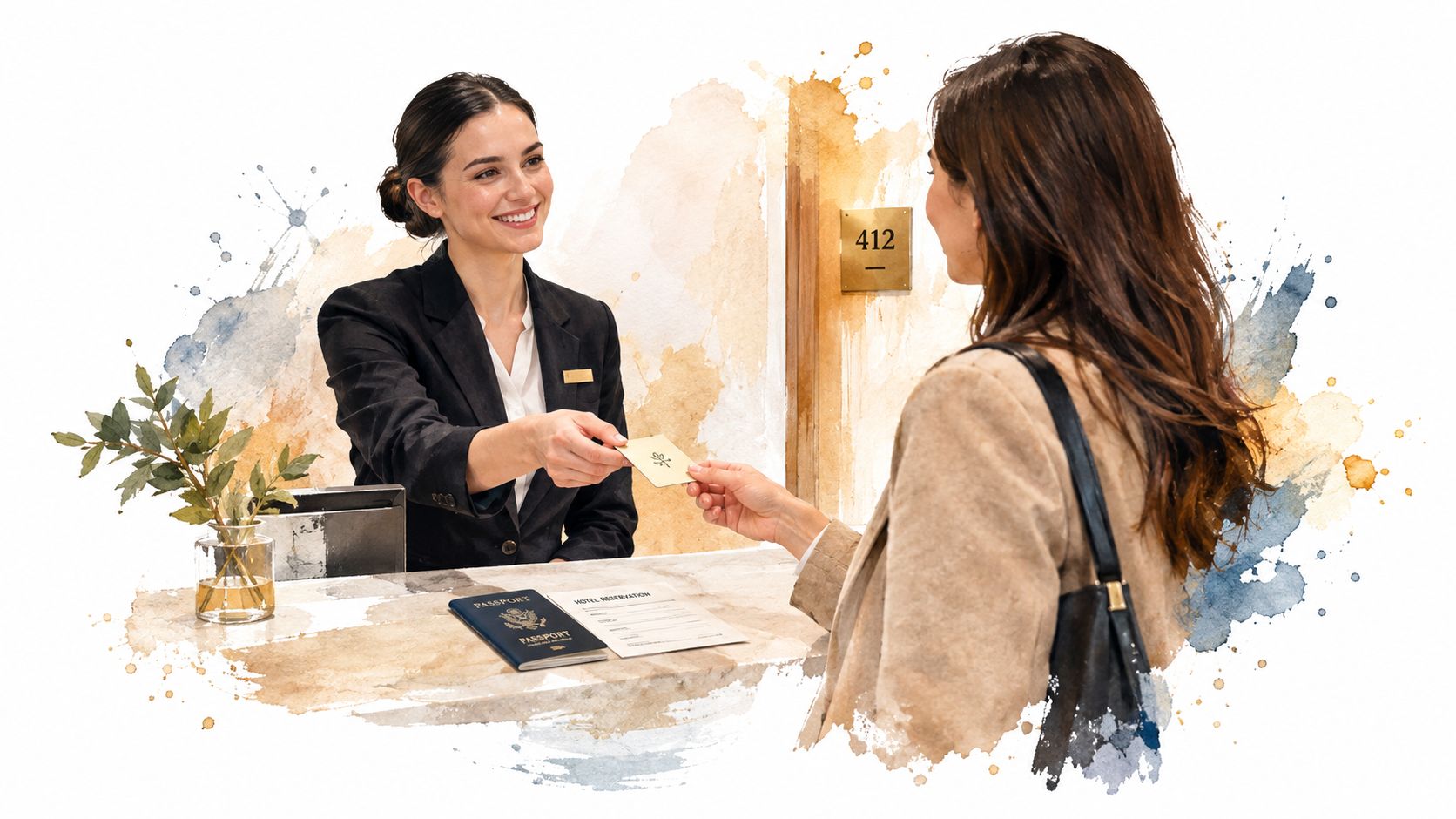
A clear check-in follows a predictable path, so learners can focus on listening instead of inventing every sentence. The usual sequence covers a greeting, the reservation name, identification, payment, room information, and key collection. At Double-Six Luxury Hotel Seminyak, researchers reported that staff often relied on spoken communication during check-in and did not use written communication in that process. The study also recorded frequent happy expressions, showing how facial expression supports the spoken exchange. How staff manage the desk, as described in this reception lobby ambassador setup, reinforces the same point: tone, eye contact, and expression work alongside the words (front-office communication study).
Guest: Good afternoon. I have a reservation under the name Patel.
Receptionist: Good afternoon. Welcome to the Grand Plaza Hotel. May I see your passport, please?
Guest: Of course. Here it is.
Receptionist: Thank you. You've booked a double room for three nights, correct?
Guest: That's right.
Receptionist: Could you confirm your payment method?
Guest: I'd like to pay by card.
Receptionist: Certainly. Your room is 407. Breakfast is served from seven to ten in the restaurant on the ground floor. Check-out is at noon.
Guest: Thank you. So, room 407, breakfast from seven to ten, and check-out at noon?
Receptionist: Exactly. Here's your key card.
Guest: Great, thank you.
Phrases that make the exchange clear
“I have a reservation under the name…” gives the receptionist the search detail immediately. A more formal alternative is “I believe I have a reservation in the name of…”. Repeating important information aloud works like checking a label before leaving the desk. “So, room 407, breakfast from seven to ten, and check-out at noon?” confirms several details without sounding confrontational. If something remains unclear, ask, “Could you confirm the check-out time?”
Practice room-related vocabulary carefully. Spanish habitación, Italian stanza, and French chambre sound different, so learners should follow the target language rather than apply English pronunciation. Say the room number back to the receptionist, prepare passport details, and ask about payment if the method differs from the booking.
Rehearse this complete exchange with other travel conversation starters, then use ChatPal voice practice to vary the room number, payment method, or receptionist's reply. Familiarity with the sequence leaves more attention for real pronunciation, polite alternatives, and unexpected questions.
2. Check-In with Special Room Requests and Modifications
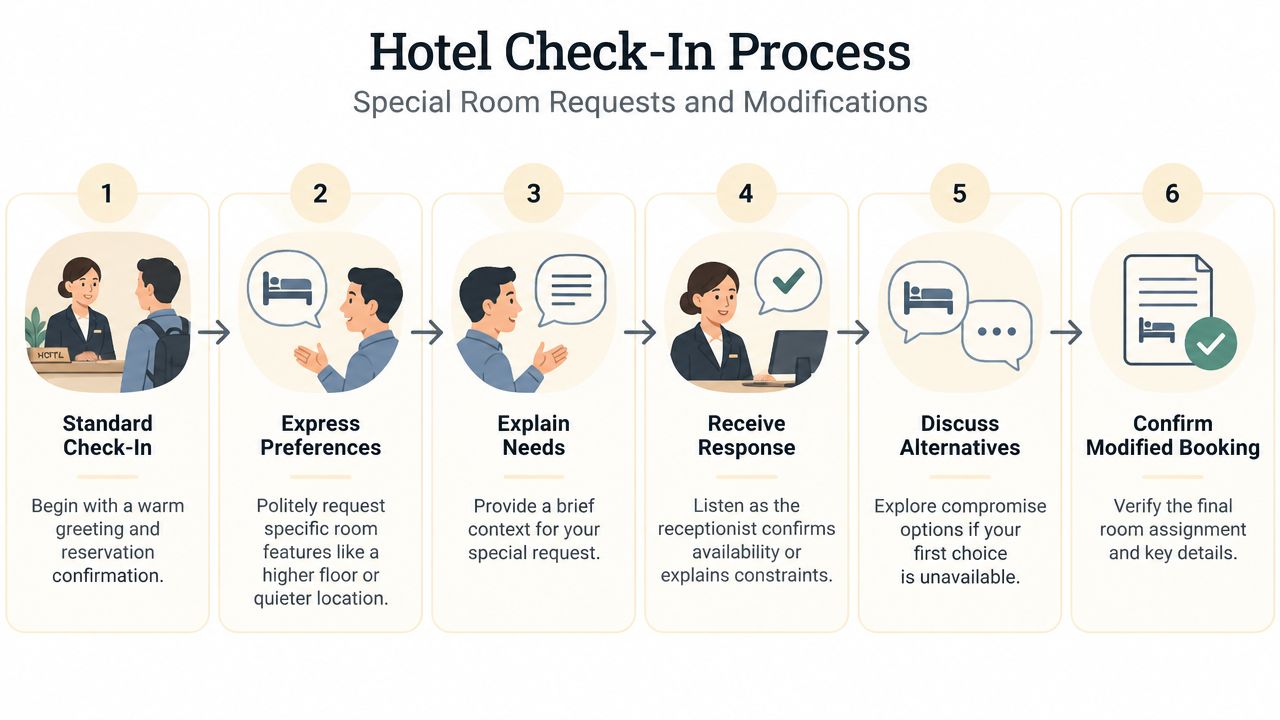
A confirmed reservation covers the booking, while specific preferences still depend on availability. Guests may need step-free access, a quieter location, a different bed arrangement, or a higher floor. The clearest request names the need first, then asks what the hotel can provide.
Guest: Hello, I have a reservation under the name Silva.
Receptionist: Welcome. May I see your ID, please?
Guest: Certainly. Before we complete the check-in, would it be possible to have a room near the elevator? My mother uses a wheelchair.
Receptionist: Let me check. We have an accessible room on the ground floor, but it has twin beds.
Guest: That could work. Does it have step-free access to the bathroom?
Receptionist: Yes, it does.
Guest: Thank you. If available, I'd prefer a quieter room, away from the street.
Receptionist: We can offer a room at the back of the building on the second floor.
Guest: That sounds good. Could we have that room, please?
Receptionist: I'll arrange it now.
Make preferences diplomatic
“Would it be possible to…” makes a request polite while leaving the receptionist room to check availability. “If available, I'd prefer…” presents a choice rather than a demand. If the first option does not work, give a clear alternative: “In that case, could we have a room away from the elevator?”
Hotel staff may answer with “We can offer…”, “We have…”, or “Unfortunately, that isn't available.” These phrases distinguish a confirmed option from a limitation. Listen closely to comparison words such as higher, quieter, larger, closer, and more accessible, since one word can change the room being discussed.
Practical rule: State the need, ask about the available option, then confirm the arrangement.
For accessibility, practise the destination language for step-free access, accessible bathroom, lift or elevator, and shower seat. Families can ask, “Do you have connecting rooms?” or “Could we have one double bed and two single beds?” A light sleeper might say, “Could you place us away from street noise?”
Pronunciation matters when the request affects safety or comfort. Say the key term slowly, then check the receptionist's reply: “So the bathroom has step-free access, correct?” If the preferred room is unavailable, respond calmly with “What alternatives are available?” This keeps the exchange cooperative and makes the next option easier to understand.
Practise the full script with language partners to build natural pacing and turn-taking (guide to authentic language exchange). Then use ChatPal voice practice to rehearse an accepted request, a refusal, and a modified room offer. Repeating these variations prepares learners for the expected exchange and the unexpected turns that make real check-ins difficult.
3. Late Arrival and Special Check-In Procedures
A late arrival needs a plan for both entry and failure. The front desk may be closed, the entrance may use a keypad, or the hotel may require an app or kiosk. Confirm the arrival time, repeat each access step, and ask who can help if the system stops working.
Guest: Good evening. I'm calling about my reservation for tonight under the name Rossi. My train is delayed, and I'll arrive around eleven p.m.
Night staff: That's fine. The main reception will be closed, but you can use the side entrance.
Guest: Could you explain the process, please?
Night staff: Enter the code 4826 on the keypad, then collect your envelope from the box beside the door.
Guest: Let me check that. I enter 4826 at the side entrance and take the envelope from the box. Is that correct?
Night staff: Yes. Your room key and instructions will be inside.
Guest: Will I need to use the app as well?
Night staff: No, not tonight. If the code doesn't work, call the number in your confirmation email.
Guest: Thank you. Could you also send those instructions in writing?
Night staff: Certainly.
Confirm digital and physical access
“Could you explain the process?” invites a complete explanation instead of one isolated instruction. Then ask, “Could you send that in writing?” Spoken directions can disappear from memory after a long journey. Repeat the code and sequence aloud, just as a pilot confirms a checklist. This gives both people a chance to correct a mistake before arrival.
Ask whether the hotel still requires ID verification, whether payment must be completed in the app, and where to collect a physical key if a digital key fails. Useful vocabulary may include código, PIN, acceso, and contraseña, depending on the language and system. For clearer pronunciation, separate the code into individual digits and confirm each one: “Four, eight, two, six, correct?”
Keep the phone charged and save a backup copy of the access instructions. Ask, “Who should I call if the keypad fails?” Also confirm whether the emergency number works after reception closes. These questions turn a vague late-arrival promise into a usable procedure.
After practising the script, use ChatPal voice practice to rehearse three versions: mobile check-in, kiosk entry, and assistance from a night security guard. Try an accepted instruction, a failed code, and a request for repetition. The wording changes, while the goal stays consistent: identify the reservation, understand the procedure, and confirm the backup plan.
4. Check-In with Language Barriers and Clarification
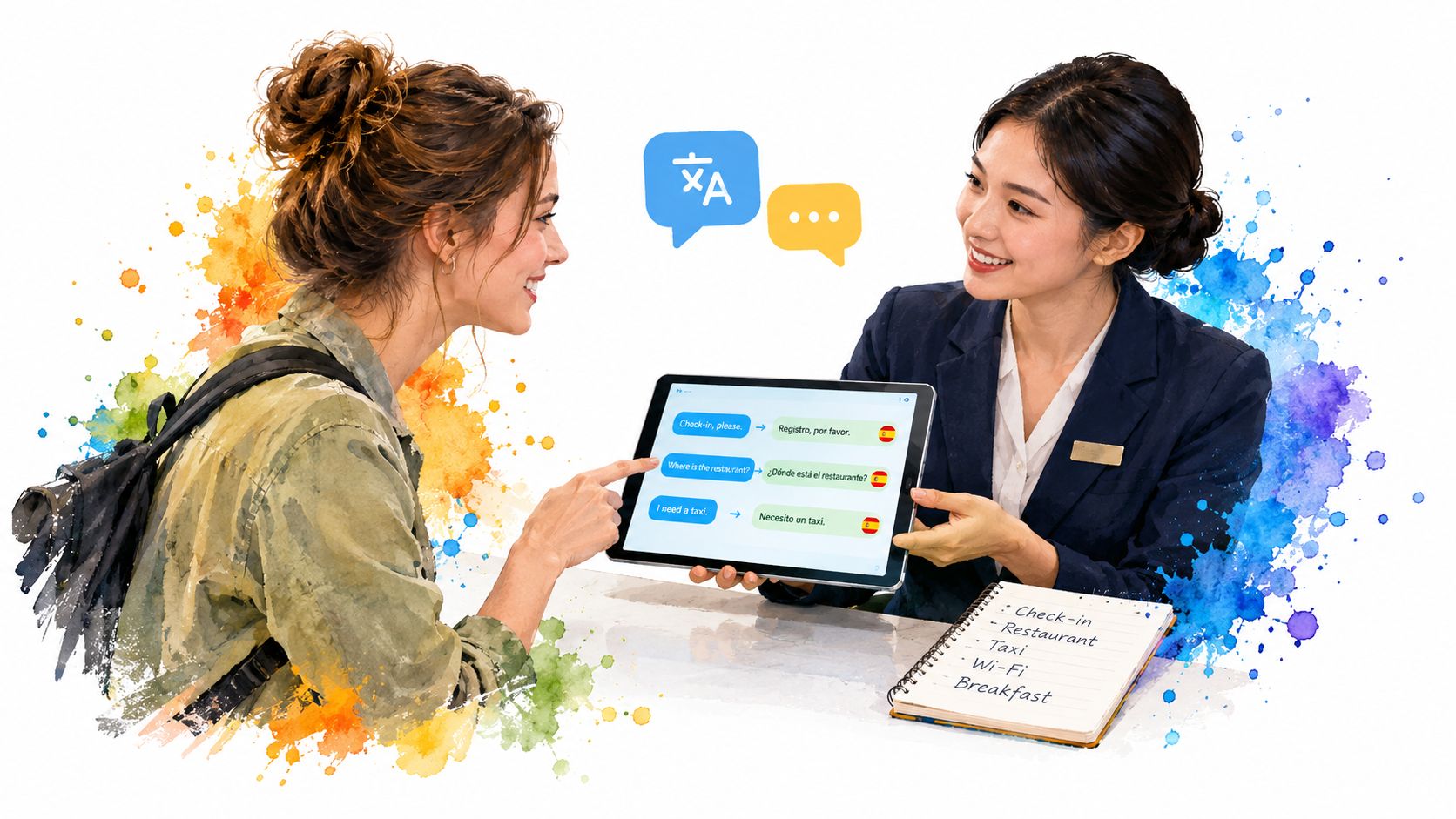
Clear clarification can prevent a small misunderstanding from becoming a billing or access problem. Accents, quick speech, unfamiliar numbers, and lobby noise may hide important details. Treat the conversation like checking a map: confirm each turn before continuing.
Receptionist: Your room is on the fourth floor. Breakfast is included, and the municipal tax will be added to the final bill.
Guest: I'm sorry, could you please repeat the last part more slowly?
Receptionist: The city tax will be added to your bill.
Guest: Thank you. Is that paid now or at check-out?
Receptionist: At check-out.
Guest: Could you spell the Wi-Fi password, please?
Receptionist: Of course. M, A, R, E, 7, 2.
Guest: Let me repeat it: M, A, R, E, 7, 2.
Receptionist: That's correct.
Guest: I'm afraid I didn't catch the room number. Could you write it down?
Receptionist: Certainly. Room 418.
Use repair language without embarrassment
Begin with “Could you please repeat that?” This phrase is polite and works when any part of the message was unclear. If the receptionist is speaking quickly, use “More slowly, please” or the softer “Could you speak a little more slowly, please?” For names and passwords, ask, “Could you spell that for me?” To check a number, say, “Did you say room 418?”
Important information should pass through a second channel. Ask for the room number, Wi-Fi password, breakfast time, tax details, or check-out procedure in writing when needed. Written confirmation works like a second set of ears, giving the learner something to check after the spoken exchange. A notepad may also reinforce listening and memory more effectively than relying only on a translation app.
“I don't understand” is a useful starting point, not a failure.
Keep the tone friendly, maintain eye contact, and avoid repeated apologies. Hotel staff regularly help international guests, and a specific clarification request shows exactly what support is needed. Speak first, then use a translation app as backup if the conversation still does not work.
Learners studying Spanish can pair this dialogue with Spanish for travel practice. ChatPal voice prompts can simulate a receptionist who speaks quickly, asks for spelling, or gives an unfamiliar room number. Practise the expected exchange, then repeat it with a request for slower speech, written confirmation, or number verification.
5. Group Check-In with Multiple Guests and Room Arrangements
A group check-in succeeds when one person manages the conversation and the others prepare to respond. Families, university groups, and teams must confirm names, rooms, keys, payment, and shared requests without letting several voices compete at the desk.
Coordinator: Good afternoon. We have a group reservation under the name Bennett. There are four rooms for eight guests.
Receptionist: Welcome. Could I see the guest list, please?
Coordinator: Certainly. Here are all the names. The two family rooms should have connecting doors, if possible.
Receptionist: We have one connecting pair available. The other two rooms are on the same floor, but they are not next to each other.
Coordinator: That's fine. How will the payment be handled?
Receptionist: The rooms are charged to the main card, and extras can be paid individually.
Coordinator: Thank you. Could you give the keys to me? I'll distribute them to the group.
Receptionist: Of course.
Coordinator: Could you also confirm the check-out time for everyone?
Receptionist: Check-out is at noon.
Assign roles before reaching the desk
Designate a primary speaker and prepare the guest list, booking confirmation, and passports before arrival. The coordinator can say, “I'm coordinating the group” to show who should answer first. This simple signal works like a traffic light: it gives the receptionist one clear route through the information.
Use short follow-up questions when arrangements differ from the request:
- Room locations: “Are the other rooms on the same floor?”
- Payment: “Will all rooms be charged to one card?”
- Separate costs: “Can guests pay individually for their extras?”
- Included services: “Is breakfast included for everyone?”
- Room charges: “Can we add charges to individual rooms?”
These questions make responsibilities visible. Families should confirm the bed setup and decide which adults will receive keys. Study groups can ask whether the coordinator may hold all room cards temporarily. Friends sharing costs should agree beforehand about tax, deposits, and incidental charges.
Polite wording also protects the group when the hotel cannot meet every request. “What options do we have?” invites a solution without blaming the receptionist. If several guests need to speak, establish an order: room location first, payment second, and individual requests last. This prevents an important answer from being lost in overlapping conversation.
Practise the exchange with ChatPal voice prompts. One learner can play the receptionist, another can coordinate payment, and a third can ask about room locations. Change the group size, connecting-room availability, or key distribution in each round. Rehearsing these variations prepares learners for the unexpected turns that make real hotel conversations harder than a memorized script.
6. Check-In with Problem Resolution and Room Changes
A room problem becomes easier to solve when the guest separates the facts, the original booking, and the requested remedy. The room type may differ from the reservation, a facility may be damaged, or the hotel may need to suggest another room. A calm opening gives the receptionist clear information to check.
Guest: I'm sorry, I noticed that this room has twin beds. My reservation was for one double bed.
Receptionist: Let me check the booking. Yes, I can see the request. Unfortunately, the double rooms are currently occupied.
Guest: I understand. Could you tell me what options might be available?
Receptionist: We can move you to a larger room tomorrow, or offer a different room tonight on the fifth floor.
Guest: Does the room on the fifth floor have one double bed?
Receptionist: Yes, it does.
Guest: In that case, we'd prefer to move there tonight. Could you also confirm whether there's any additional charge?
Receptionist: There won't be an additional charge.
Guest: Thank you for checking.
Describe the problem before expressing frustration
“I noticed…” points to something observable. “My reservation was for…” states the expected arrangement without blaming the person at the desk. “What options might be available?” then invites the receptionist to explain what can be done.
Useful alternatives include “There seems to be a problem with the room,” “Could someone inspect this, please?” and “Would it be possible to change rooms?” For damage or cleanliness concerns, name the exact location: “There's a mark on the bed linen,” or “The bathroom door doesn't close.” Specific wording works like a clear address. It helps staff identify the task instead of guessing what the complaint means.
Front-office interactions can account for 20% to 40% of total guest satisfaction scores, according to the RoomRaccoon's front-desk overview. A courteous tone supports cooperation while still protecting the guest's request.
Useful sequence: “I noticed…” + “I expected…” + “What options are available?”
Before accepting another room, confirm its location, bed type, accessibility, and extra cost. If the issue is serious, photos can document the condition if further discussion becomes necessary. Give the front desk a chance to correct the problem first, then ask for the next available solution if the first option does not work.
Practise both the expected exchange and an unexpected turn with ChatPal voice prompts. Ask the tool to change the room type, move the guest to another floor, or introduce an extra charge. Repeating the script with these variations builds flexible responses and supports clearer pronunciation of phrases such as “additional charge” and “available options.”
7. Virtual and Phone-Based Check-In Before Arrival
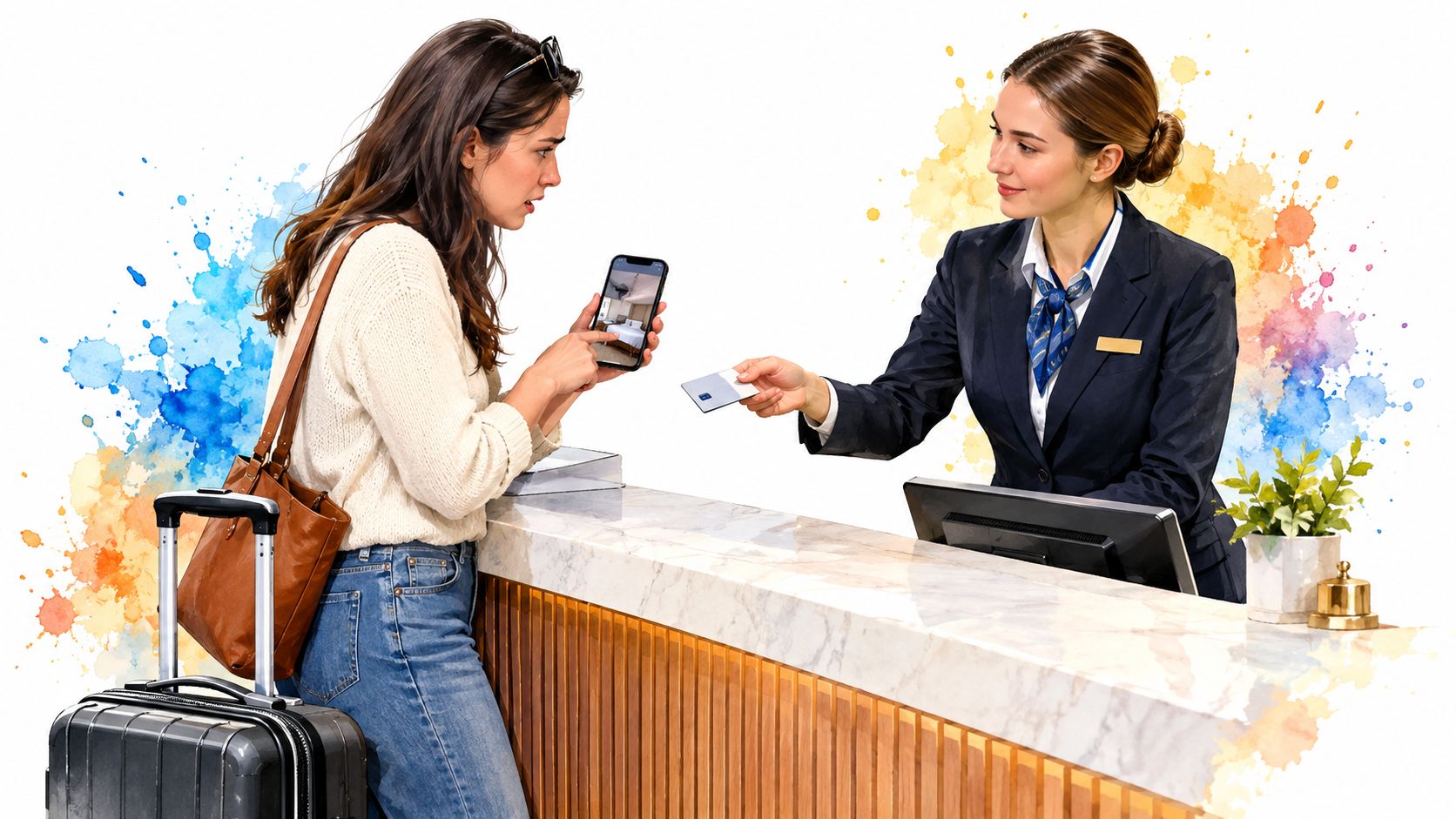
A well-prepared phone call can prevent several arrival problems before they reach the front desk. Without visual clues, the receptionist cannot see a confused expression, and the traveler cannot point to a booking detail. Notes, deliberate confirmation, and a written follow-up keep the exchange clear.
Guest: Hello, I'm calling about my reservation for Friday under the name Costa. Could I confirm a few details before I arrive?
Receptionist: Certainly. How can I help?
Guest: I'll arrive early in the morning. Can you store my luggage before check-in?
Receptionist: Yes, we can store it at reception.
Guest: Thank you. I'll also arrive late in the evening. Do I need to arrange late check-in?
Receptionist: Yes. We'll send you the entrance code and instructions by email.
Guest: Could you confirm the email address on the reservation?
Receptionist: It ends in costa@example.com.
Guest: That's correct. Could you also confirm whether parking needs to be booked in advance?
Receptionist: Yes, I'll add a parking request to your reservation.
Guest: I appreciate it. Could you send confirmation of these arrangements in writing?
Prepare the call like a short business meeting
Write the reservation name, arrival date, expected time, and questions on paper before calling. Open with “Could I confirm a few details?”, “I'd like to check whether…”, or “Could you send me written confirmation?” These phrases signal a clear purpose and make the request polite.
Phone vocabulary helps when the sound is unclear: “I'm calling regarding…”, “Could you speak up, please?”, “The line is breaking up,” and “Could you repeat the email address?” If several instructions arrive quickly, say “Could I write that down?” A short pause gives time to record each step accurately.
A follow-up email creates a record of luggage storage, parking, late arrival, payment holds, and early access. It also lets learners check spelling and review useful phrases after the call. Written confirmation supports the spoken arrangement, while the call provides practice with real-time responses.
Learners practising Spanish can use Spanish verbal practice to rehearse a call without visual context. Ask ChatPal to act as a hotel employee, then repeat the exchange with a different arrival time, a new request, or a changed email address. Pay attention to clear pronunciation of “late check-in,” “parking request,” and “written confirmation.”
Add one interruption to the rehearsal. The receptionist might ask for the booking number before answering the question. The learner then has to provide the detail, confirm the answer, and return to the original purpose of the call. This small change prepares the speaker for the flexible turn-taking that real hotel conversations require.
8. Luxury and Upscale Hotel Check-In with Concierge Services
Luxury check-in is a coordinated conversation, not just a key handover. Staff may confirm the reservation while the concierge arranges dining, transport, directions, or celebration details. As Haute Black explains concierge services, concierge support can connect a guest's request with a practical local solution.
Guest: Good evening. I have a reservation under the name Laurent.
Receptionist: Good evening, Monsieur Laurent. Welcome. May I assist you with your luggage?
Guest: Thank you. We'd also appreciate a recommendation for a quiet restaurant this evening.
Concierge: Certainly. Do you prefer local cuisine or something more contemporary?
Guest: We'd prefer local cuisine, within walking distance if possible.
Concierge: I can recommend a small restaurant nearby and make a reservation for you.
Guest: That would be wonderful. Could you also arrange a car for tomorrow morning?
Concierge: Of course. What time would you like to leave?
Guest: At eight thirty, please. Could you also tell us the best way to reach the conference center?
Concierge: I'll print the route and arrange the car.
The script follows a useful sequence: state the booking, make one request, answer the follow-up question, then add another request. This structure keeps several services from becoming confused. If a recommendation is unavailable, ask, “What would you suggest instead?” If the timing is unclear, say, “Could you confirm the pickup time?”
Match the level of formality
Titles such as Señor or señora, signore or signora, and monsieur or madame vary by language and culture. Use one when staff introduce it or when local service practice calls for it. Avoid forcing a title into every sentence.
Choose “We would prefer…” instead of “We want…”. Open questions, including “What would you recommend for a quiet dinner?” and “What's the most convenient way to reach the airport?”, invite useful detail rather than a yes-or-no answer.
Useful vocabulary includes reservation, transfer, itinerary, availability, private dining, spa appointment, and valet service. Confirm names and times with “Could you repeat the reservation time?” or “Under which name is the booking?”
Appreciation acknowledges the work being arranged. Use “That's very kind of you,” “I appreciate your assistance,” or “Thank you for arranging that.” A short exchange about the journey or local plans can also build confidence with small-talk practice before learners rehearse an unexpected change, such as a restaurant becoming unavailable.
8-Scenario Hotel Check-In Dialogue Comparison
| Scenario | Implementation complexity | Resource requirements | Expected outcomes | Ideal use cases | Key advantages |
|---|---|---|---|---|---|
| Standard Hotel Check-In with Room Confirmation | Low, predictable, scripted flow | ID/passport, reservation, payment method | Confirmed room assignment and key issued | Typical hotel arrivals and chain hotels | High transferability; builds basic travel confidence |
| Check-In with Special Room Requests and Modifications | Medium, negotiation and alternatives | Preference list, backup options, accessibility docs | Modified room or acceptable compromise | Accessibility needs, bed/quiet preferences, families | Develops polite negotiation and preference language |
| Late Arrival and Special Check-In Procedures | Medium, tech and security instructions | Phone/app access, access codes, written instructions | Off-hours access and entry instructions confirmed | Late flights, self-check-in properties, hostels | Teaches interaction with tech; reduces late-arrival anxiety |
| Check-In with Language Barriers and Clarification | Low–Medium, requires repair strategies | Translation app, notepad, patience, repetition phrases | Mutual understanding via clarification methods | High-accent environments; limited target-language skills | Builds recovery strategies; normalizes communication gaps |
| Group Check-In with Multiple Guests and Room Arrangements | High, multiple parties and billing complexity | List of names/reservations, payment plan, designated speaker | Coordinated room assignments and split payments | Families, study-abroad groups, business delegations | Teaches coordination, group vocabulary, and logistics |
| Check-In with Problem Resolution and Room Changes | High, emotional negotiation under pressure | Photos/docs, diplomatic complaint phrases, alternatives | Issue resolved, compensation or room change arranged | Overbookings, wrong room type, facility problems | Develops complaint diplomacy and negotiation skills |
| Virtual and Phone-Based Check-In Before Arrival | Medium, remote communication skills needed | Reliable connection, prepared questions, written follow-up | Pre-confirmed arrangements; fewer surprises on arrival | Pre-arrival confirmations, special requests, remote check-in | Allows time to prepare; reduces in-person stress |
| Luxury and Upscale Hotel Check-In with Concierge Services | Medium–High, formal register and specialized requests | Knowledge of formal language, concierge options, clear preferences | Personalized service, reservations, tailored recommendations | Business travelers, executives, luxury stays | Teaches formality and specialized hospitality vocabulary |
Turn Scripts Into Real Conversations
A script is useful because it reduces the number of decisions required at the beginning. Start with the core exchange: greeting, reservation name, identification, payment, room number, breakfast, and check-out. Then substitute details, such as Madrid for Milan, a double room for twin beds, or a late arrival for an early luggage drop-off.
The next step is controlled flexibility. Add one request to the standard exchange, then add one clarification. For example, ask for a quiet room, confirm the floor, and request the information in writing. Once that feels manageable, introduce a problem: the room type is wrong, the access code fails, or the receptionist speaks too quickly.
A useful practice sequence looks like this:
- Shadow the script: Read each line aloud immediately after hearing it, matching rhythm and polite intonation.
- Record a role-play: Play both guest and receptionist, leaving a pause before each response.
- Change the details: Replace names, dates, room types, payment methods, and requests without changing the conversation structure.
- Add an interruption: Have the receptionist ask an unexpected question or offer an unavailable option.
- Review the language: Note grammar mistakes, unclear pronunciation, and phrases that sounded too direct.
- Repeat from memory: Perform the exchange again, using the corrected language without reading every line.
Speaking practice matters because authentic interaction develops pacing, listening, and turn-taking alongside vocabulary. A peer-reviewed study found a substantial correlation between time devoted to speaking and fluency gains, while role-plays, discussions, presentations, and debates helped learners overcome fear and build confidence (study of interactive speaking practice). Another ESL study found that regular speaking activities and opportunities to communicate freely increased learners' confidence (study of speaking activities and ESL confidence).
ChatPal fits naturally into the final stage. Choose a hotel scenario, speak with Nora, and ask for a recap of grammar, pronunciation, and better phrasing after the session. Repeat the same scenario with changed details until the language becomes available without long pauses. The app is designed primarily for beginner and intermediate learners who understand more than they can comfortably say, so it can provide a low-pressure bridge between study and real conversation.
Language learning becomes a positive force when it helps people meet one another with greater patience and curiosity. A traveler who can clarify a tax, explain an accessibility need, thank a concierge, or resolve a room problem isn't only completing a transaction. That traveler is participating more fully in another culture. Speaking completes the puzzle piece that passive knowledge leaves unfinished, and regular practice turns familiar words into confident human connection.
ChatPal offers voice-first practice with Nora for realistic hotel arrivals, requests, clarification, and problem-solving, followed by feedback on grammar, pronunciation, and phrasing. Build a short daily hotel check-in routine, then visit ChatPal to rehearse the conversations before your next trip.