
Blog
Speaking Spanish and English: A Practical Fluency Plan
Build real confidence in speaking Spanish and English with a practical, step-by-step plan. Daily routines, exercises, and scripts that actually work.
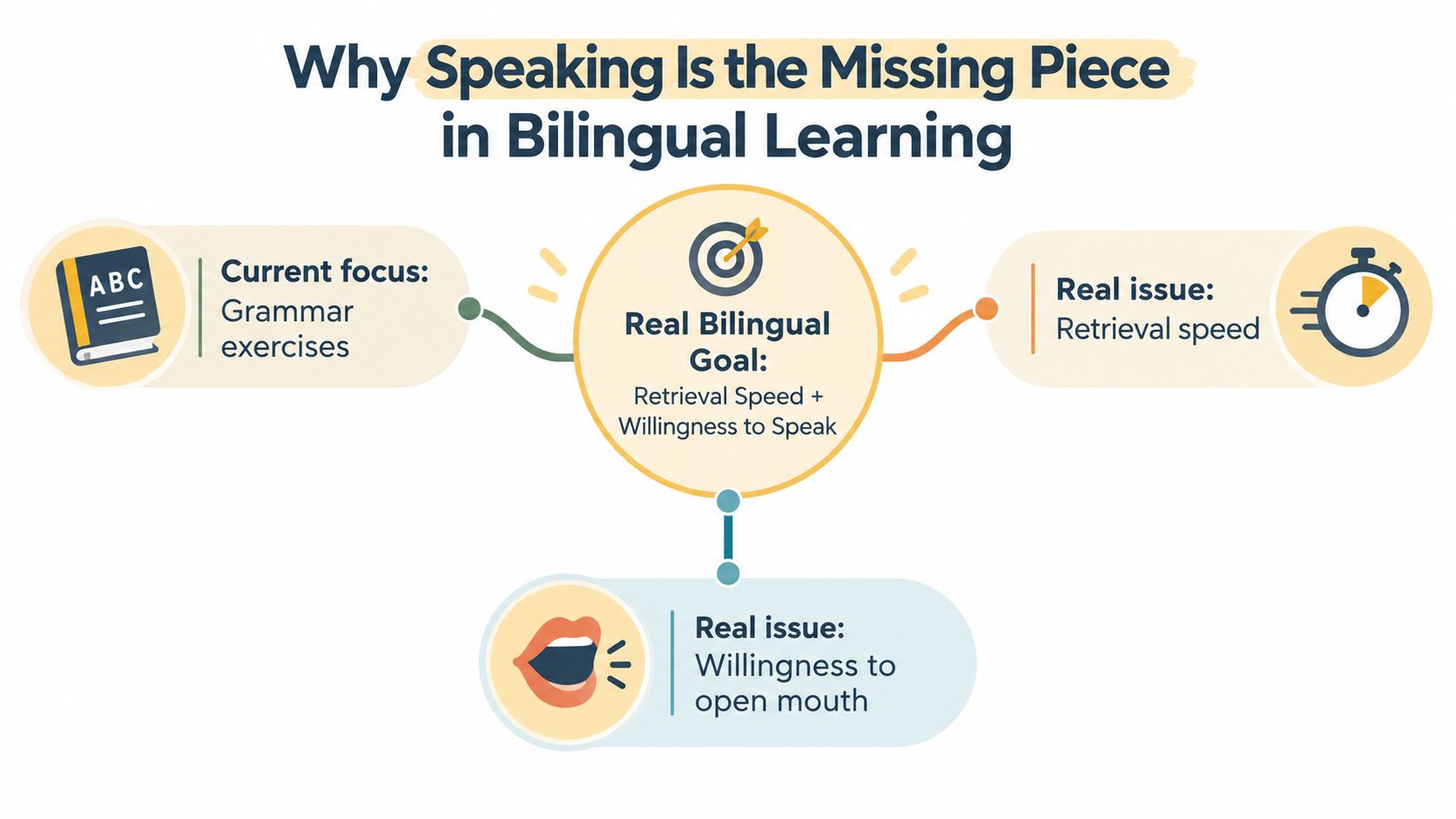
The most popular advice for speaking Spanish and English is to study more grammar, memorize more vocabulary, and wait until you feel ready. That approach produces a familiar frustration: you can understand a lesson, recognize a phrase, or read a message, yet freeze when another person expects an answer. The missing skill usually isn't knowledge. It's retrieval speed under pressure, supported by enough confidence to open your mouth before the perfect sentence arrives.
That distinction changes the training plan. Spanish-English bilingualism is a large, durable part of life in the United States, not a niche ability. Pew Research found that 44% of U.S. Latino adults were comfortable speaking both English and Spanish, while 41% spoke mainly Spanish and 15% mainly English in its analysis of bilingual adults (Pew Research on bilingual Latino adults). The practical question isn't whether you should “learn both” in the abstract. It's which language fails you in the situations that matter, and how you can create enough spoken repetitions to make that language usable.
Why Speaking Is the Missing Piece in Bilingual Learning
More grammar study will not automatically make Spanish or English available in conversation. A lesson can explain why a sentence works, yet a customer's question, a colleague's small talk, or a family member's quick topic change can still leave you searching. Passive knowledge supports recognition. Conversation requires rapid word selection, clear pronunciation, timing, and enough confidence to continue after an error.
The practical bottleneck is often the pause between hearing a prompt and producing an answer. Another vocabulary list may add recognition without improving that pause. Speaking drills expose the gap directly. Each attempt shows whether you need a phrase, faster sentence construction, better pronunciation, or a recovery line.
A better definition of bilingual progress
Balanced bilingualism can guide long-term development, but daily practice should begin with the language that breaks down most often. Pew's earlier analysis found that 46% of Hispanic adults reported speaking both English and Spanish well enough to carry on a conversation, while many others had greater strength in one language than the other (Pew's analysis of bilingual adults). That unevenness is ordinary. Reading, family exposure, schooling, and professional use can build separate strengths in Spanish and English.
Give each language a specific job. The weaker language gets focused retrieval practice and repeated low-pressure speaking. The stronger language remains active through conversation, but it should not take over whenever the weaker one becomes uncomfortable. This dual-track approach concentrates practice where it produces usable speech while preserving the ability you already have.
A practical guide to becoming fluent in a language makes the same output-focused point: active speaking turns passive knowledge into faster access. If speaking is the bottleneck, it deserves the most valuable practice time.
Mapping Your Starting Point and the Weaker Language
Don't label Spanish or English as your weaker language based on emotion alone. Many learners feel less capable in the language associated with family, work, travel, or formal evaluation, even when their underlying knowledge is stronger. Record yourself before choosing a curriculum.
Use the same four prompts in both languages:
- Introduce yourself, including where you live and what you do.
- Describe yesterday from morning to evening.
- Complain about a small frustration, such as a delayed order or a difficult commute.
- Explain a process, such as making coffee, submitting an expense, or preparing for a trip.
Give yourself one minute per prompt in each language. Don't write a script first. Afterward, listen for pauses, abandoned sentences, repeated fillers, pronunciation breakdowns, and places where you translate.
Score the behavior, not your identity
Use the rubric below. A score of 1 means the skill regularly blocks communication. A score of 5 means you can perform it comfortably in an ordinary conversation. The numbers are a personal diagnostic scale, not a test result.
| Metric | Spanish Score (1-5) | English Score (1-5) |
|---|---|---|
| Retrieval speed | ||
| Sentence completion | ||
| Vocabulary access | ||
| Pronunciation clarity | ||
| Grammatical accuracy | ||
| Recovery after a mistake | ||
| Ability to keep talking | ||
| Comfort with follow-up questions | ||
| Topic flexibility | ||
| Overall speaking confidence |
Add the scores within each language and compare the pattern, not just the total. A language with lower retrieval speed but strong comprehension needs timed output. A language with clear speech but weak sentence completion needs reusable structures and short roleplays.
If accent clarity is the main obstacle in English, Intonetic accent reduction for professionals offers a useful reference for separating pronunciation work from general fluency practice. Keep the distinction clear. Accent refinement can improve intelligibility, but it shouldn't become an excuse to postpone conversation.
Finally, choose two situations that matter this month. A heritage speaker might prioritize family stories and phone calls. A professional might choose office small talk and deadline discussions. Your weaker language is defined by the moments where you stop participating, not by a label on a language app.
The Core Speaking Drills That Actually Build Fluency
Fluency grows when practice resembles the pressure of real interaction without becoming so stressful that you avoid it. Three drills cover the essential mechanics: hearing connected speech, retrieving language quickly, and managing a changing exchange.
Shadowing trains timing and sound
Choose a 30-second clip in Spanish or English. Play it repeatedly and speak along with the speaker, matching rhythm and pauses rather than translating each sentence. A 10-minute daily session is enough to create a focused habit, especially when you alternate languages instead of letting your stronger language dominate every day.
For a café exchange in Spanish, shadow this short sequence:
“Buenos días. Un café con leche, por favor. ¿Me lo puede poner para llevar? También quisiera una botella de agua. ¿Cuánto es? Gracias.”
For English office small talk, use:
“Morning. How's your day going so far? I'm catching up on a few messages before the meeting. Have you worked on this project before?”
Shadowing works best when you record one attempt and compare your rhythm with the source. Don't chase a perfect accent. Chase clearer stress, smoother linking, and fewer pauses between familiar phrases.
Micro-conversations build retrieval speed
Set a 5-minute timer and stay with one prompt. Order coffee, negotiate a deadline, describe a photograph, or explain a problem with a delivery. The weaker language gets twice the weekly slots because equal practice doesn't correct unequal access.
Use a prompt card with three levels:
- Start: “What would you like?”
- Follow-up: “Would you like anything else?”
- Recovery: “Could you repeat that more slowly, please?”
In Spanish, the same café practice can move from “¿Qué desea?” to “¿Lo quiere aquí o para llevar?” and then “Perdone, ¿puede repetirlo un poco más despacio?” The point isn't to recite a dialogue. It's to make the next response available without a long internal translation.
Roleplay adds consequences and flexibility
Roleplay for 10 minutes. Switch roles halfway through so you must both ask and answer. Rotate among customer and server, manager and direct report, or patient and doctor. Add one unexpected detail, such as a missing item or a changed deadline, because real conversations rarely follow the first script.
A practical weekly rhythm might look like this:
| Day | Shadowing (min) | Micro-Conversation (min) | Roleplay (min) | Language Focus |
|---|---|---|---|---|
| Monday | 10 | 5 | 0 | Weaker language |
| Tuesday | 10 | 0 | 10 | Weaker language |
| Wednesday | 10 | 5 | 0 | Stronger language |
| Thursday | 10 | 5 | 10 | Weaker language |
| Friday | 10 | 0 | 10 | Stronger language |
| Saturday | 10 | 5 | 10 | Weaker language |
| Sunday | 10 | 5 | 0 | Review and choice |
Travel preparation benefits from the same method. Resources such as Northern Spain Travel's language tips can supply culturally relevant phrases, but phrases only become useful after you say them aloud in varied contexts.
For targeted sound work, use this practical guide to improve pronunciation. Keep pronunciation attached to speaking, rather than treating it as a separate perfection project.
Real-World Scripts You Can Reuse in Spanish and English
Scripts aren't meant to make you sound robotic. They reduce the number of decisions you must make at the start of an exchange, leaving enough attention for listening and adapting. Rehearse them aloud, then replace selected details so the structure stays familiar while the content changes.
Spanish café counter
Context: You're at a busy café counter and want to order without switching to English.
Goal: Place the order, answer a follow-up, and close the exchange.
Opening
- “Buenos días. Un café con leche, por favor.”
Good morning. A coffee with milk, please.
Branch one, eating there
- “¿Lo quiere aquí o para llevar?”
- “Aquí, por favor.”
- “¿Me puede traer también un vaso de agua?”
- “Claro. Ahora mismo.”
Branch two, taking it away
- “¿Lo quiere aquí o para llevar?”
- “Para llevar, por favor.”
- “¿Puede ser descafeinado?”
- “Sí, sin problema.”
Branch three, asking for a recommendation
- “¿Qué me recomienda?”
- “La tostada con tomate está muy buena.”
- “Perfecto. Una tostada con tomate y un café con leche, por favor.”
Closing
- “¿Cuánto es?”
- “Son ocho euros.”
- “Aquí tiene. Muchas gracias.”
Substitute “un té” for the drink, “una tostada” for the food, and “para llevar” for the location. These are deliberate retrieval points. Practice them until you can change one detail without rebuilding the whole sentence.
English office small talk
Context: You meet a new colleague in the break room.
Goal: Start warmly, ask a follow-up, and exit without forcing a long conversation.
Opening
- “Hi, I don't think we've met. I'm Alex from the operations team.”
- “Nice to meet you. I'm Priya from design.”
Branch one, weekend
- “How was your weekend?”
- “Pretty good. I visited my family and caught up on some errands.”
- “That sounds nice. Do you live nearby?”
Branch two, current project
- “How's your first week going?”
- “Busy, but everyone's been helpful.”
- “Good to hear. Is there anything you're still trying to figure out?”
Branch three, shared environment
- “Have you tried the coffee here?”
- “Not yet. Is it any good?”
- “It's decent. The café downstairs is better, though.”
Closing
- “I'll let you get back to it, but it was great meeting you.”
- “You too. See you around.”
Use this small-talk practice resource to expand the pattern. When you lose a word, slow down by shortening the sentence, not by apologizing repeatedly. Redirect with “What about you?” or “Could you say that another way?” End cleanly with “I need to get back to this, but let's talk again soon.”
Handling Code-Switching, Mistakes, and Confidence Dips
Code-switching isn't a character flaw. It usually appears for a reason, and identifying that reason gives you a recovery move.
Match the trigger to the tactic
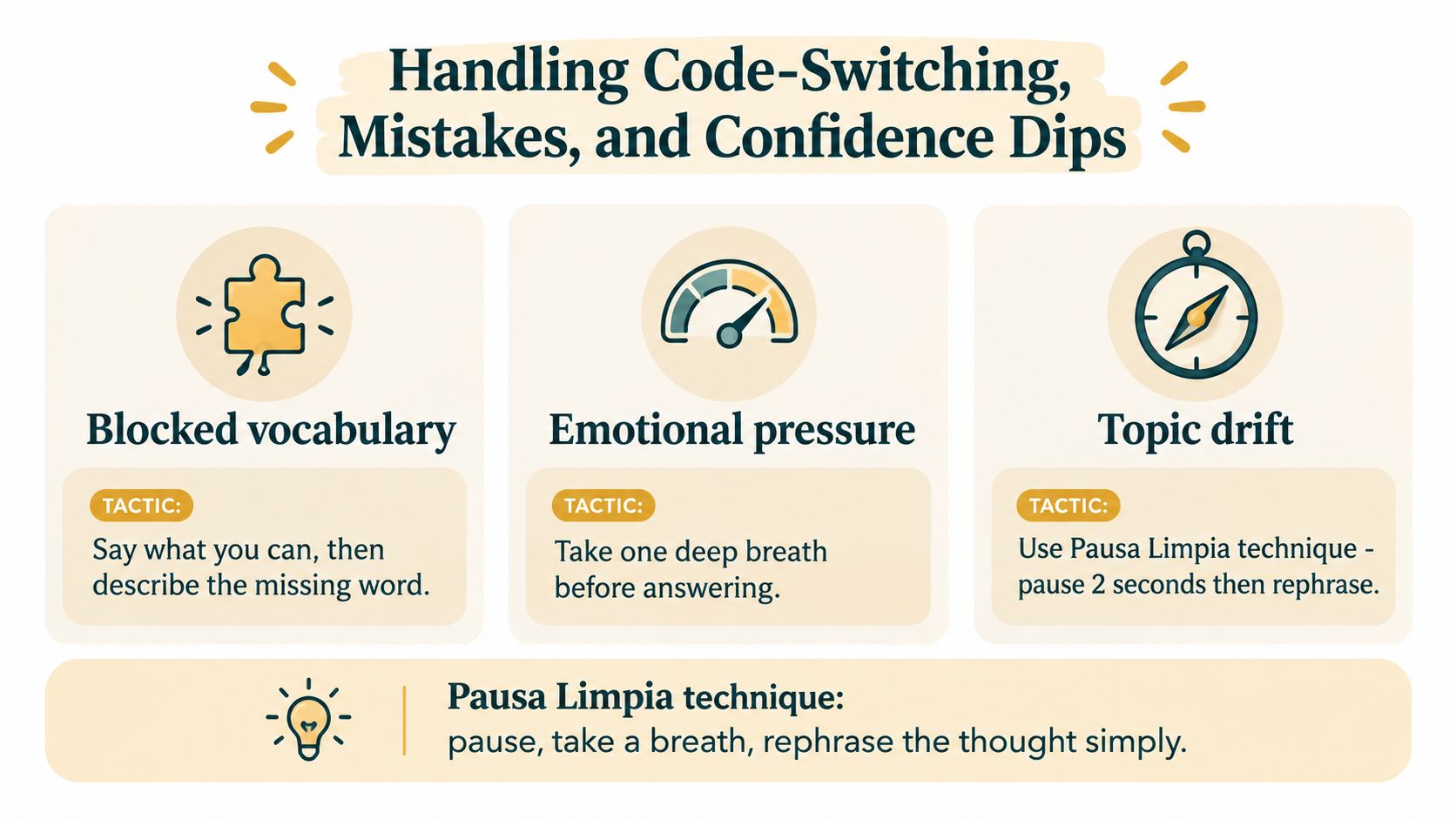
- Blocked vocabulary: Describe the missing word. In Spanish, say “Es una cosa que usamos para...” In English, say “It's the thing you use to...” Keep speaking while the word returns.
- Emotional pressure: Take one slow breath before answering. Lowering the pace gives your retrieval system room to work.
- Topic drift: Use a clean reset. Say “Un momento, quiero decirlo de otra manera” or “Let me rephrase that,” then restart with a simpler sentence.
Call this the Pausa Limpia technique: stop, breathe, restart in the target language, and repeat the sentence once cleanly. You aren't hiding the mistake. You're practicing controlled recovery, which matters more than producing an untouched first attempt.
Log errors instead of fearing them
Perfection blocking turns every conversation into an exam. Error logging turns it into usable evidence. After a session, write down the trigger phrase, what you said, what you meant, and the corrected version.
| Trigger phrase | What was said | What was meant | Corrected version |
|---|---|---|---|
| Asking for repetition | “Repeat, please” | Ask politely for slower speech | “¿Puede repetirlo más despacio?” |
| Explaining a delay | “I finish tomorrow” | The task will be finished tomorrow | “I'll finish it tomorrow.” |
| Describing uncertainty | “No understand” | You didn't understand | “No lo entiendo” or “I don't understand.” |
Confidence dips often arrive with the thought, “I sound fake.” Answer it with three observable wins: you stayed in the target language, you recovered without abandoning the sentence, and you completed an exchange. Track those wins alongside corrections.
A useful weekly question is: Did I communicate more willingly than last week, even when accuracy wasn't perfect? Speaking confidence is connected to participation, and systematic speaking practice can create a reinforcing cycle in which willingness supports more practice (discussion of speaking confidence and achievement). For more strategies on moving through mistakes, use this guide to handle the fear of making mistakes.
Using Voice-First Tools to Multiply Practice Time
Human conversation is essential when the stakes are real, but it isn't always available on demand. A voice-first AI partner can provide repetitions between classes, trips, work meetings, and social exchanges. It should complement people, not replace them. Human conversations bring interruption, emotion, cultural context, and consequences that a practice tool can't fully reproduce.
A focused solo session takes 15 minutes:
- Pick one scenario, such as the Spanish café order or English office introduction.
- Set a timer and speak aloud from the opening line.
- Respond to the partner's questions without reading a full script.
- Restart once when you code-switch or lose the sentence.
- Review the recap and choose the next target.
Read feedback as a training decision
Focus on three metrics after each session:
- New vocabulary used: Did you produce new words in a meaningful sentence, or only recognize them?
- Filler words avoided: Did you replace repeated “um,” “like,” or “este” with a pause?
- Average response latency: How long did it take to begin answering?
Map each metric to a drill. New vocabulary belongs in roleplay. Filler reduction belongs in shadowing and recorded retakes. Response latency belongs in timed micro-conversations.
The distinction between dictation versus live-call AI is useful here. Dictation can help you inspect production, while live interaction pressures you to listen, decide, and respond. Both have a place, but only back-and-forth practice exposes whether you can retrieve language when the next turn arrives.
ChatPal is one voice-first option that lets learners practice realistic Spanish and English conversations with its AI partner Nora, then review feedback on phrasing, grammar, vocabulary, and pronunciation. The operating rule remains simple: human time for stakes, AI time for reps, and no day should pass without at least 10 minutes of spoken output.
A 30-Day Plan to Make Speaking a Daily Habit
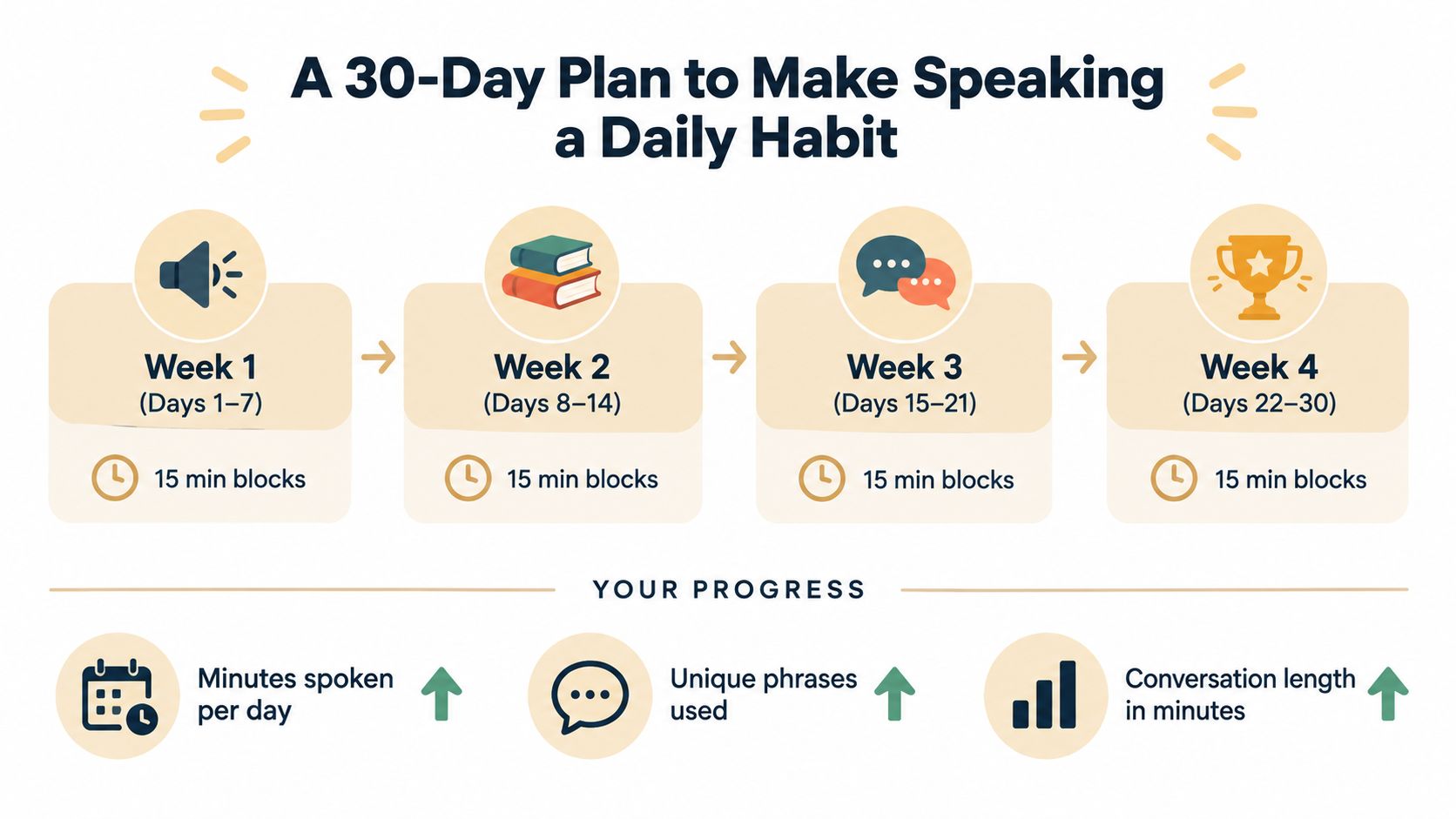
A month of speaking practice works better when every week has a narrow purpose. Keep the daily block short enough to protect consistency, then measure output rather than the number of lessons completed.
Week one establishes the baseline
Record the four diagnostic prompts in Spanish and English. Select the weaker language from the score pattern, then choose two situations that create real friction. Spend each daily block on a brief recording, a short shadowing clip, and one sentence added to your error log.
Track:
- Minutes spoken per day
- Unique sentences produced without translation pauses
- Successful real-world exchanges logged
Don't adjust the plan because one recording felt awkward. The baseline is supposed to reveal awkwardness.
Week two builds repetition
Repeat the same core scenarios instead of chasing novelty. Use shadowing daily, give the weaker language twice the micro-conversation slots, and add voice-first practice on days when a human partner isn't available. Keep one session in the stronger language so it remains active without competing for the main training dose.
A sample 15-minute daily block can use 10 minutes of shadowing and 5 minutes of micro-conversation, or 5 minutes of shadowing and 10 minutes of roleplay. Choose the version that addresses the weakest metric from your baseline.
Week three moves speech into the world
Deploy one script in a café, store, travel setting, or coworker conversation. Don't wait for an impressive exchange. A successful interaction can mean opening in the target language, answering one follow-up, and closing without switching.
Log what happened. Mark the phrase that worked, the question that surprised you, and the point where you wanted to retreat into your stronger language.
Week four reviews and adjusts
Compare your recordings, not just your feelings. Are responses starting sooner? Are you producing more original sentences? Are real exchanges lasting longer before you switch?
Use this tracker in a notes app or print it:
| Week | Weaker-language target | Weekly theme | End-of-week review question |
|---|---|---|---|
| 1 | Baseline | Where did retrieval stop? | |
| 2 | Repetition | Which drill made answers easier? | |
| 3 | Real-world use | Which exchange did I complete? | |
| 4 | Adjustment | What deserves more practice next month? |
Bilingual fluency is the cumulative sum of spoken sentences, not passive study hours. One sentence spoken deliberately each day compounds into observable change by day 30, especially when the weaker language receives consistent, direct output.
ChatPal gives beginner and intermediate learners a voice-first way to practice Spanish and English with Nora through realistic conversations, followed by recaps on phrasing, grammar, vocabulary, and pronunciation. Visit ChatPal to turn today's speaking target into a low-pressure conversation and start building the habit.